ISRA FACTSHEETS
ISRA FACTSHEETS
EUROPEAN ATLANTIC
Sal Rei Bay
Summary
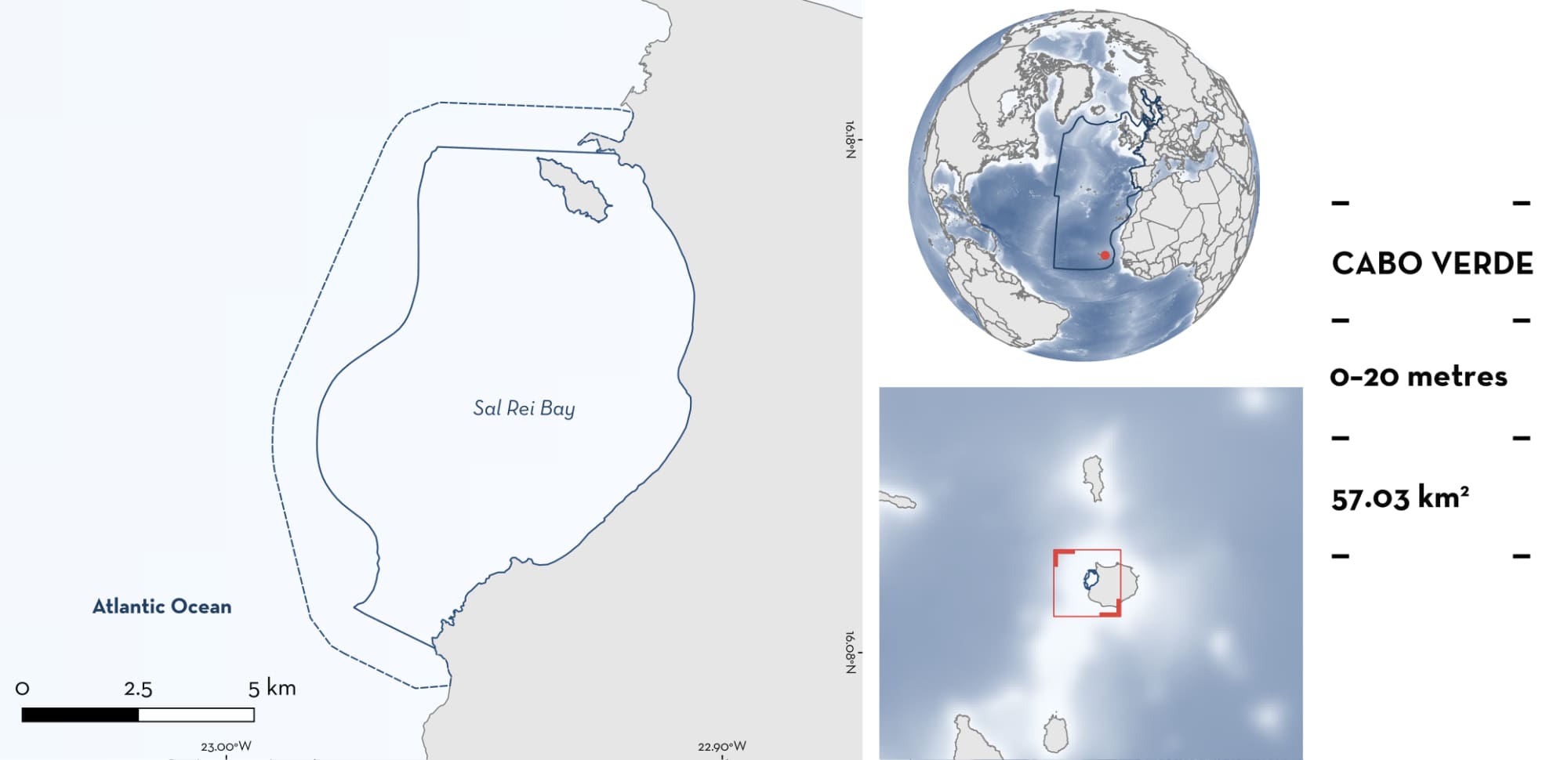
Sal Rei Bay is located on the coast of Boa Vista Island, Cabo Verde. The area encompasses shallow waters of predominantly sandy substrate along a relatively wave-protected coastline. Within this area there are: threatened species (e.g., Atlantic Weasel Shark Paragaleus pectoralis) and reproductive areas (e.g., Scalloped Hammerhead Sphyrna lewini).
Download factsheet
Sal Rei Bay
DESCRIPTION OF HABITAT
Sal Rei Bay is located on the coast of Boa Vista Island, Cabo Verde. Boa Vista Island is the easternmost (windward) island of the archipelago, with a coastline mostly composed of sandy and rocky beaches and high-energy exposed shores (Gomes 2019). The area encompasses shallow waters of predominantly sandy substrate along a relatively wave-protected coastline compared to most of other areas around Boa Vista Island especially during the boreal summer months. There is also a small islet in the northern part of the bay that provides further protection (Rosa et al. 2023). The predominant direction of waves in Boa Vista Island is from the northeast under the influence of the Canary Current (Peña-Izquierdo et al. 2012).
This Important Shark and Ray Area is benthic and pelagic and is delineated from inshore and surface waters (0 m) to 20 m based on the bathymetry of the area.
CRITERION A
VULNERABILITY
Four Qualifying Species considered threatened with extinction according to the IUCN Red List of Threatened Species regularly occur in the area. These are the Critically Endangered Scalloped Hammerhead (Rigby et al. 2019), the Endangered Atlantic Weasel Shark (Jabado et al. 2021), and the Vulnerable Blacktip Shark (Rigby et al. 2021) and Milk Shark (Rigby et al. 2020).
CRITERION C
SUB-CRITERION C1 – REPRODUCTIVE AREAS
Sal Rei Bay is an important reproductive area for four shark species.
Between August 2016–September 2019, the incidental catch of artisanal beach gillnets was surveyed (4 cm square-mesh monofilament gill net; 30 m length; 3 m deep) on a monthly basis (Rosa et al. 2023). Gillnets were always set perpendicular to the shore, with soak time ranging from 2–4 h, depending on tidal and weather (seasonal) conditions. Sharks were identified to the species-level, and total length (TL) was measured to the nearest 0.5 cm.
A total of 6,162 sharks were captured, of which 115 were Blacktip Shark, 93 were Atlantic Weasel Shark, 4,908 were Milk Shark, and 1,035 were Scalloped Hammerhead (Rosa et al. 2023). All species revealed seasonal variations, with the highest catches observed during summer or autumn periods (Rosa et al. 2023). Neonates and young-of-the-year (YOY) accounted for ~85% of all Blacktip Sharks captured (n = 95; 58–90 cm TL). Size-at-birth for Blacktip Sharks is 38–72 cm TL (Ebert et al. 2021). The remaining individuals (n = 20) were <110 cm TL. Neonates and YOY accounted for ~97% of Atlantic Weasel Sharks (n = 91; 43–61 cm TL). Size-at-birth for Atlantic Weasel Sharks is ~47 cm TL (Ebert et al. 2021). All Milk Sharks were neonates or YOY (n = 4,908; 30–52 cm TL). Size-at-birth for Milk Sharks is 25–40 cm TL (Ebert et al. 2021). All Scalloped Hammerheads were neonates or YOY (n = 1,035; 30–65 cm TL). Size-at-birth for Scalloped Hammerheads is 31–57 cm TL (Ebert et al. 2021).
Baited Remote Underwater Videos Stations (BRUVS) deployed in June and August 2022 and additional scientific longline surveys between 2015–2019 within the area, support the high proportion of neonates and YOY (RT Graham unpubl. data 2025). Observed Blacktip Sharks ranged 60–175 cm TL, Scalloped Hammerheads 35–54 cm TL, Milk Sharks 35–125 cm TL, and Atlantic Weasel Sharks 58.5–135 cm TL (RT Graham unpubl. data 2025).
To understand if sharks are found more often in Sal Rei Bay than in other areas of the island, a short questionnaire was conducted in August 2022 with local artisanal and semi-industrial fishers (Rosa et al. 2023). From a list of 92 licensed fishers operating around Boa Vista Island, a total of 55 interviews were undertaken (~60%). Local fishers identified 11 areas of occurrence of small sharks around the island, with 78% of respondents identifying this area as important for the occurrence of small animals, and 60% as the area with the highest number of juvenile sharks across the entire island (Rosa et al. 2023).
Download factsheet
SUBMIT A REQUEST
ISRA SPATIAL LAYER REQUEST
To make a request to download the ISRA Layer in either a GIS compatible Shapefile (.shp) or Google Earth compatible Keyhole Markup Language Zipped file (.kmz) please complete the following form. We will review your request and send the download details to you. We will endeavor to send you the requested files as soon as we can. However, please note that this is not an automated process, and before requests are responded to, they undergo internal review and authorization. As such, requests normally take 5–10 working days to process.
Should you have questions about the data or process, please do not hesitate to contact us.