
ISRA FACTSHEETS
ISRA FACTSHEETS
EUROPEAN ATLANTIC
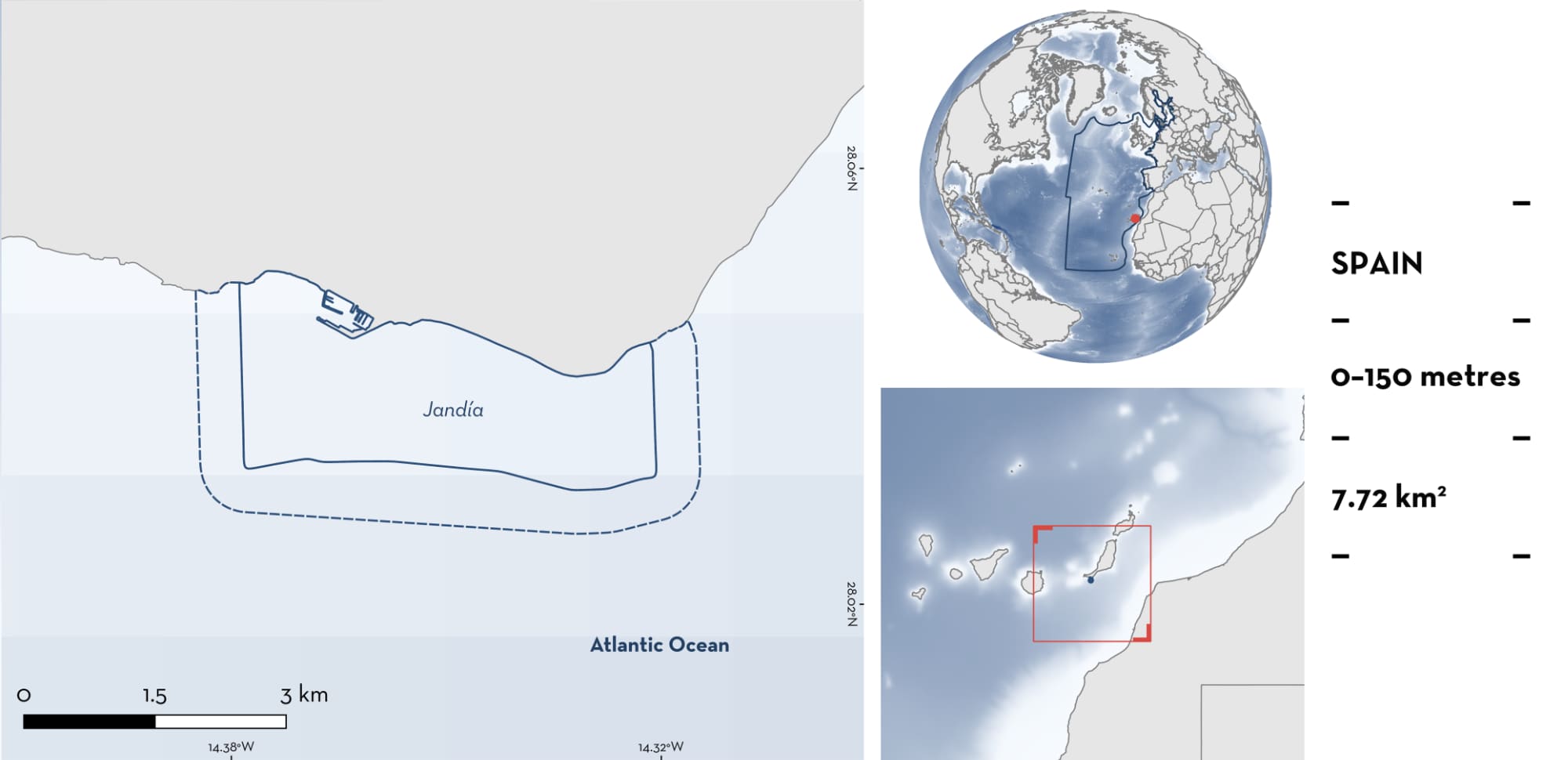
Jandía
Summary
Jandía is situated on the southeast coast of Fuerteventura Island in the Canary Islands, Spain. This coastal area features benthic habitats characterised by permanently submerged sublittoral sandbanks. The area overlaps with the Oceanic Islands and Seamounts of the Canary Region Ecologically or Biologically Significant Marine Area. Within this area there are: threatened species and undefined aggregations (Angelshark Squatina squatina).
Download factsheet
Jandía
DESCRIPTION OF HABITAT
Jandía is located on the southeast coast of Fuerteventura Island in the Canary Islands. The Canary Islands are a Spanish archipelago in the northeast Atlantic, consisting of eight main islands and five islets, situated ~100 km from the northwest African coastline. Benthic habitats in the area are characterised by permanently submerged sublittoral sandbanks.
The area is strongly influenced by the Eastern Boundary Upwelling System (EBUS), the Canary Current, and Calima events (Sahara Desert dust). The Azores High pressure system and trade winds drive complex patterns of seasonal upwelling, temperature fluctuation, and ocean stratification, leading to high productivity and nutrient richness along the West African continental shelf, which in turn influences environmental and biological conditions across the Canary Islands (Vázquez et al. 2024).
The area overlaps with the Oceanic Islands and Seamounts of the Canary Region Ecologically or Biologically Significant Marine Area (EBSA; CBD 2025).
This Important Shark and Ray Area is benthic and is delineated from inshore and surface waters (0 m) to 150 m based on the bathymetry of the area.
CRITERION A
VULNERABILITY
One Qualifying Species considered threatened with extinction according to the IUCN Red List of Threatened Species regularly occurs in the area. This is the Critically Endangered Angelshark (Morey et al. 2019).
CRITERION C
SUB-CRITERION C5 – UNDEFINED AGGREGATIONS
Jandía is an important area for undefined aggregations of one shark species.
Since 2015, the Angel Shark Project has conducted a combination of underwater visual census (UVC) surveys, tagging, and citizen science data collection in the Canary Islands. Visual transects and tagging surveys were conducted across the Canary Islands in high suitability areas (Meyers et al. 2017), potential nursery areas (Jiménez-Alvarado et al. 2020), and locations where Angelsharks are commonly observed. Within this area, seven UVC campaigns (1–2 days each) were conducted between 2018–2025. Aggregations of 3–60 adults were recorded in five of the seven surveys (Angel Shark Project unpubl. data 2025). Two particularly large aggregations were recorded. In March 2019, 24 adult sharks were tagged during a single dive conducted in a ~400 m radius from an aggregation of >50 sharks observed over two days in the same location. Another large aggregation was recorded in 2025 with 60 sharks spotted in the same location with most of the individuals appearing to be females (Angel Shark Project unpubl. data 2025). These are the largest aggregations recorded globally for the species. In addition, citizen science data reported by local dive centres between 2019–2024 provided regular records of aggregations of 3–9 individuals every year in the area (Angel Shark Project unpubl. data 2025). Angelsharks are regularly seen individually and scattered almost year-round, but these aggregations have been recorded during the reported mating season in winter (November–March) for the Canary Islands (Meyers et al. 2017; Mead et al. 2023) and occasionally during other periods of the year. Mating events have been observed and recorded over multiple years, suggesting that this area may be used for reproductive purposes. Mating events are very rare to observe and Jandía is one of the few locations across the archipelago where they have been regularly recorded. Neonate individuals were also observed in the area (Jiménez-Alvarado et al. 2020) including one neonate (<30 cm total length) tagged in 2020. Additional information is needed to confirm the nature and function of these aggregations.
Download factsheet
SUBMIT A REQUEST
ISRA SPATIAL LAYER REQUEST
To make a request to download the ISRA Layer in either a GIS compatible Shapefile (.shp) or Google Earth compatible Keyhole Markup Language Zipped file (.kmz) please complete the following form. We will review your request and send the download details to you. We will endeavor to send you the requested files as soon as we can. However, please note that this is not an automated process, and before requests are responded to, they undergo internal review and authorization. As such, requests normally take 5–10 working days to process.
Should you have questions about the data or process, please do not hesitate to contact us.

