
ISRA FACTSHEETS
ISRA FACTSHEETS
EUROPEAN ATLANTIC
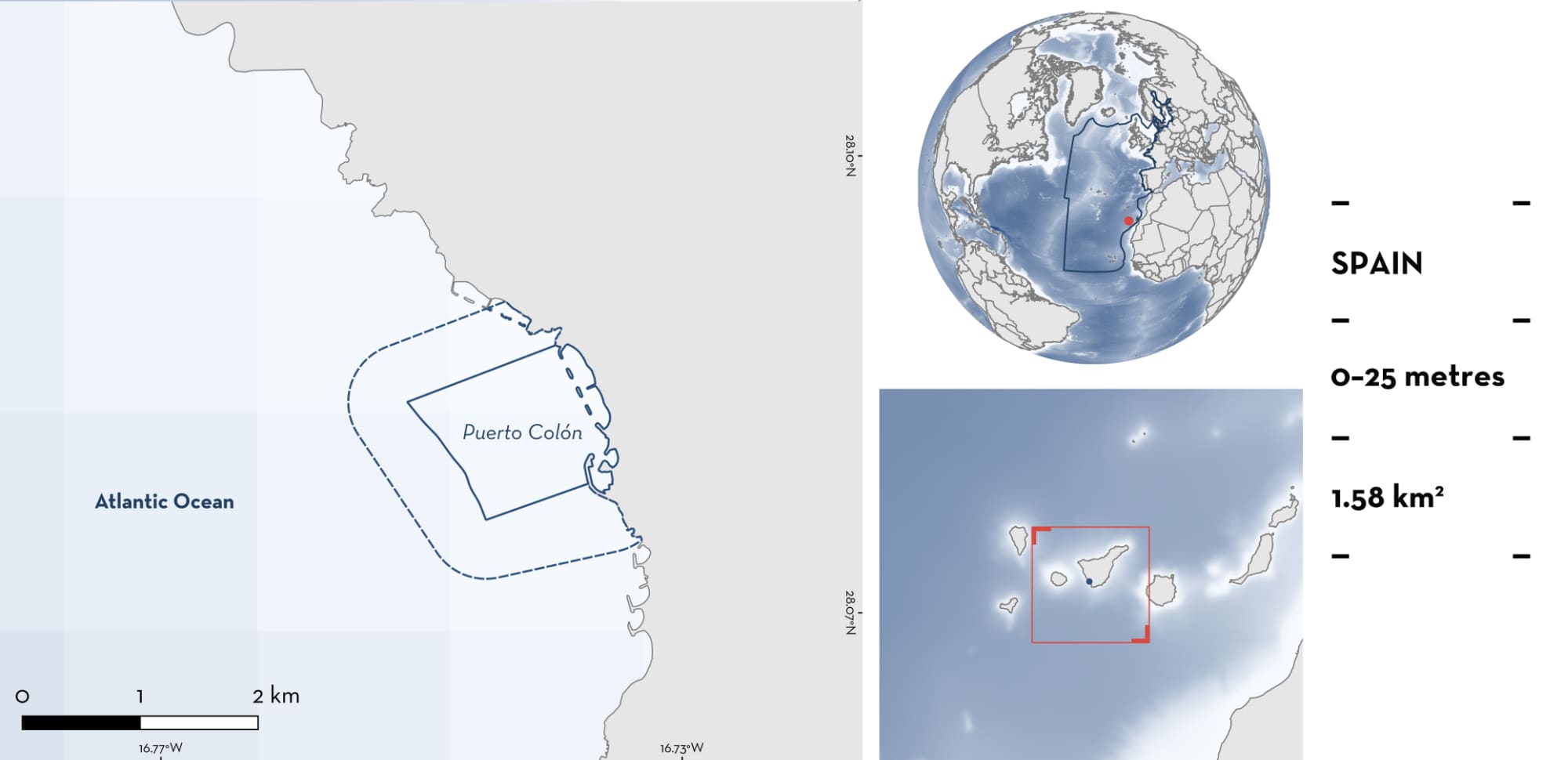
Puerto Colón
Summary
Puerto Colón is located on the southwestern coast of Tenerife Island, Canary Islands, Spain. It encompasses two bays bounded by rocky breakwaters. The area is characterised by rocky reefs, basaltic platforms, and sandy substrates. It is influenced by the Canary Current and the seasonal coastal upwelling system off northwest Africa. This area overlaps with the Oceanic Islands and Seamounts of the Canary Region Ecologically or Biologically Significant Marine Area. Within this area there are: threatened species and undefined aggregations (Spiny Butterfly Ray Gymnura altavela).
Download factsheet
Puerto Colón
DESCRIPTION OF HABITAT
Puerto Colón is located on the southwestern coast of Tenerife Island, Canary Islands, Spain. It encompasses two bays bounded by rocky breakwaters, with a gradual depth gradient. The area is characterised by rocky reefs, basaltic platforms, and sandy substrates (Rays of Paradise pers. obs. 2025).
The area is influenced by the Canary Current and the seasonal coastal upwelling system off northwest Africa, which brings cold, nutrient-rich waters, enhancing primary productivity especially from the boreal spring to autumn (Gómez-Letona et al. 2017).
This area overlaps with the Oceanic Islands and Seamounts of the Canary Region Ecologically or Biologically Significant Marine Area (EBSA; CBD 2025).
This Important Shark and Ray Area is benthic and is delineated from inshore and surface waters (0 m) to 25 m based on the bathymetry of the area.
CRITERION A
VULNERABILITY
One Qualifying Species considered threatened with extinction according to the IUCN Red List of Threatened Species regularly occurs in the area. This is the Endangered Spiny Butterfly Ray (Dulvy et al. 2021).
CRITERION C
SUB-CRITERION C5 – UNDEFINED AGGREGATIONS
Puerto Colón is an important area for undefined aggregations of one ray species.
Aggregations of Spiny Butterfly Ray occur in the area from July–October, with a peak during August–September. The area was surveyed using snorkel, drones, and beach walks for ~10 days every month of the year, during 2017–2022 (F Ravina unpubl. data 2025). During this period, aggregations of Spiny Butterfly Rays were observed along the beach on every visit during the aggregation season (July–October) (F Ravina & Rays of Paradise unpubl. data 2025). Aggregations ranged between 10–40 individuals and were composed mainly of females, with the size of individuals visually estimated at 94–200 cm disc width (DW) (F Ravina & Rays of Paradise unpubl. data 2025). Size-at-maturity for females is 102–108 cm DW (Last et al. 2016), indicating that the majority of individuals were adults. Further information is required to understand the nature and function of these aggregations.
Download factsheet
SUBMIT A REQUEST
ISRA SPATIAL LAYER REQUEST
To make a request to download the ISRA Layer in either a GIS compatible Shapefile (.shp) or Google Earth compatible Keyhole Markup Language Zipped file (.kmz) please complete the following form. We will review your request and send the download details to you. We will endeavor to send you the requested files as soon as we can. However, please note that this is not an automated process, and before requests are responded to, they undergo internal review and authorization. As such, requests normally take 5–10 working days to process.
Should you have questions about the data or process, please do not hesitate to contact us.

