ISRA FACTSHEETS
ISRA FACTSHEETS
EUROPEAN ATLANTIC
Galicia Bank
Summary
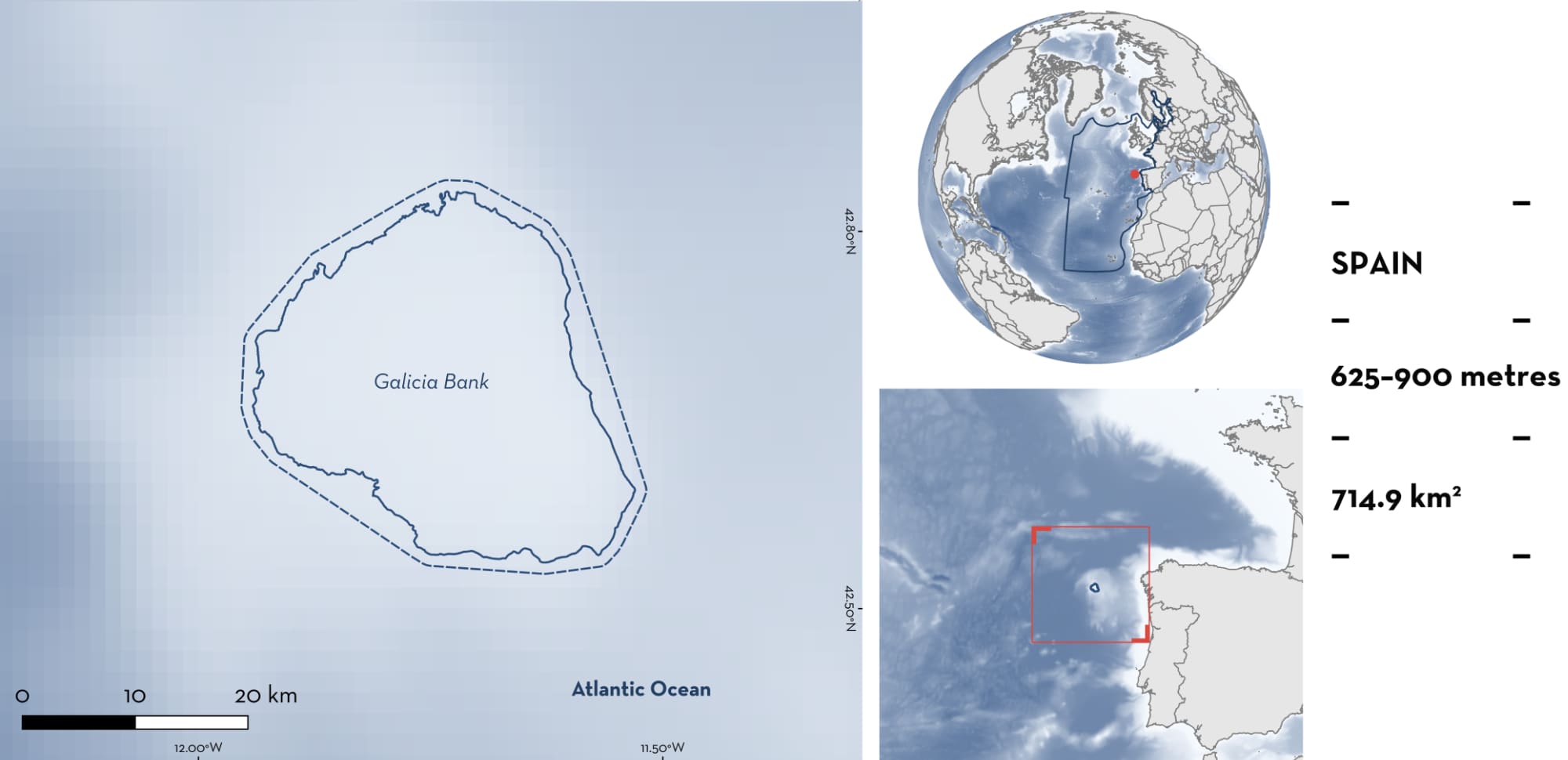
Galicia Bank is located off the west coast of Galicia, Spain. It encompasses an isolated seamount rising to 625 m depth. The area is characterised by rocky substrates of basaltic lava origin. It is influenced by several distinct water masses which contribute to high primary productivity. This area overlaps with the West Iberian Canyons and Banks Ecologically or Biologically Significant Marine Area and the Banco de Galicia Key Biodiversity Area. Within this area there are: threatened species and feeding areas (Velvet Belly Lanternshark Etmopterus spinax).
Download factsheet
Galicia Bank
DESCRIPTION OF HABITAT
Galicia Bank is located off the west coast of Galicia, Spain. It encompasses an isolated seamount rising to 625 m depth. The bank is ~50 km long along its east-west axis and 90 km along its north-south axis. The area is characterised by rocky substrates of basaltic lava origin (Ercilla et al. 2011; Lourido et al. 2024). The slope on the eastern side is very steep with rocky substrates, while on the western side, there is a sandy platform at ~800 m depth (Duineveld et al. 2004).
The area is influenced by several distinct water masses: the North Atlantic Central Water at depths ~540 m, the Mediterranean Outflow Water at ~1,490 m, the Labrador Sea Water at ~2,155 m, the Lower North Atlantic Deep Water at ~3,450 m, and the Lower Deep Water below this depth (Rey et al. 2008). These water masses contribute to high primary productivity in the region (Rey et al. 2008).
This area overlaps with the West Iberian Canyons and Banks Ecologically or Biologically Significant Marine Area (EBSA; CBD 2025) and the Banco de Galicia Key Biodiversity Area (KBA 2025).
This Important Shark and Ray Area is benthic, pelagic, and subsurface from 625 m to 900 m based on the bathymetry of the area.
CRITERION A
VULNERABILITY
One Qualifying Species considered threatened with extinction according to the IUCN Red List of Threatened Species regularly occurs in the area. This is the Vulnerable Velvet Belly Lanternshark (Finucci et al. 2021).
CRITERION C
SUB-CRITERION C2 – FEEDING AREAS
Galicia Bank is an important feeding area for one shark species.
Between 2009–2011, shark and ray surveys were conducted in the area and surrounding areas using a benthic (20 mm mesh size at cod-end, 30-minute hauls) and a beam (3.5 m width, 10 mm mesh size, 15-minute hauls) trawl (Rodríguez-Cabello et al. 2012; Isbert et al. 2015; Preciado et al. 2017). A total of 22 hauls were undertaken (2009, n = 3; 2010, n = 10; 2011, n = 9) at depths of 700–1,800 m (Rodríguez-Cabello et al. 2012; Preciado et al. 2017). Data on species, total length (TL), and stomach wet mass were recorded, and prey items were separated and identified to the lowest possible taxonomic level, and the percent by number of prey (%N) was calculated (Isbert et al. 2015; C Rodríguez-Cabello unpubl. data 2025). Muscle tissue samples were also collected for stable isotopic analysis (Rodríguez-Cabello et al. 2014; Isbert et al. 2015; Preciado et al. 2017).
Between 2009–2011, a total of 175 Velvet Belly Lanternsharks were captured with 75 individuals analysed for stomach contents and 45 for isotopic analysis (Rodríguez-Cabello et al. 2014; C Rodríguez-Cabello unpubl. data 2025). Of these stomachs, 40% (n = 30) were full, with isotopic values of δ13C -18.55 ± 0.45 (mean ± standard deviation [SD]) and δ15N 10.80 ± 0.49 (Rodríguez-Cabello et al. 2014; Preciado et al. 2017). This δ13C isotopic value suggest that Velvet Belly Lanternsharks are mainly feeding on pelagic food sources at the base of the food chain, while the δ15N value suggest this species is a secondary or tertiary consumer, with a low variability in its diet due to the small SD (Preciado et al. 2017). Individuals ranged in size from 17–44 cm TL and were sampled at depths of 750–870 m (Preciado et al. 2017). In 2010 only, 56.7% (n = 17 out of 30) of Velvet Belly Lanternshark stomachs analysed were full with these sharks ranging in size from 15.3–45.9 cm TL (Isbert et al. 2015). Crustaceans (%N = 61.5%; mainly carideans Pasiphaea spp and euphausiids) and fishes (%N = 30.8%) were the main prey items, while molluscs and echinoderms played a minor role indicating a benthopelagic feeding behaviour (Isbert et al. 2015; Preciado et al. 2017). No significant dietary differences were observed between the boreal spring and summer, as suggested by the similarity between stomach content data collected in summer and isotopic values, which likely reflect spring diets due to tissue turnover rates (Preciado et al. 2017).
Although haul surveys were conducted in surrounding areas and the depth range of the species goes to 2,000 m depth, Velvet Belly Lanternshark, were only captured from the summit of the Galica Bank down to 900 m (Rodríguez-Cabello et al. 2012). The summit of the Galicia Bank hosts dense populations of caridean shrimps like Pasiphaea sivado, as well as euphausiids such as Meganyctiphanes norvegica (Cartes et al. 2014), which are some of the main prey for Velvet Belly Lanternshark in the area (Preciado et al. 2017). These species are highly abundant at these depths in the area due to the influence of the Mediterranean Outflow Water, which may reach velocities of 5–10 cm/s and contribute to maintain suspension feeder communities (Preciado et al. 2017), combined with the entrapment during their dawn descent of the vertically migrating zooplankton, a pattern commonly observed on deep seamounts (Clark et al. 2010). The higher productivity found at the summit of Galicia Bank compared to adjacent waters and the presence of large aggregations of euphausiids, and up to five species of Pasiphaea shrimps (Cartes et al. 2014), highlights the importance of the area for the feeding habits of Velvet Belly Lanternshark.
Download factsheet
SUBMIT A REQUEST
ISRA SPATIAL LAYER REQUEST
To make a request to download the ISRA Layer in either a GIS compatible Shapefile (.shp) or Google Earth compatible Keyhole Markup Language Zipped file (.kmz) please complete the following form. We will review your request and send the download details to you. We will endeavor to send you the requested files as soon as we can. However, please note that this is not an automated process, and before requests are responded to, they undergo internal review and authorization. As such, requests normally take 5–10 working days to process.
Should you have questions about the data or process, please do not hesitate to contact us.