ISRA FACTSHEETS
ISRA FACTSHEETS
EUROPEAN ATLANTIC
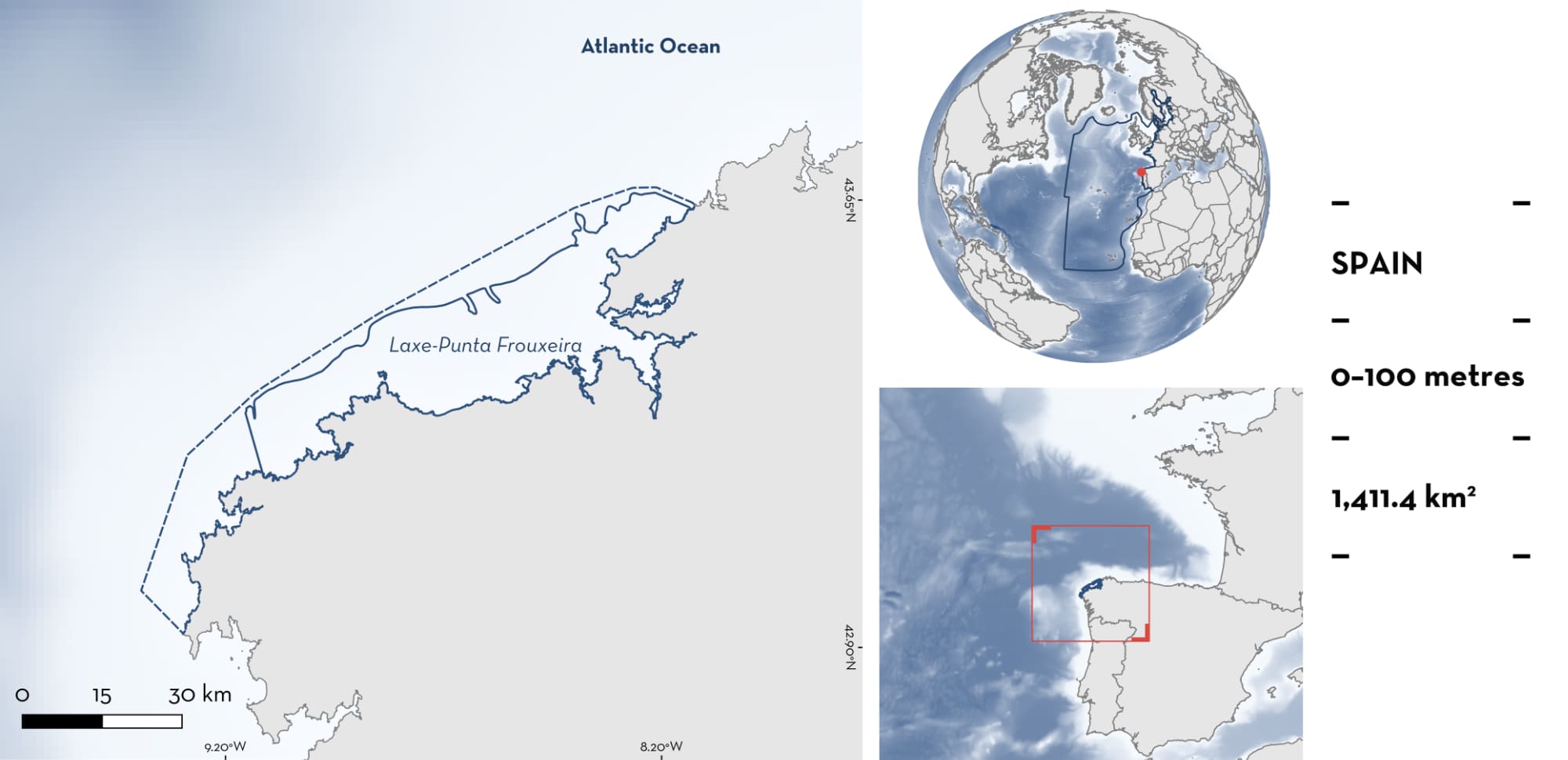
Laxe-Punta Frouxeira
Summary
Laxe-Punta Frouxeira is located along the coast of A Coruña Province in Galicia, Spain. This area encompasses part of the gently sloping continental shelf, several beaches and capes, and multiple estuarine inlets. Laxe-Punta Frouxeira is characterised by sandy and gravel substrates. The area is influenced by a seasonal cycle of upwelling and downwelling driven by the prevailing wind regimes influenced by the Azores High. The area overlaps with the West Iberian Canyons and Banks Ecologically or Biologically Significant Marine Area, and the Costa da Morte and Ferrolterra-Valdoviño Coast Key Biodiversity Areas. Within this area there are: reproductive areas (Blue Shark Prionace glauca).
Download factsheet
Laxe-Punta Frouxeira
DESCRIPTION OF HABITAT
Laxe-Punta Frouxeira is located along the coast of A Coruña Province in Galicia, Spain. This area encompasses part of the gently sloping continental shelf, several beaches and capes, and the estuarine inlets of the Ría Corme-Laxe, Ría da Coruña, Ría de Betanzos, and Ría de Ferrol. The habitat is characterised by sandy and gravel substrates.
The area is influenced by a seasonal cycle of upwelling and downwelling driven by the prevailing wind regimes influenced by the Azores High (Ruiz-Villarreal et al. 2006). From April to September, upwelling conditions dominate, bringing nutrient-rich deeper waters to the surface, which supports high biological productivity and contributes to the formation of filaments, fronts, and eddies (Ruiz-Villarreal et al. 2006). In contrast, the downwelling season from October to March is marked by the presence of the poleward slope current, a subsurface current that transports warmer and saltier Eastern North Atlantic Central Waters northward along the continental slope (Ruiz-Villarreal et al. 2006).
The area overlaps with the West Iberian Canyons and Banks Ecologically or Biologically Significant Marine Area (EBSA; CBD 2025), and the Costa da Morte and Ferrolterra-Valdoviño Coast Key Biodiversity Areas (KBA 2025a, KBA 2025b).
This Important Shark and Ray Area is pelagic and is delineated from inshore and surface waters (0 m) to 100 m based on the bathymetry of the area.
CRITERION C
SUB-CRITERION C1 – REPRODUCTIVE AREAS
Laxe-Punta Frouxeira is an important reproductive area for one shark species.
Between 2013–2025, Blue Shark observations were collected across the northwestern coast of the Iberian Peninsula from recreational and professional fisher catch records (supported by photographs and videos), regional newspapers, and citizen science data collected via Tiburones Pelagicos Shiny app (Mejuto et al. 2014; Bañón et al. 2016; Mucientes et al. 2018; K Papadopoulo unpubl. data 2025). Collected data included location, depth, number of individuals, sex, behaviour, estimated size of individuals (total length [TL]; based on photographs, videos, or descriptions from the observers), and the presence of umbilical scars. This resulted in 963 Blue Shark records from the coast of Galicia, including this area. Of these observations, more than half (n = 502; 52%) were estimated to be neonates, young-of-the-year (YOY), or small juveniles based on size estimations. Size-at-birth for the species is 33–60 cm TL (Skomal & Natanson 2003; Ebert et al. 2021), and size of YOY are reported up to ~122 cm TL (Skomal & Natanson 2003). The rest were mainly subadults measuring <180 cm TL (Mejuto et al. 2014; Bañón et al. 2016; Mucientes et al. 2018; K Papadopoulo unpubl. data 2025).
Within Laxe-Punta Frouxeira, 215 Blue Sharks were recorded between 2013–2022, including 146 neonates and YOY ranging in size from 40–80 cm TL (Mejuto et al. 2014; Bañón et al. 2016; Mucientes et al. 2018; Tiburones Pelágicos Galicia 2025; K Papadopoulo unpubl. data 2025). Neonates and YOY were recorded in 2013 (n = 89 individuals), 2015 (n = 15), 2016 (n = 2), 2018 (n = 30), 2019 (n = 6), 2020 (n = 2), 2021 (n = 1), and 2022 (n = 1) during the months of July–September (Mejuto et al. 2014; Bañón et al. 2016; Mucientes et al. 2018; K Papadopoulo unpubl. data 2025). This aligns with the primary pupping season in the boreal spring and summer (between April–July; Nakano & Stevens 2008). The lower number of observations in this area is likely due to the sparsely populated coastline and the limited coverage of the citizen science campaign. However, monthly spatial predictions of habitat preference for small juveniles in the Northeast Atlantic highlighted waters around Galicia, including Laxe-Punta Frouxeira and Rías Baixas, as important from June–September (Vandeperre et al. 2016). Kernel density analyses of YOY distribution based on fishery observer data, scientific research projects, surveys, and recreational fisheries across the Atlantic Ocean similarly highlighted this region (Coelho et al. 2018). The shallower inshore waters within the area may represent a particularly critical nursery ground for Blue Shark in the Northeast Atlantic. Laxe-Punta Frouxeira in conjunction with Rías Baixas, encompass the largest number of records of Blue Shark neonate and YOY recorded from the north coast of Spain. These coastal zones, shaped by the narrow Galician Shelf, provide accessible foraging opportunities for neonates and YOYs, which can feed on abundant cephalopods and small pelagic fishes nearshore (Mejuto et al. 2014; Bañón et al. 2016; Mucientes et al. 2018; K. Papadopoulo unpubl. data 2025).
Download factsheet
SUBMIT A REQUEST
ISRA SPATIAL LAYER REQUEST
To make a request to download the ISRA Layer in either a GIS compatible Shapefile (.shp) or Google Earth compatible Keyhole Markup Language Zipped file (.kmz) please complete the following form. We will review your request and send the download details to you. We will endeavor to send you the requested files as soon as we can. However, please note that this is not an automated process, and before requests are responded to, they undergo internal review and authorization. As such, requests normally take 5–10 working days to process.
Should you have questions about the data or process, please do not hesitate to contact us.