ISRA FACTSHEETS
ISRA FACTSHEETS
EUROPEAN ATLANTIC
Parda Reef
Summary
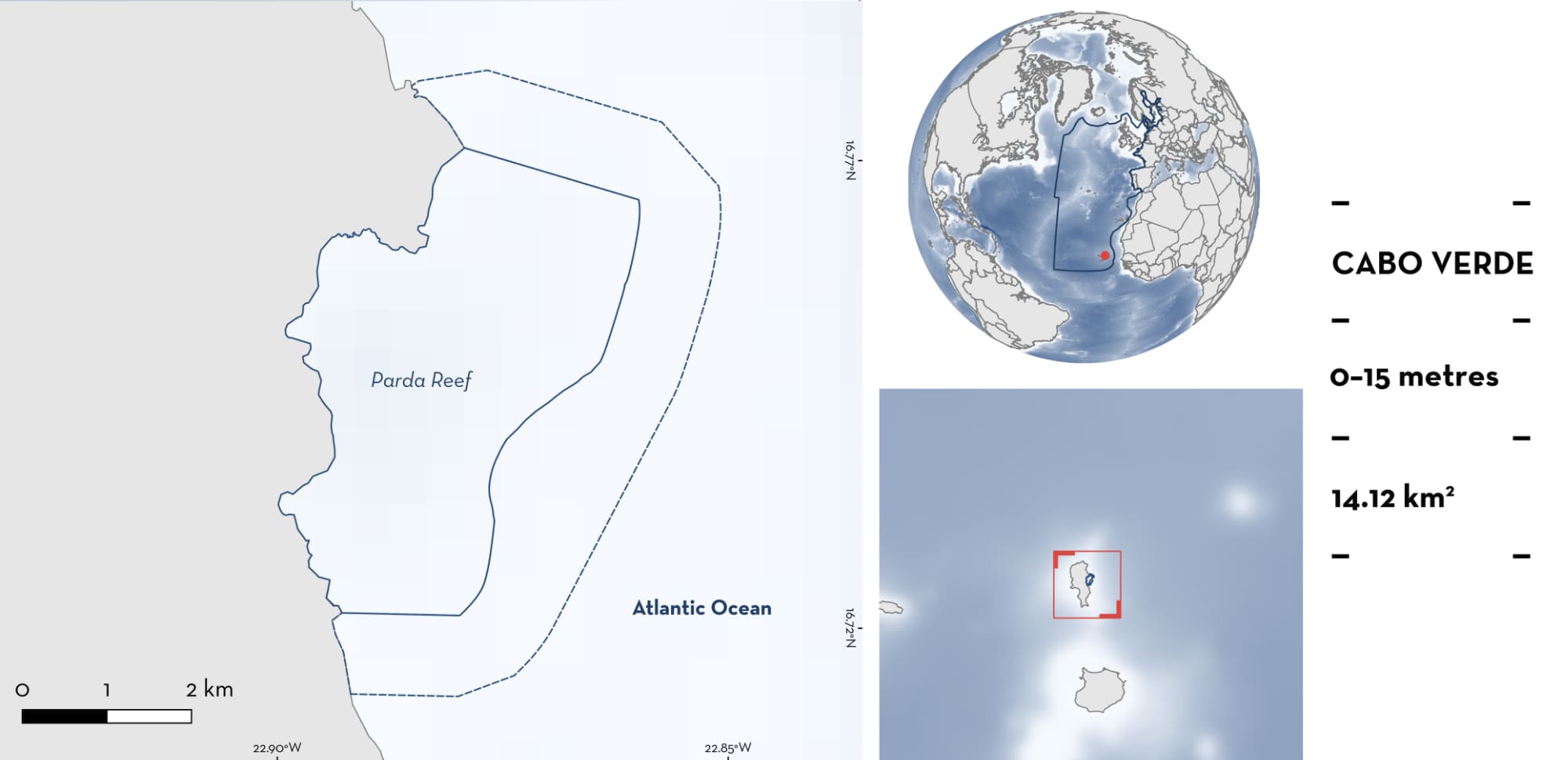
Parda Reef is located on northeast Sal Island, Cabo Verde. The habitat is composed of basaltic rock from ancient eruptions, forming a shallow rocky reef. The northern and southern sections of the area encompass two small narrow beaches Within this area there are: threatened species and reproductive areas (Lemon Shark Negaprion brevirostris).
Download factsheet
Parda Reef
DESCRIPTION OF HABITAT
Parda Reef is located on northeast Sal Island, Cabo Verde. Sal Island is one of the windward islands in the northern sector of Cabo Verde. This area is a coastal zone composed of basaltic rock from ancient eruptions, forming a shallow rocky reef. The northern and southern sections of the area encompass two small narrow beaches (Johnson et al. 2020).
Sal Island is impacted on a steady basis by wave swell generated from the Northeast Trade Winds coming from the Canary Islands, commonly reaching 5 to 6 on the Beaufort scale and capable of generating surface swells with an amplitude of 3.5 m (Johnson et al. 2020).
This Important Shark and Ray Area is benthic and pelagic and is delineated from inshore and surface waters (0 m) to 15 m based on the bathymetry of the area.
CRITERION A
VULNERABILITY
One Qualifying Species considered threatened with extinction according to the IUCN Red List of Threatened Species regularly occurs in the area. This is the Vulnerable Lemon Shark (Carlson et al. 2021).
CRITERION C
SUB-CRITERION C1 – REPRODUCTIVE AREAS
Parda Reef is an important reproductive area for one shark species.
Aggregations of 12–23 neonate, young-of-the-year (YOY), and small juvenile Lemon Sharks are observed year-round within this area (Associação Projeto Biodiversidade [APB] unpubl. data 2011–2025). Visual census surveys were carried out by 1–2 people standing in the water within this area. Over an average of 2.5 hours per survey, observers recorded the number of visible Lemon Sharks every 10 minutes. Neonates and YOY represent 80% of the reported aggregations, although during boreal summer months (June–September), this percentage increases to ~90% (APB unpubl. data 2011–2025).
Between November 2022–February 2025, 59 tagging surveys were conducted within this area. Each shark received a Passive Integrated Transponder (PIT) tag, and when feasible, an external identification tag was also applied. A total of 83 Lemon Sharks were captured and tagged, of which 81 were measured (50–92 cm total length [TL]) and 90.1% measured <80 cm TL (APB unpubl. data 2022–2025). The size-at-birth for Lemon Shark is 60–65 cm TL (Ebert et al. 2021) indicating ~90% were neonates and YOY. Of the 83 Lemon Sharks captured, 35 individuals were recaptured (n = 43 recaptures), supporting that Lemon Sharks remain or return to the area for up to 22 months. Of these individuals, five were recaptured after 12 months (influenced by the fact that ~50% of the sharks had been tagged less than 12 months from the date of the report). Additionally, information from 68 Baited Remote Underwater Video Station (BRUVS) surveys (APB unpubl. data 2022–2025) and 250 drone flights (The Eizaguirre Lab unpubl. data 2025) in the area suggest more intensive use of Parda Reef by Lemon Sharks compared to adjacent areas (APB unpubl. data 2025).
Collectively, the evidence supports that the area meets the three criteria to be identified as a nursery (Heupel et al. 2007). Lemon Sharks are more commonly encountered in the area than in surrounding areas, individuals tend to remain in the area, and the habitat is consistently used across multiple years.
Download factsheet
SUBMIT A REQUEST
ISRA SPATIAL LAYER REQUEST
To make a request to download the ISRA Layer in either a GIS compatible Shapefile (.shp) or Google Earth compatible Keyhole Markup Language Zipped file (.kmz) please complete the following form. We will review your request and send the download details to you. We will endeavor to send you the requested files as soon as we can. However, please note that this is not an automated process, and before requests are responded to, they undergo internal review and authorization. As such, requests normally take 5–10 working days to process.
Should you have questions about the data or process, please do not hesitate to contact us.