ISRA FACTSHEETS
ISRA FACTSHEETS
EUROPEAN ATLANTIC
Trégor
Summary
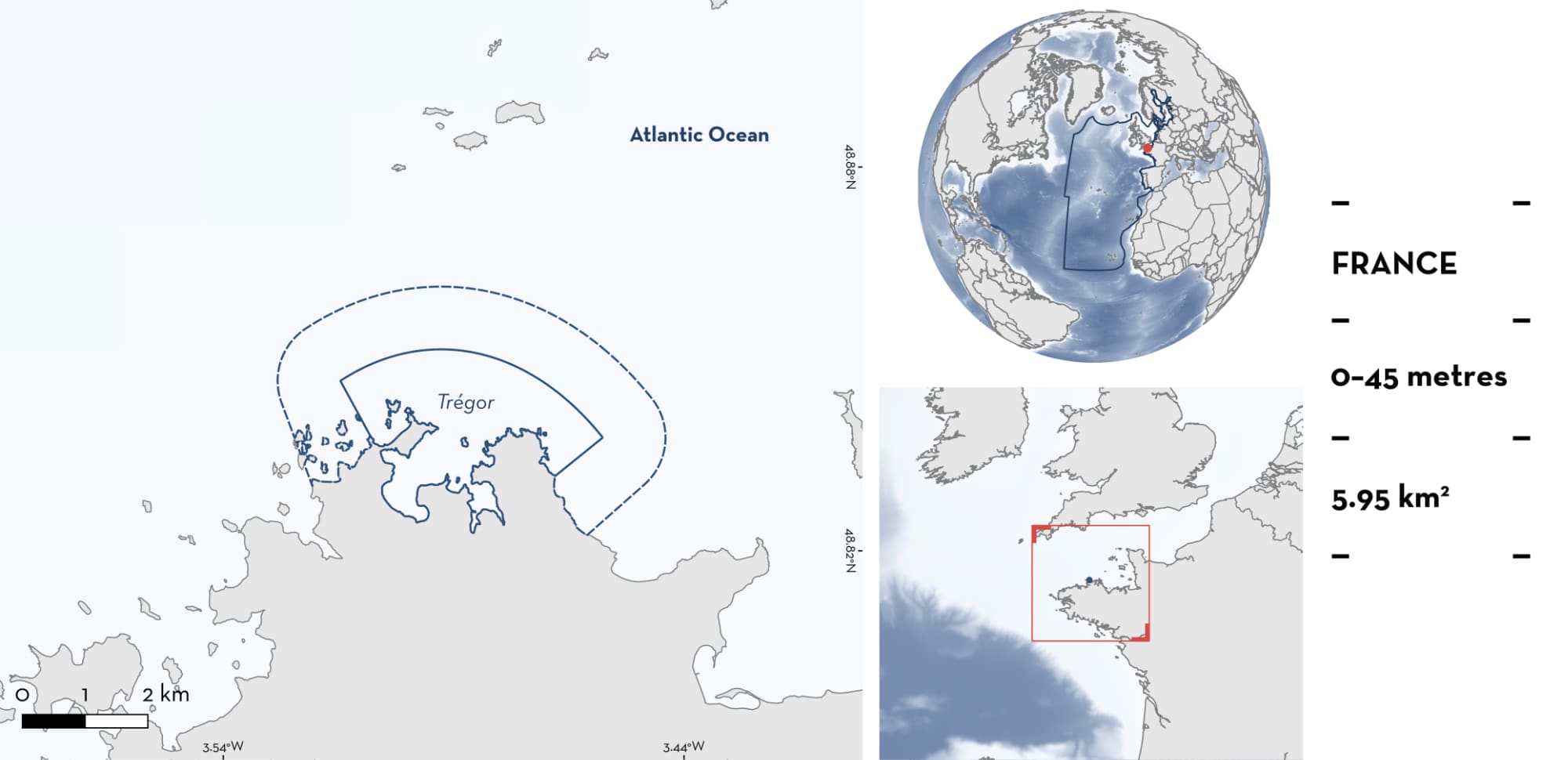
Trégor is located on the northern coast of Brittany in France. This area comprises coastal bays, rocky islands, and pelagic waters of the western English Channel. The habitat is characterised by rocky substrates, sand, coarse sediments, kelp, algae, and some patches of seagrass. The area is influenced by strong currents and a large tidal variation. Within this area there are: threatened species; reproductive areas; and undefined aggregations (Porbeagle Lamna nasus).
Download factsheet
Trégor
DESCRIPTION OF HABITAT
Trégor is located on the northern coast of Brittany in France. This area comprises coastal bays, rocky islands, and pelagic waters of the western English Channel. There is a steep rocky slope close to the coast (Jung et al. 2024). The granitic rocks here have an unusual magnetic anomaly (Jung et al. 2024). The habitat is characterised by rocky reefs, sand, coarse sediments, kelp forests (Laminaria spp.), seagrass beds (Zostera marina), and red algae. It is influenced by strong tidal currents and large tidal variations.
This Important Shark and Ray Area is pelagic and is delineated from inshore and surface waters (0 m) to 45 m based on the bathymetry of the area.
CRITERION A
VULNERABILITY
One Qualifying Species considered threatened with extinction according to the IUCN Red List of Threatened Species regularly occurs in the area. This is the Vulnerable Porbeagle (Rigby et al. 2019).
CRITERION C
SUB-CRITERION C1 – REPRODUCTIVE AREAS
Trégor is an important reproductive area for one shark species.
Pregnant Porbeagle are regularly and predictably observed in this area each year (Jung et al. 2024; A Jung et al. unpubl. data 2025). In-water snorkelling surveys were conducted in this area between April–September from 2021–2025, with surveys in April (n = 2), May (n = 3), June (n = 15), July (n = 14), August (n = 8), and September (n = 10) (Jung et al. 2024; A Jung et al. unpubl. data 2025). Surveys used an olfactory attraction bait attached to a 15 m long rope and were limited to 90 minutes. Porbeagles were filmed, identified using the lateral line pattern and any other distinctive marks, and their size was either estimated visually or with the help of parallel lasers (from 2022 onwards). Records from other divers using the area were also recorded.
A total of 226 encounters of 158 individual Porbeagles were recorded during this period. Across the encounters, six sharks were estimated to be between 120–160 cm fork length (FL), 81 sharks were between 170–190 cm FL, 97 sharks were between 200–220 cm FL, and 42 sharks were between 230–250 cm FL (noting that individuals were measured each time they were encountered). Almost all sharks were females, except two immature males measuring 140 and 180 cm FL and one mature male (200 cm FL). There were 181 immature and subadult females (81%) with a size of <218 cm FL and 42 mature females (19%) >218 cm FL. The size at which 50% of females are mature is 218 cm FL for this species (Jensen et al. 2002). Among the 42 mature females, fifteen were pregnant (35% of mature females) with visibly extended abdomens recorded in April (n = 2), June (n = 10), July (n = 2), and August (n = 1). The wide extension of the abdomen suggests that these individuals were in the late stages of pregnancy and potentially using this area to gestate. Additionally, one female was pregnant in July 2023 and was then seen again post-partum in August 2023, suggesting that they pup either in this area or nearby. One potential mating attempt was also observed in October 2024. It is possible that mating occurs later in the year, outside the surveys, but observations are too limited to draw a definitive conclusion. Trégor is the only known location in the region where pregnant Porbeagles are regularly observed.
CRITERION C
SUB-CRITERION C5 – UNDEFINED AGGREGATIONS
Trégor is an important area for undefined aggregations of one shark species.
During the surveys outlined above, a total of 226 encounters of 158 different individuals were recorded. Porbeagles show a degree of site fidelity to this area, with 24 individuals re-sighted in separate years (15%) and three individuals sighted in six consecutive years. The number of different sharks observed on a dive ranges from 0–9 with a mean of 2–4 individuals, depending on the month. Groups of 2–3 Porbeagles are common during the scientific dive surveys. Additionally, up to nine animals have been observed during a single dive (Jung et al. 2024). Over the 2015–2024 surveys, in April there were only two dives with observations, and as a result, the average number of sharks observed per dive was the same as both the minimum and maximum, which was four sharks per dive. In May, with four dives with observations, there were 1–4 individuals, with a mean of 2.5 individuals. June had 23 dives with observations and had 1–9 individuals with a mean of 3.0 individuals. July saw 18 dives with observations, with a range from 1–9 sharks and a mean of 3.6 sharks. August had 12 dives with observations, with 1–4 individuals and a mean of 1.8 sharks. Finally, in September, there were 16 dives with observation, ranging from 1–9 sharks with a mean of 2.6 sharks. Importantly, Porbeagles consistently did not show any interest in the deployed bait and generally are seen within 30 minutes of the start of the dive (A Ory pers. obs. 2025), suggesting that they are naturally aggregating in this area. This area was also the hotspot along the northern coast of Brittany where most public sightings of Porbeagles were reported between 2008–2023 (APECS unpubl. data 2025). Porbeagles tracked with passive acoustic telemetry showed high residency in Trégor and were detected throughout the year (Couturier et al. 2024), further highlighting their regular use of the area.
It is possible that these aggregations are related to feeding, with Porbeagles observed breaching within this area at Squéouel Cape, sometimes pursuing prey such as European Sea Bass (Dicentrarchus labrax) or pollacks (Pollachius spp.). Further information is needed to understand the nature and function of these aggregations.
Download factsheet
SUBMIT A REQUEST
ISRA SPATIAL LAYER REQUEST
To make a request to download the ISRA Layer in either a GIS compatible Shapefile (.shp) or Google Earth compatible Keyhole Markup Language Zipped file (.kmz) please complete the following form. We will review your request and send the download details to you. We will endeavor to send you the requested files as soon as we can. However, please note that this is not an automated process, and before requests are responded to, they undergo internal review and authorization. As such, requests normally take 5–10 working days to process.
Should you have questions about the data or process, please do not hesitate to contact us.