
ISRA FACTSHEETS
ISRA FACTSHEETS
EUROPEAN ATLANTIC
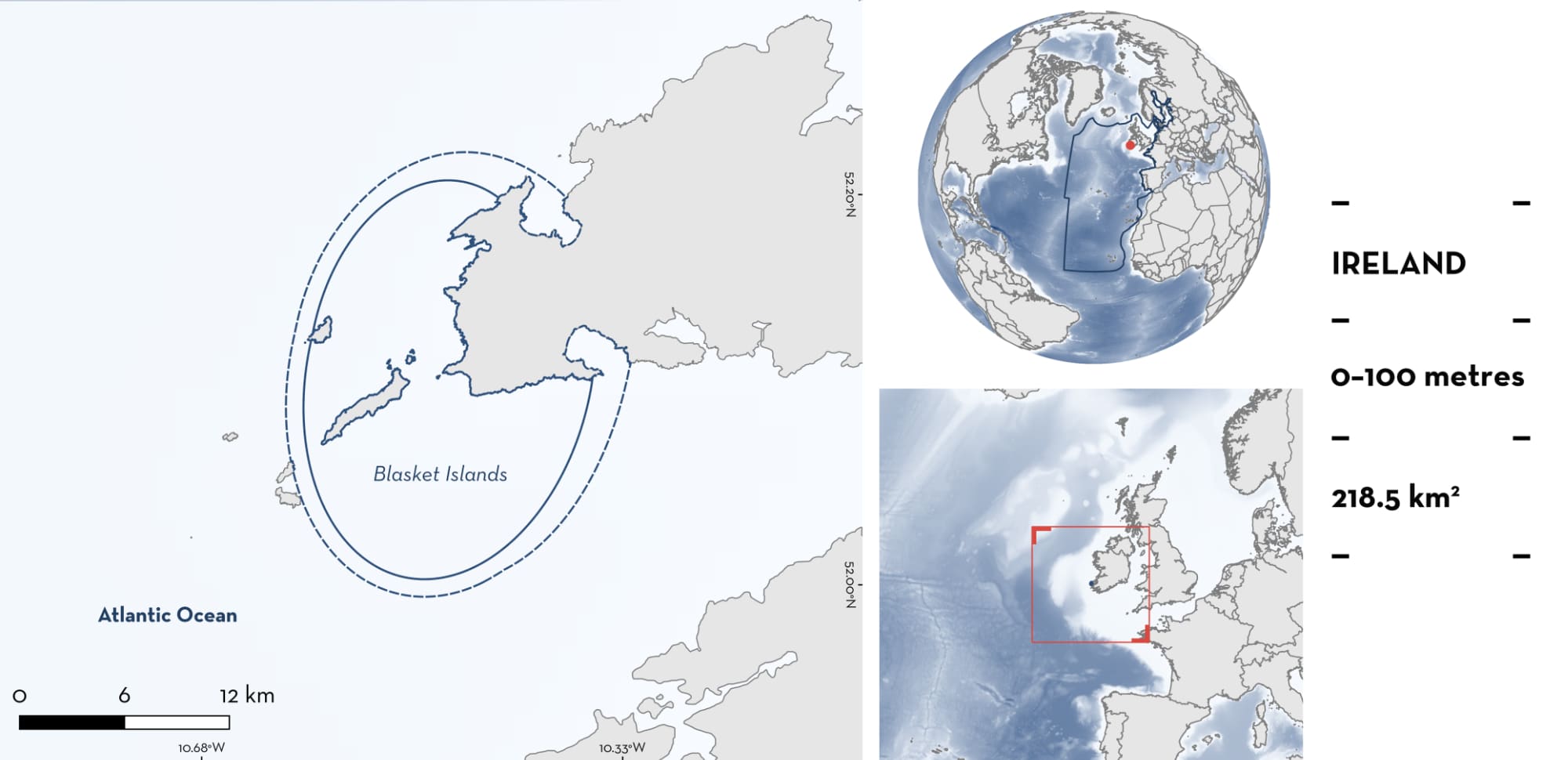
Blasket Islands
Summary
Blasket Islands is located at the western end of the Dingle Peninsula in County Kerry, Ireland. The area is situated on the continental shelf around southwest Ireland and encompasses a diversity of habitats, including headlands and a series of islands (the Blasket Islands), which likely serve to create small fronts and eddies that aggregate prey. This area overlaps with the Kerry National Marine Park (Páirc Náisiúnta na Mara, Ciarraí). Within this area there are: threatened species and feeding areas (Basking Shark Cetorhinus maximus).
Download factsheet
Blasket Islands
DESCRIPTION OF HABITAT
Blasket Islands is located at the western end of the Dingle Peninsula in County Kerry, Ireland. There are six main islands with associated rocky islets and sea stacks. The largest island, Great Blasket Island, is separated from the mainland by Blasket Sound and reaches 292 m above sea level. It, alongside the smallest island, Beginish, lie within 2 km of the mainland. The other four islands are located between 7–12 km from the mainland (NPWS 2014).
The area is situated on the Celtic Shelf of the Atlantic Ocean which is exposed to the prevailing Atlantic Ocean wind and swells. The area contains submarine rocky substrates and biogenic concretions as well as submerged or partially submerged sea caves at the base of many of the cliffs (EEA 2020). These likely serve to create small fronts and eddies that aggregate prey, such as dense patches of zooplankton which have been detected by echosounders (D Cade pers. comm. 2025).
This area overlaps with the Kerry National Marine Park (Páirc Náisiúnta na Mara, Ciarraí; NPWS 2025).
This Important Shark and Ray Area is delineated from inshore and surface waters (0 m) to a depth of 100 m based on the bathymetry of the area.
CRITERION A
VULNERABILITY
One Qualifying Species considered threatened with extinction according to the IUCN Red List of Threatened Species regularly occurs in the area. This is the Endangered Basking Shark (Rigby et al. 2021).
CRITERION C
SUB-CRITERION C2 – FEEDING AREAS
Blasket Islands is an important feeding area for one shark species.
Aggregations of Basking Sharks were regularly reported in this area from 2007–2024 (n = 124 aggregations, 1,516 individuals; mean = 7 aggregations/year, 10.4 individuals/year in each aggregation; range = 1–15 aggregations/year) via the Irish Basking Shark Group (IBSG) (Irish Basking Shark Group [IBSG]/Irish Whale and Dolphin Group [IWDG] unpubl. data 2025). Although these reports do not always document animal behaviour, these aggregations are frequently linked to feeding. Based on images reported to the IBSG directly from citizen scientists as well as social media pages of boat operators which operate in the area, feeding is the most commonly observed behaviour in this location (IBSG/IWDG unpubl. data 2025; AG McInturf & JR Bortoluzzi unpubl. data 2025). Aggregations are of notable size in the Blasket Islands, with 17 sightings of >20 individual sharks identified between 2010–2024. In 2011, 2023, and 2024, aggregations of 60 or more sharks were also reported in this area. The maximum number of sharks sighted at once was 65 individuals in 2024. The vast majority of aggregations fall between April–May (with one in March and three in September), with this trend most notable from 2010–2024. Furthermore, between 2022–2024, research using biologgers (n = 14 individuals) and boat-based echosounders documented feeding bouts of Basking Sharks (total percent of time feeding during videos: 48.4% or 36.8 hours; range among individuals: 12.2–100%) in response to micro-patches of zooplankton characteristic to this location (Chapple et al. 2024; D Cade pers. comm. 2025).
Download factsheet
SUBMIT A REQUEST
ISRA SPATIAL LAYER REQUEST
To make a request to download the ISRA Layer in either a GIS compatible Shapefile (.shp) or Google Earth compatible Keyhole Markup Language Zipped file (.kmz) please complete the following form. We will review your request and send the download details to you. We will endeavor to send you the requested files as soon as we can. However, please note that this is not an automated process, and before requests are responded to, they undergo internal review and authorization. As such, requests normally take 5–10 working days to process.
Should you have questions about the data or process, please do not hesitate to contact us.

