ISRA FACTSHEETS
ISRA FACTSHEETS
EUROPEAN ATLANTIC
Las Canteras
Summary
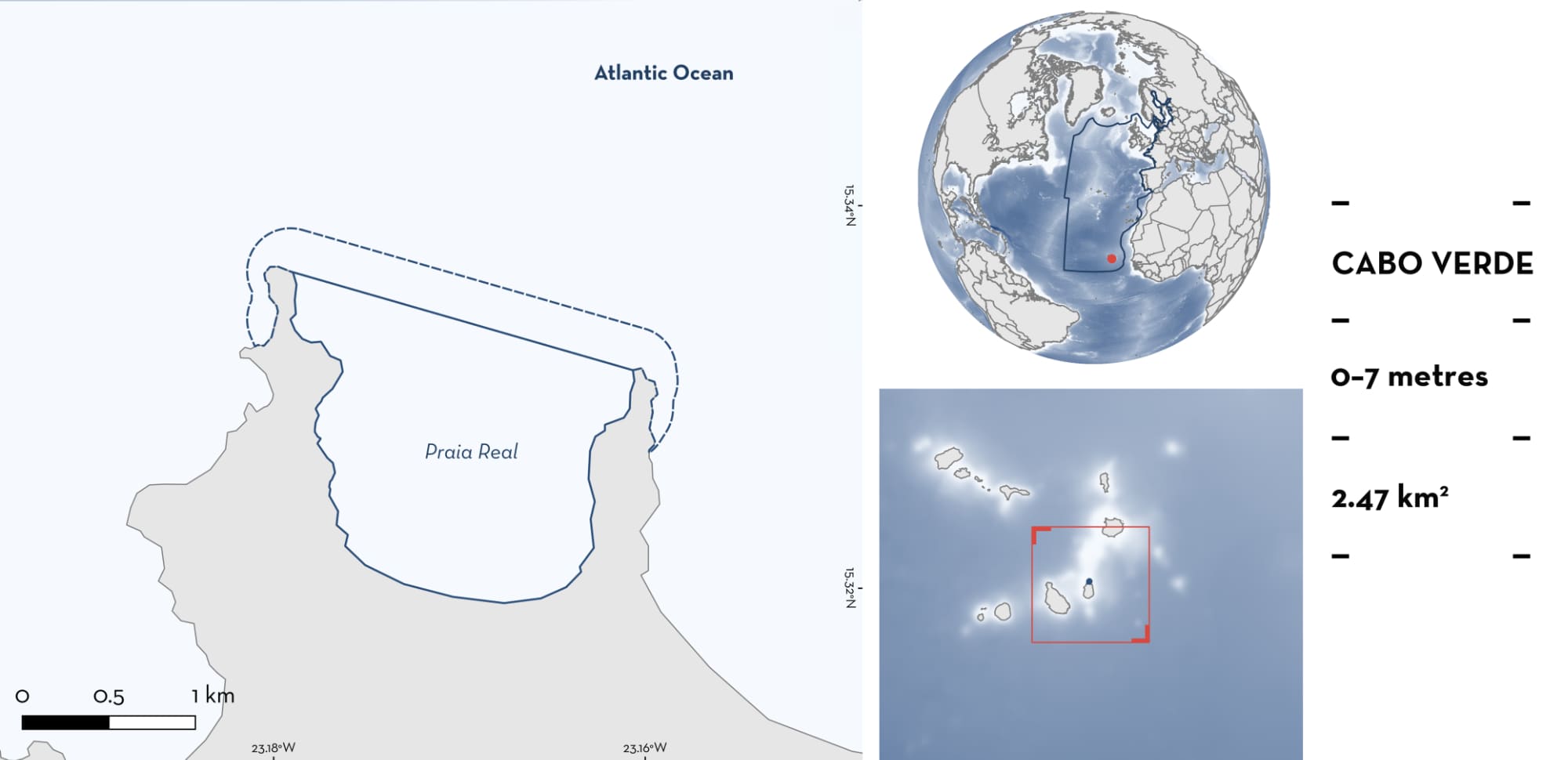
Praia Real is located on the northern coast of Maio island, Cabo Verde. This area is a shallow bay, characterised by a mixed rocky-sandy substrate, with coral, algae, and rhodoliths. Within this area there are: threatened species and reproductive areas (Atlantic Nurse Shark Ginglymostoma cirratum).
Download factsheet
Las Canteras
DESCRIPTION OF HABITAT
Praia Real is located on the northern coast of Maio Island, Cabo Verde. The area is a small, shallow bay characterised by mixed rocky-sandy substrate, with coral, algae, and rhodoliths (Ratão et al. 2023). The bay is exposed to frequent northeast waves at its open entrance, with limited protection from a discontinuous chain of islets between Ponta Cais and Ponta Pipa. This high-energy environment promotes the dislodgement and deposition of large rhodolith limestone slabs within the bay (Johnson et al. 2016). Sea surface temperature between July–November is 26–28°C (Almada 1994).
This Important Shark and Ray Area is benthic and pelagic and is delineated from inshore and surface waters (0 m) to 7 m based on the bathymetry of the area.
CRITERION A
VULNERABILITY
One Qualifying Species considered threatened with extinction according to the IUCN Red List of Threatened Species regularly occurs in the area. This is the Vulnerable Atlantic Nurse Shark (Carlson et al. 2021).
CRITERION C
SUB-CRITERION C1 – REPRODUCTIVE AREAS
Praia Real is an important reproductive area for one shark species.
Between 2014–2017, Atlantic Nurse Sharks were observed in 60.6% of 71 underwater visual surveys (n = 43). Aggregations of 3–10 individuals were recorded in seven surveys and aggregations of 10–15 individuals in two surveys between June–August in this area (Fundação Maio Biodiversidade [FMB] unpubl. data 2014–2018). Indications of copulatory attempts have also been observed as sharks engaged in vigorous, wrestling-like movements in July 2016 and May 2025 (FMB unpubl. data 2014–2018; T Macedo pers. obs. 2025). During a shark tagging survey using beach fishing in October 2015, one pregnant female measuring 215 cm total length (TL; with a distended belly, and visible pups moving) was captured and released (M Dureuil unpubl. data 2015–2016). Additionally, one neonate Atlantic Nurse Shark (24 cm TL) with a fresh umbilical scar was found in a tidal pool in November 2016 during the tagging survey (M Dureuil unpubl. data 2015–2016).
Between 2014–2025, at least 10 Atlantic Nurse Shark egg cases were found each year between September–October along the shoreline in the area (M Dureuil pers. obs. 2014–2025). Embryos within a single female may be at different developmental stages during the first four months. They are enclosed in egg capsules during early gestation (~12–14 weeks). Gestation lasts about five to six months, and parturition occurs over several days. Egg cases may occasionally be expelled during parturition period, indicating that pregnant females utilise this area during mid to late gestation period (Castro 2000).
Although surveys were not initially focused on documenting reproductive behaviour, i.e. there was no focus on identifying if females were pregnant, this area exhibits all known features of reproductive habitats of the species: sandy or seagrass flats, low-lying islands, high temperatures, and shallow waters adjacent to deep areas (Pratt et al. 2022; Bettcher et al. 2023). Elsewhere, breeding grounds in the Caribbean Sea are used mostly by males in May–June, while female occurrence peaks in June and August–September, likely for thermoregulation during gestation (Pratt et al. 2022). In the Southwestern Atlantic, the habitat used during the reproductive season is similar, as well as the months (Bettcher et al. 2023). Acoustic tagging and aerial surveys in this area indicate that Atlantic Nurse Sharks regularly aggregate during the same period.
During 2015–2016, 21 sharks (20 females, 1 male) were acoustically tagged (M Dureuil, FMB, & Biosfera I unpubl. data 2016–2017). Of these, nine females (45%) reappeared 1–2 years later, between June–October. Five tagged females (25%) were also recorded around Santa Luzia and/or São Vicente (~250 km from Maio), with three returning to Maio, reinforcing its reproductive relevance (M Dureuil, FMB, & Biosfera I unpubl. data 2016–2017).
From June 2023 to October 2024, 28 drone surveys (~biweekly, except Dec 2023–Jan 2024) recorded Atlantic Nurse Shark aggregations year-round, but mainly between May–October. In this period, 1,762 individuals were seen in 130 aggregations (3–50 sharks). Between November–April, only 29 individuals and one aggregation of six were recorded. Average shark counts per flight during rising/high tide from June–October reached 90, versus 40 during falling/low tide. While these surveys did not allow to evaluate reproductive behaviour, similar tidal use of pregnant females in breeding grounds has been observed at two Brazilian oceanic islands (V Bettcher Brito pers. obs. 2018–2025).
Download factsheet
SUBMIT A REQUEST
ISRA SPATIAL LAYER REQUEST
To make a request to download the ISRA Layer in either a GIS compatible Shapefile (.shp) or Google Earth compatible Keyhole Markup Language Zipped file (.kmz) please complete the following form. We will review your request and send the download details to you. We will endeavor to send you the requested files as soon as we can. However, please note that this is not an automated process, and before requests are responded to, they undergo internal review and authorization. As such, requests normally take 5–10 working days to process.
Should you have questions about the data or process, please do not hesitate to contact us.