ISRA FACTSHEETS
ISRA FACTSHEETS
EUROPEAN ATLANTIC
Luce Bay
Summary
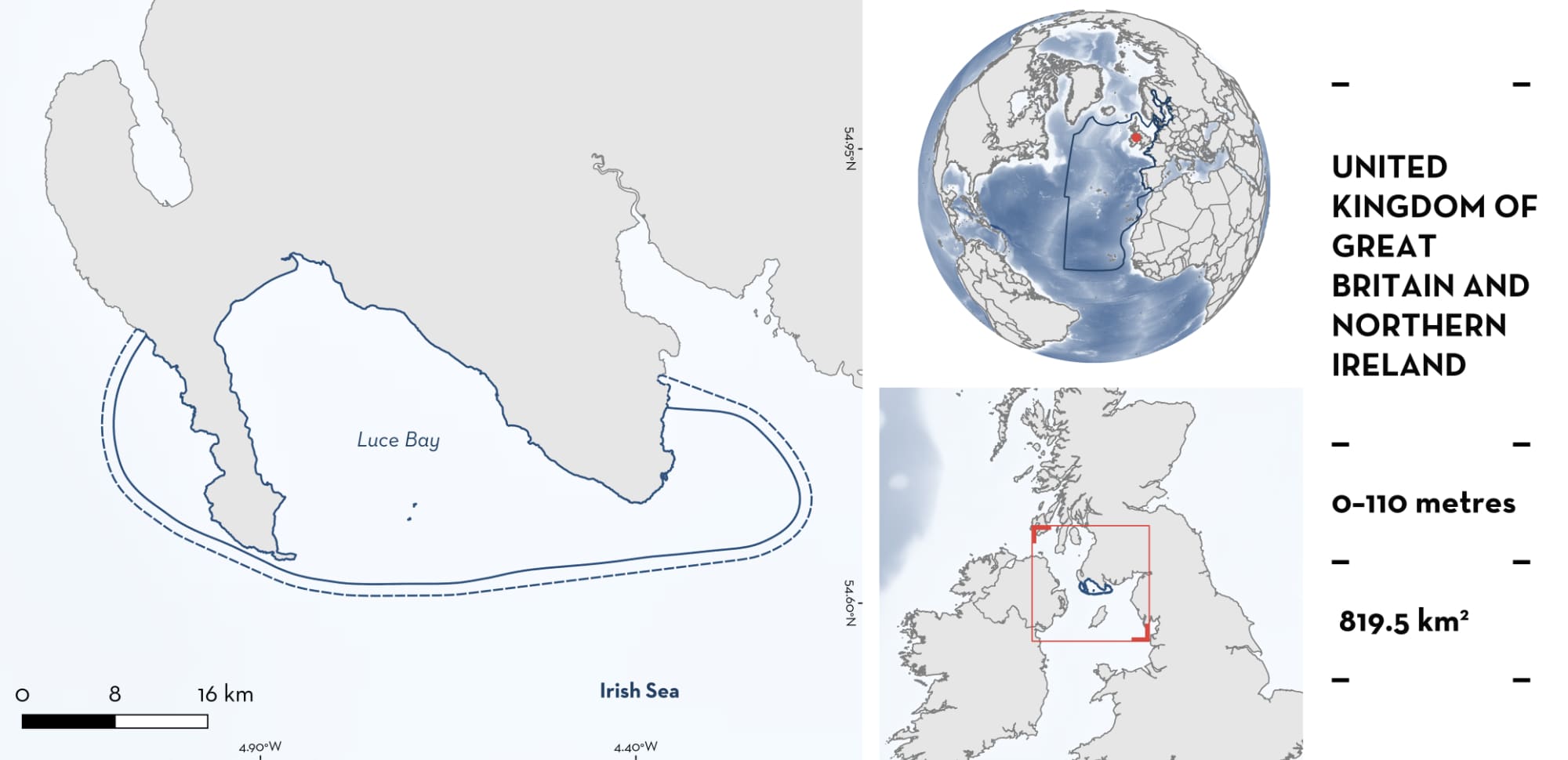
Luce Bay is located on the southwest coast of Scotland, United Kingdom of Great Britain and Northern Ireland. The area is characterised by mud, sand, gravel, and rocky outcrops. It is influenced by strong tidal currents, salinity gradients, and seasonal stratification. This area overlaps with The Scallops (Luce Bay) protected area. Within this area there are: threatened species and undefined aggregations (Tope Galeorhinus galeus).
Download factsheet
Luce Bay
DESCRIPTION OF HABITAT
Luce Bay is located on the southwest coast of Scotland, United Kingdom of Great Britain and Northern Ireland. It is situated within the Mull of Galloway and the northern Irish Sea. This area is characterised by a continental shelf which is influenced by complex oceanographic processes, varied seabed topography, and a broad range of interconnected habitats. The area is also characterised by a patchwork of sedimentary and hard substrates. Extensive mud, sand, and gravel areas are interspersed with boulder fields, rocky outcrops, and shell-rich deposits (Smith et al. 2020).
Oceanographic conditions are driven by strong semi-diurnal tides, which generate significant current flows through channels and around headlands. These tidal forces promote water column mixing, enhance nutrient cycling, and maintain generally well-oxygenated conditions, although areas of seasonal thermal stratification can develop in deeper or more sheltered parts. Salinity and temperature gradients are influenced by Atlantic inflows and freshwater inputs from major river systems, notably from Northern Ireland and northwest England. The area is also influenced by seasonal phytoplankton blooms that underpin a high biomass of zooplankton.
This area overlaps with The Scallops (Luce Bay) protected area (Scottish Statutory Instruments 2025).
This Important Shark and Ray Area is benthic and pelagic and delineated from inshore and surface waters (0 m) to a depth of 110 m based on the bathymetry of the area and the depth range of Qualifying Species in the area.
CRITERION A
VULNERABILITY
One Qualifying Species considered threatened with extinction according to the IUCN Red List of Threatened Species regularly occurs in the area. This is the Critically Endangered Tope (Walker et. al. 2020).
CRITERION C
SUB-CRITERION C5 – UNDEFINED AGGREGATIONS
Luce Bay is an important area for undefined aggregations of one shark species.
This area has one of the highest densities among Tope hotspots around the United Kingdom of Great Britain and Northern Ireland and is a well-known location among sportfishers for Tope angling (Thorburn et al. 2019; Scottish Shark Tagging Programme unpubl. data. 2025). Tope are known to exhibit aggregation behaviour around the world (Drake et al. 2005; McCord 2005; Bovcon et al. 2018), including for reproductive purposes. Anglers describe this area as being amongst the, if not the, best locations for Tope angling with no chumming needed during trips because of the number of animals present during the fishing season. The number of Tope caught here is greater and more frequent than in adjacent areas based on tagging and recreational angling data.
Between 1994–2012, Tope were caught on rod-and-line, tagged, released, and reported to the Scottish Shark Tagging project (Scottish Shark Tagging Programme unpubl. data. 2025). Trips were either from shore or from a boat and were limited to a few hours per day (up to ~8 hours). The number of anglers reporting in this area between 1994–2009 ranged between 1–8, and 10–26 in 2010 and 2011. Between 1994–2009, three or more Tope were caught in one day on 118 instances: 1994 (n = 3 days), 1995 (n = 5), 1996 (n = 4), 1997 (n = 4), 1998 (n = 3), 1999 (n = 4), 2000 (n = 9), 2001 (n = 10), 2002 (n = 30), 2003 (n = 7), 2005 (n = 9), 2006 (n = 16), 2007 (n = 6), and 2009 (n = 8). Further, ten or more Tope were caught in one day on 18 instances: 1997 (n = 1 day), 2000 (n = 1 day), 2001 (n = 3), 2002 (n = 8), 2005 (n = 1), 2006 (n = 1), and 2009 (n = 3). Between 2010–2011, three or more Tope were caught in one day on 64 instances (2010 = 27 days; 2011 = 37 days). Further, ten or more Tope were caught in one day on 12 instances (2010 = 5 days; 2011 = 7 days). The highest number of Tope caught in one day was 107 individuals in 2010 (Scottish Shark Tagging Programme unpubl. data 2025). In addition, recreational anglers continue to share high catches of Tope within this area on social media. For example, ~100 Tope were caught in one day of angling in June 2025. The function of these aggregations may be for reproductive purposes based on observations of Tope releasing milt on-deck (possible evidence of courtship), mating scars, and pregnant females. Further, tagging data shows that Tope demonstrates a cyclical return to this location, which is more pronounced during the boreal summer and autumn months (Thorburn et al. 2019). However, further information is needed to understand the nature and function of these aggregations.
Download factsheet
SUBMIT A REQUEST
ISRA SPATIAL LAYER REQUEST
To make a request to download the ISRA Layer in either a GIS compatible Shapefile (.shp) or Google Earth compatible Keyhole Markup Language Zipped file (.kmz) please complete the following form. We will review your request and send the download details to you. We will endeavor to send you the requested files as soon as we can. However, please note that this is not an automated process, and before requests are responded to, they undergo internal review and authorization. As such, requests normally take 5–10 working days to process.
Should you have questions about the data or process, please do not hesitate to contact us.