ISRA FACTSHEETS
ISRA FACTSHEETS
EUROPEAN ATLANTIC
Isles of Scilly Archipelago
Summary
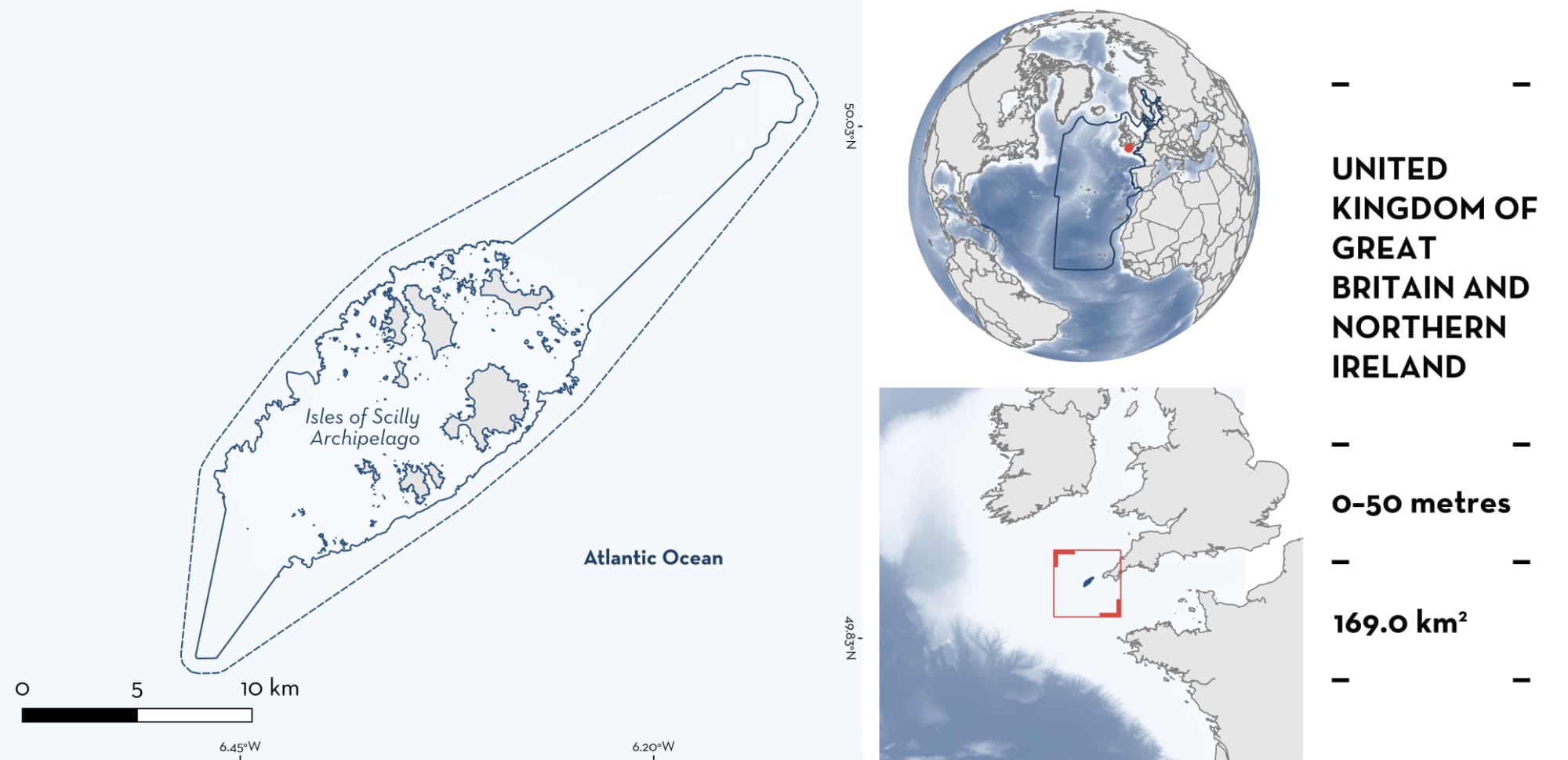
Isles of Scilly Archipelago is located ~40 km off the southwestern corner of the British Isles in the United Kingdom of Great Britain and Northern Ireland. This archipelago lies within a biogeographic transition zone between the warm and cold temperate waters of the Northeast Atlantic Ocean. It is strongly influenced by coastal processes and oceanic currents, including the Gulf Stream. The habitat encompasses both warm and cool temperate species, including seagrass beds, kelp forests, subtidal sediments, and extensive circalittoral reefs. The area overlaps with the Isles of Scilly Ramsar Site. Within this area there are: reproductive areas and resting areas (Smallspotted Catshark Scyliorhinus canicula).
Download factsheet
Isles of Scilly Archipelago
DESCRIPTION OF HABITAT
Isles of Scilly Archipelago is located ~40 km from the western tip of Cornwall in the United Kingdom of Great Britain and Northern Ireland, in the Northeast Atlantic Ocean. The archipelago consists of over 300 islands and rocky outcrops, only five of which are inhabited. The area is on the continental shelf and is surrounded by relatively shallow waters (<150 m in depth) that are exposed to strong North Atlantic Ocean pelagic currents, including the Gulf Stream, which provides consistent nutrient-rich upwelled waters supporting high primary productivity (Exeter et al. 2024).
The archipelago is situated in a biogeographic transition zone between warm and cold temperate waters and is ecologically distinct regionally. It supports warm temperate water habitats and habitat-forming species at the northerly extent of their distribution that are rarely found in the wider British Isles, as well as cold-water habitat and habitat-forming species that are uncommon on mainland western Europe. The habitat includes one of the largest seagrass beds (Common Eelgrass Zostera marina) in the United Kingdom, kelp forests, subtidal sediments, and extensive circalittoral reefs supporting cold-water coral and sponge communities. The influence of pelagic currents additionally means that pelagic habitats and associated plankton communities occur within proximity to the islands and in relatively shallow depths (Exeter et al. 2024).
This area overlaps with the Isles of Scilly Ramsar Site (Wetland of International Importance; Ramsar 2001).
This Important Shark and Ray Area is benthic and pelagic and is delineated from inshore and surface waters (0 m) to 50 m based on the bathymetry of the area.
CRITERION C
SUB-CRITERION C1 – REPRODUCTIVE AREAS
Isles of Scilly Archipelago is an important reproductive area for one shark species.
A stereo Baited Remote Underwater Video Station (BRUVS) study selected 32 of 280 deployments made in this area between May–September in 2022 and 2023 for behavioural analyses (Vickers 2024; Exeter et al. in press). Eight samples were from each of four habitat types: infralittoral rock, seagrass, circalittoral rock, and subtidal sediment. Evidence of courtship behaviour was observed for Smallspotted Catsharks. Courtship was defined by sequences of males repetitively biting and escorting avoidant females and these events had a mean duration of 00:17 ± 00:18 (standard deviation). While courtship accounted for just 1.7% (n = 54) of all behavioural observations, it contributed mean proportions of 3.4 ± 11.7% and 8.1 ± 17.1% to their time budgets in infralittoral rock and subtidal sediments, respectively (Vickers 2024). These are likely to be the first recorded observations of Smallspotted Catshark courtship behaviour globally (Vickers 2024), highlighting the importance of this area for the reproduction of Smallspotted Catsharks. Additionally, the 280 BRUVS deployments made in this area recorded aggregations of two or more individuals in 74 instances (49.3% of deployments with a Smallspotted Catshark record). Aggregations were based on MaxN, which is the maximum number of individuals within any one frame per deployment, with a maximum aggregation of eight individuals in this area. The mean aggregation size recorded was 2.7 ± 1.0 individuals. The species is well known to aggregate (Jacoby et al. 2012) and most of the measured individuals (n = 169 of 182) were adults, based on a size-at-maturity for the species of >52 cm TL (Ebert et al. 2021; O Exeter et al. unpubl. data 2025). Aggregations are more frequent and contain more individuals in this area compared to other regional and national studies that also used baited cameras (Griffin et al. 2016; Clark et al. 2024; Exeter et al. in press; C Laing & P Doherty unpubl. data 2025). Of all national or regional BRUVS studies that reported abundance and/or aggregation data, the largest aggregation of Smallspotted Catsharks was just two (highest MaxN), compared to eight in this area. Similarly, the frequency of aggregations was lower elsewhere, for example just 13% in mainland Cornwall ~80 km east of this area (C Laing & P Doherty unpubl. data 2025). The comparatively larger and more frequent aggregations of adults in this area show that there is a high potential for courtship and mating in Isles of Scilly Archipelago, highlighting its importance.
CRITERION C
SUB-CRITERION C3 – RESTING AREAS
Isles of Scilly Archipelago is an important resting area for two shark species.
A BRUVS study selected 32 of 280 deployments made in this area between May–September in 2022 and 2023 for behavioural analyses (Vickers 2024; O Exeter et al. unpubl. data 2025). While the main behaviours for Smallspotted Catsharks were parading, swimming, or feeding, there was also evidence of resting behaviour, observed for 25 of an estimated 82 individuals (~30%). The main habitat associated with resting in the species was infralittoral rock areas, in which 9.6% of behavioural observations were for resting (Vickers 2024). This habitat is concentrated in Isles of Scilly Archipelago, with deeper water surrounding it and extending to the nearest coast ~40 km east in Cornwall.
Download factsheet
SUBMIT A REQUEST
ISRA SPATIAL LAYER REQUEST
To make a request to download the ISRA Layer in either a GIS compatible Shapefile (.shp) or Google Earth compatible Keyhole Markup Language Zipped file (.kmz) please complete the following form. We will review your request and send the download details to you. We will endeavor to send you the requested files as soon as we can. However, please note that this is not an automated process, and before requests are responded to, they undergo internal review and authorization. As such, requests normally take 5–10 working days to process.
Should you have questions about the data or process, please do not hesitate to contact us.