ISRA FACTSHEETS
ISRA FACTSHEETS
EUROPEAN ATLANTIC
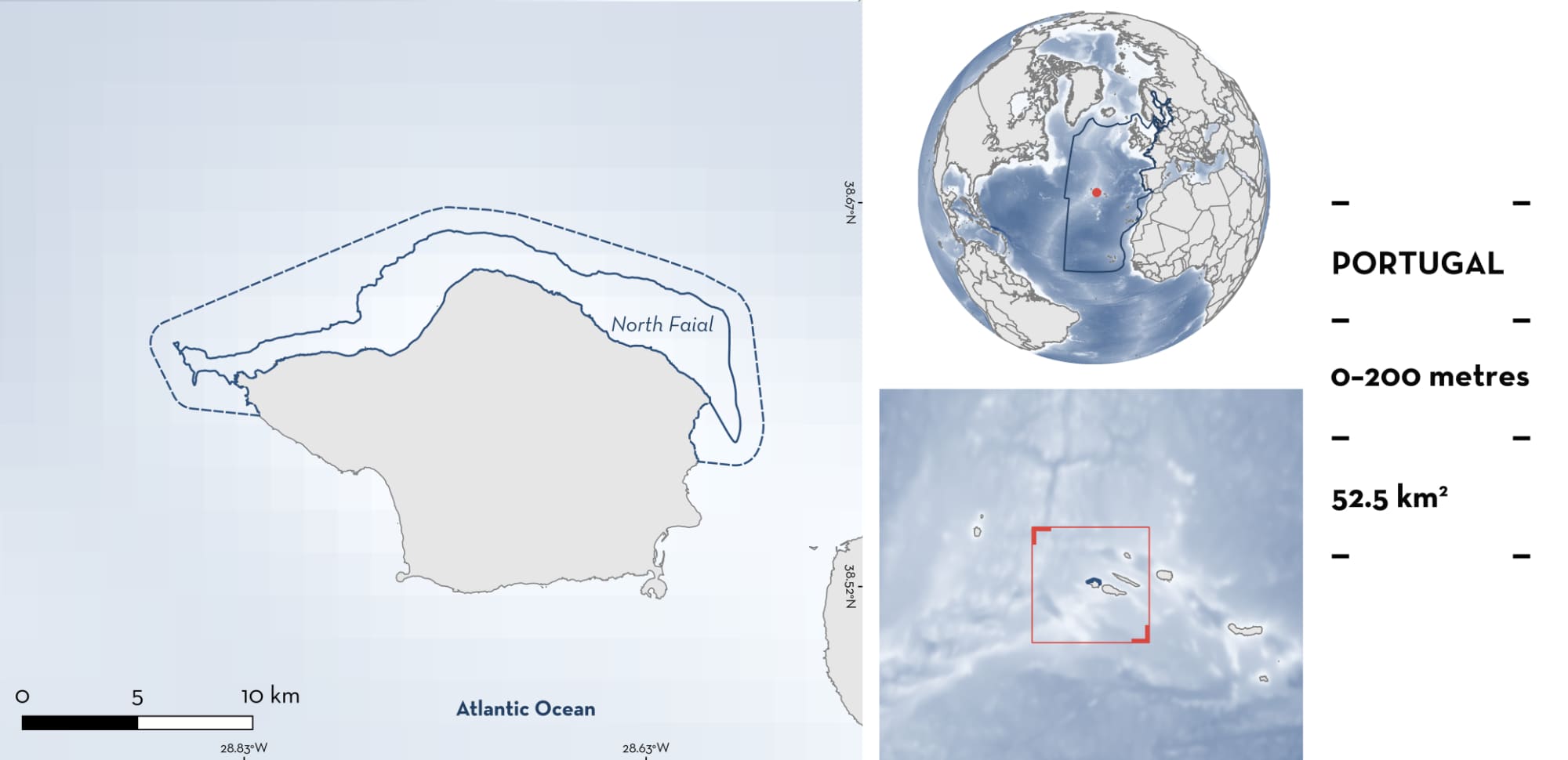
North Faial
Summary
North Faial is located in the Azores Archipelago, Portugal. The area is characterised by sandy substrate and rocky basaltic reef resulting from volcanic eruptions and the dismantling of the steep shores. The shoreline is typically subjected to high swells throughout the year and especially during the boreal autumn–winter. Within this area there are: threatened species and reproductive areas (Smooth Hammerhead Sphyrna zygaena).
Download factsheet
North Faial
DESCRIPTION OF HABITAT
North Faial is located on the northern coast of Faial Island in the Azores Archipelago, Portugal. The area is characterised by sandy substrate and rocky basaltic reef resulting from volcanic eruptions and the dismantling of the steep shores, with the tidal regime largely determining the local scale circulation pattern (Afonso et al. 2022). The shoreline is typically subjected to high swells throughout the year and especially during the boreal autumn–winter.
The island’s coastal habitats are greatly influenced by the region’s ecotone position and dominant oceanographic regime whereby the southern branch of the warm Gulf Current, which passes south of the islands, and its eddies and filaments, promote a dynamic sub-tropical influence on its warm-temperate characteristics (Santos et al. 1995; Afonso et al. 2020).
This Important Shark and Ray Area is pelagic and is delineated from inshore and surface waters (0 m) to a depth of 200 m based on the depth range of habitat in the area.
CRITERION A
VULNERABILITY
One Qualifying Species considered threatened with extinction according to the IUCN Red List of Threatened Species regularly occurs in the area. This is the Vulnerable Smooth Hammerhead (Rigby et al. 2019).
CRITERION C
SUB-CRITERION C1 – REPRODUCTIVE AREAS
North Faial is an important reproductive area for one shark species.
Based on scientific fishing, Baited Remote Underwater Video Station (BRUVS) surveys, and telemetry, North Faial has been identified as a nursery area for Smooth Hammerhead (Afonso et al. 2022; Das et al. 2025). These data sources demonstrate repeated use of this area by neonates, young-of-the-year (YOY), and small juveniles over multiple years, evidence of aggregation, and higher presence and residency within this area than in the adjacent areas year-round and seasonally, therefore meeting all criteria for defining shark nursery areas (Heupel et al. 2007).
Aggregations of 3–20 small juvenile Smooth Hammerheads swimming at the surface are known to occur in this area during summer (P Afonso pers. obs. 2010–2025). Between October 2018–November 2019, 53 Smooth Hammerheads (54–159 cm total length [TL]) were caught in scientific longline sets (20 benthic and 1 pelagic) within this area (˜2.8 km off the coast). Of these, 17 were neonates/YOY (54–80 cm TL), representing 32.1% of the total catch (Das et al. 2025). Size-at birth for Smooth Hammerhead is 49–63 cm TL (Ebert et al. 2021). Additionally, one pregnant female was reportedly caught inshore in North Faial by a fixed gillnet in August 1997 (P Afonso pers. obs. 2025). Smooth Hammerheads >200 cm TL are only occasionally seen nearshore, always isolated, and only in the summer (Afonso et al. 2022). This evidence suggests that pregnant females come to give birth within the area and that neonates stay within the island shelf until reaching pre-adulthood life stage (Afonso et al. 2022)
Between 2018–2022, 589 benthic and pelagic BRUVS were deployed around eight islands of the Azores Archipelago, of which 185 were within this area. This area had a significantly higher relative abundance of Smooth Hammerheads. The highest MaxN (maximum number of individuals of a species observed in a single frame) per year ranged from 3–14 in this area (Afonso et al. 2022; Das et al. 2025). Stereo measurements of sharks were possible in 64 deployments. Neonates and YOY (<80 cm TL) were identified in four of the eight sampled islands (n = 20 deployments; 7 within this area). The MaxN of neonates and YOY was three and was recorded in three deployments, of which two were within this area.
Between 2010 and 2019, 15 juvenile Smooth Hammerhead (90–147 cm TL) were tagged between July–September with acoustic tags and satellite (SPOT) tags (Afonso et al. 2022). Smaller sharks (80–90 cm TL) were also captured but released as tagging was focused on larger individuals due to tag size (P Afonso et al. pers. obs. 2010–2019). Thirteen of the 15 acoustic transmitters were detected on the array of acoustic receivers on the Faial-Pico shelf (the shelf area surrounding Faial Island and the adjacent Pico Island). Only data from nine transmitters were used based on uncertainty of natural behaviour of six individuals (possibly predated). Tagged individuals were co-detected at stations on the north coast of Faial Island at the same hour on up to 1,398 occasions (n = 2–6 individuals), thereby providing support that small juveniles aggregate and remain within this area (Afonso et al. 2022). All acoustically tagged sharks showed greater site fidelity and resulting home ranges centred on this area with no detections on receivers in adjacent areas (Afonso et al. 2022). Finally, all five transmitting SPOT-tagged individuals revealed a constant moving pattern over the northern island shelf of Faial for months even when away from the acoustic receiver detection range (Afonso et al. 2022). Finally, tagging undertaken between 2019–2025, which included YOY individuals, also shows increased residency along the north shore of Faial, despite individuals eventually moving out over the contiguous shelf of Faial and Pico islands on a regular basis (Priester et al. unpubl. data 2025).
Download factsheet
SUBMIT A REQUEST
ISRA SPATIAL LAYER REQUEST
To make a request to download the ISRA Layer in either a GIS compatible Shapefile (.shp) or Google Earth compatible Keyhole Markup Language Zipped file (.kmz) please complete the following form. We will review your request and send the download details to you. We will endeavor to send you the requested files as soon as we can. However, please note that this is not an automated process, and before requests are responded to, they undergo internal review and authorization. As such, requests normally take 5–10 working days to process.
Should you have questions about the data or process, please do not hesitate to contact us.