ISRA FACTSHEETS
ISRA FACTSHEETS
EUROPEAN ATLANTIC
São Roque Bay
Summary
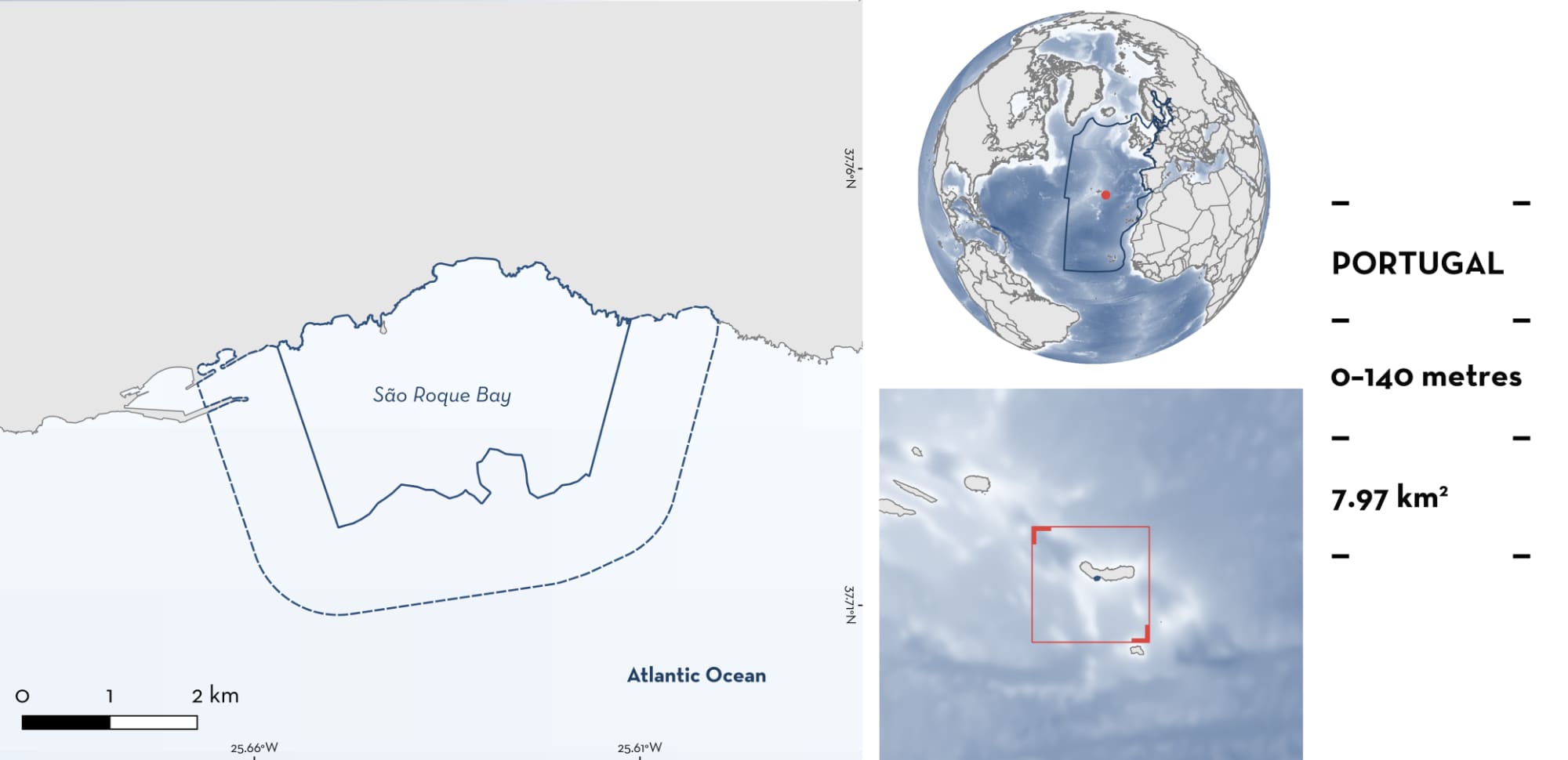
São Roque Bay is located on the coast of southern São Miguel Island in the Azores Archipelago, Portugal. The area is sheltered from wave action and swell. The substrate is characterised by compact bedrock, patches of sand, and rocks. Within this area there are: threatened species (e.g., Common Eagle Ray Myliobatis aquila); and reproductive areas (e.g., Common Stingray Dasyatis pastinaca).
Download factsheet
São Roque Bay
DESCRIPTION OF HABITAT
São Roque Bay is located on the coast of southern São Miguel Island in the Azores Archipelago, Portugal. In the Azores, most coastal shores are subject to swell and surge most of the year and only a few bays and harbours are sheltered (Neto et al. 2021). The northern coast of São Miguel is more exposed to the effects of wave action and swell (Neto 2001) while the southern coast, including São Roque Bay, is more sheltered. This area comprises a bay enclosing relatively shallow waters (Neto 2001) with steeply sloping compact bedrock of hard basaltic rock. At greater depths, patches of sand are overlain by rocks (Neto 2001).
The Azores Archipelago is located between two major oceanic currents: the North Atlantic Current to the north and the Azores Current to the south. The latter is associated with the thermohaline Azores Front, which marks the boundary between the colder, fresher waters of the eastern North Atlantic and the relatively warmer, more saline subtropical waters to the south (Tokat et al. 2024). Sea surface temperatures in São Miguel Island typically range from 22.0–22.5°C in the boreal summer, and 15.5–16.0°C in winter (Tokat et al. 2024).
This Important Shark and Ray Area is benthic and pelagic and is delineated from inshore and surface waters (0 m) to 140 m based on the depth range of habitat in the area.
CRITERION A
VULNERABILITY
Two Qualifying Species considered threatened with extinction according to the IUCN Red List of Threatened Species regularly occur in the area. These are the Critically Endangered Common Eagle Ray (Jabado et al. 2021a) and the Vulnerable Common Stingray (Jabado et al. 2021b).
CRITERION C
SUB-CRITERION C1 – REPRODUCTIVE AREAS
São Roque Bay is an important reproductive area for two ray species.
During February–September 2008, 25 research dives were conducted on São Miguel Island with the goal to identify ray species. Of these dives, 12 were undertaken within this area (Garcia 2008). Additionally, between April–October 2024, the Elasmobase Project recorded visual counts of sharks and rays via citizen science SCUBA dives across 28 dive sites. A total of 767 dives were monitored totalling 591.4 hours across the Azores. Of these, nine dive sites and 597 dives totalling 454.7 hours (65.4% of overall dive time) were within this area (Elasmobase unpubl. data. 2024).
Common Stingrays (n = 23; estimated to measure 20–100 cm [DW]) were recorded from February–September 2008, of which 20 (86.9%) were in this area (Garcia 2008). Of the 23 Common Stingrays, seven were 20–35 cm DW (June–September), six of which were from within this area (85.6%) (Garcia 2008). Between April–October 2024, 300 Common Stingrays were reported on 163 dives within this area (27.3% of dives in this area), of which at least 44 were determined to be pregnant (reported on 40 dives from May–October), inferred by observations of distended abdomens. In addition, 13 neonates/young-of-the-year (YOY) (~30 cm DW) were reported on 12 dives (Elasmobase unpubl. data. 2024). Size-at-one-year-old for Common Stingrays is 23 cm DW for males and 31 cm DW for females (Yeldan et al. 2008). Common Stingrays were regularly seen in aggregations of 3–9 individuals and were reported on 32 dives (5.4% of dives in this area) between June–October. In the 19 dive sites outside of São Roque Bay, eight neonates/YOY were reported (on six dives), four aggregations of 3–4 individuals, and no pregnant females were documented, highlighting the importance of São Roque Bay for Common Stingray reproduction (Elasmobase unpubl. data. 2024). Diving in this area occurs primarily during the summer months, and according to the diving community, aggregations, pregnant females, and neonates were regularly and predictably observed from 2018–2023 (Elasmobase unpubl. data. 2018–2023). Across several sites in the Mediterranean Sea, aggregations of pregnant and mature male Common Stingray are recorded in early summer, pregnant females with fully developed foetuses have been captured in June, and neonates are observed during the end of June and early July (Saadaoui et al. 2015; Grancagnolo et al. 2023). These observations are similar to the findings from this area suggesting a regional pattern in reproductive behaviour.
Between June–August 2008, seven Common Eagle Rays (40–70 cm DW) were recorded (Garcia 2008). Four were within this area (one estimated at 40 cm DW and three between 50–70 cm DW) and three outside the area in three different regions (one at 40 cm DW and two between 60–70 cm DW) (Garcia 2008). Additionally, in 2024, Common Eagle Rays were recorded on 88 of the 597 dives in this area (14.7%) (Elasmobase unpubl. data. 2024). Of 107 individuals observed, 64 were considered neonates/YOY as their visually estimated size ranged 15–30 cm DW and YOY Common Eagle Rays are 35–40 cm DW (Özten et al. 2024). Neonates were recorded only between May–August and represented 33.7% of observations during this period (n = 29). Outside this area, four neonates (20–30 cm DW observed in July) and seven YOY (40 cm DW observed May–August) were recorded (out of 21 individuals recorded on 20 dives) (Elasmobase unpubl. data. 2024). In France and Tunisia, mature females and neonates have been reported between August and February, aligning with the observations within this area (Capapé et al. 2007). Diving in this area occurs primarily during the summer months, and according to the diving community, aggregations, and neonates were consistently observed from 2018–2023 (Elasmobase unpubl. data. 2018–2023).
Download factsheet
SUBMIT A REQUEST
ISRA SPATIAL LAYER REQUEST
To make a request to download the ISRA Layer in either a GIS compatible Shapefile (.shp) or Google Earth compatible Keyhole Markup Language Zipped file (.kmz) please complete the following form. We will review your request and send the download details to you. We will endeavor to send you the requested files as soon as we can. However, please note that this is not an automated process, and before requests are responded to, they undergo internal review and authorization. As such, requests normally take 5–10 working days to process.
Should you have questions about the data or process, please do not hesitate to contact us.