ISRA FACTSHEETS
ISRA FACTSHEETS
EUROPEAN ATLANTIC
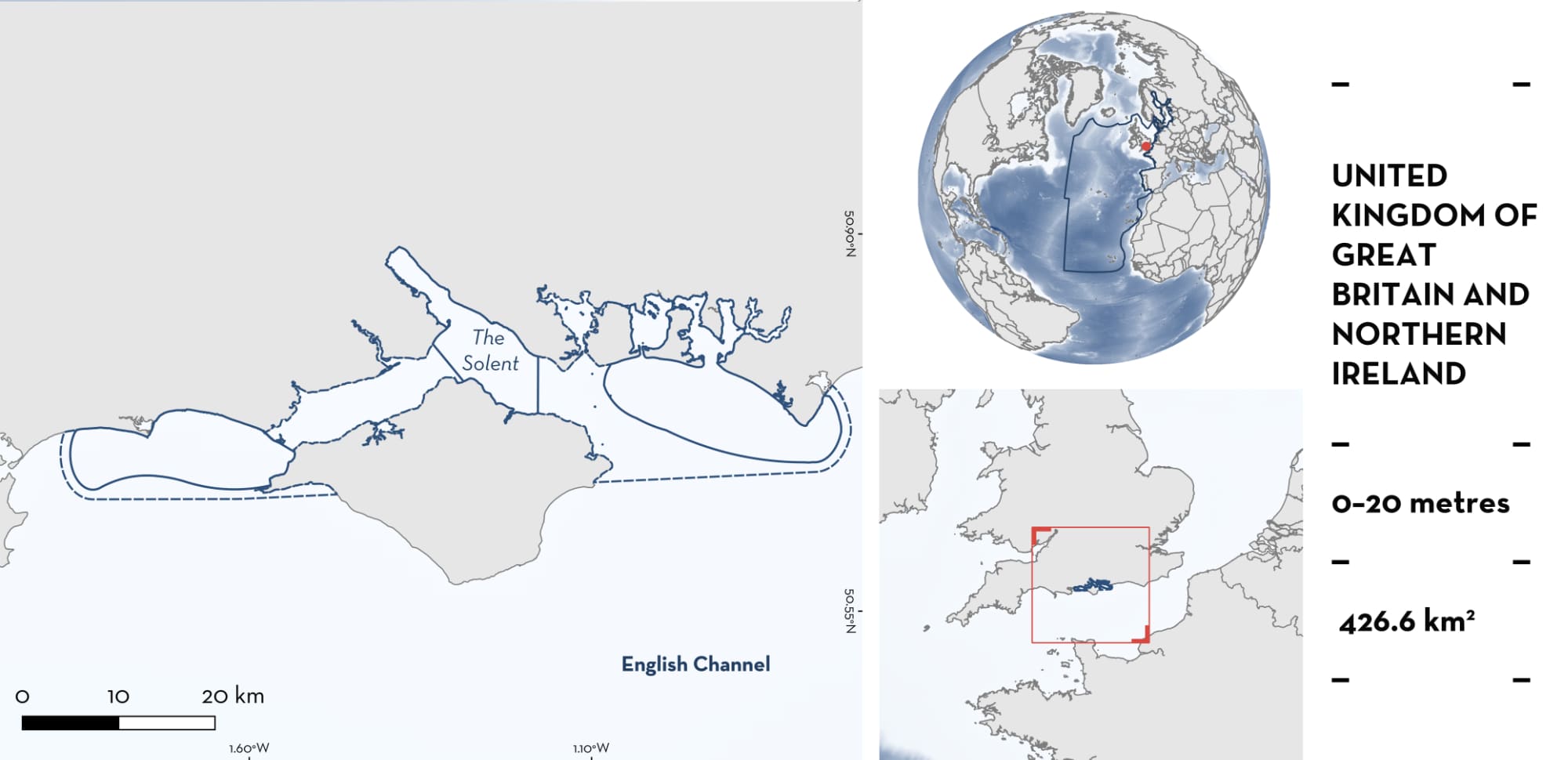
The Solent
Summary
The Solent is located on the south coast of England, United Kingdom of Great Britain and Northern Ireland. The area is situated between England and the Isle of Wight. It is characterised by muddy substrates and seagrass beds. The area is an estuarine system and a tidal strait that is influenced by large tidal ranges. The area overlaps with the Solent and Southampton Water Ramsar Site. Within this area there are: reproductive areas (e.g., Starry Smoothhound Mustelus asterias).
Download factsheet
The Solent
DESCRIPTION OF HABITAT
The Solent is located on the southern coast of England, United Kingdom of Great Britain and Northern Ireland. This split area encompasses three parts of the area separating England from the Isle of Wight. The eastern extent includes Selsey Bill. The habitat is characterised by muddy substrates, and seagrass beds (in Colwell Bay, Medina, and Osborne Bay).
The area is an estuarine system influenced by significant tidal ranges and the English Channel (National Coast Watch 2025). The Solent is a tidal strait, whereby the influence of the English Channel creates strong tidal streams at places like Hurst Narrows and the Needles Channel.
The area overlaps with the Solent and Southampton Water Ramsar Site (Wetland of International Importance; Ramsar 2025).
This Important Shark and Ray Area is benthic and pelagic and is delineated from inshore and surface waters (0 m) to a depth of 20 m based on the bathymetry of the area.
CRITERION C
SUB-CRITERION C1 – REPRODUCTIVE AREAS
The Solent is an important reproductive area for one shark and one ray species.
Early life stages of Starry Smoothhound and Thornback Skate are regularly and predictably observed, year-to-year, in this area (Ellis et al. 2012, 2024; ICES 2025). Data from the Eastern Channel beam trawl survey (2010–2024) were analysed (ICES 2025) which uses a four-metre beam trawl to survey the southeast coast of England, usually in July. Data are available for each of the 48 survey stations within this area. The size threshold for young-of-the-year (YOY) individuals of each species was supported by analysis of catch data from across the United Kingdom of Great Britain and Northern Ireland (J Ellis & S McCully Phillips pers. obs. 2025).
Overall, 225 neonate/YOY Starry Smoothhounds measuring ≤45 cm total length (TL) were caught in this area. These were caught at 42 fixed survey stations within this area. Size-at-birth for this species is reported at 28–32 cm TL (Ebert et al. 2021). Neonate/YOY Starry Smoothhounds were recorded in 2011 (n = 3), 2013 (n = 6), 2014 (n = 6), 2015 (n = 8), 2016 (n = 28), 2017 (n = 17), 2018 (n = 16), 2019 (n = 21), 2020 (n = 31), 2021 (n = 24), 2023 (n = 14), and 2024 (n = 51). During this period, the number of years that neonate/YOY Starry Smoothhounds were recorded ranged from 1–6 years across stations. The number of neonate/YOY Starry Smoothhounds caught in The Solent was greater than in adjacent surveyed areas and is the largest known hotspot on the south coast of England. In addition, anglers report that males are usually found within this area, and females are caught outside of The Solent (Angling for Sustainability 2024). Still, one pregnant female was caught whilst tagging in 2024 and exhibited early signs of pregnancy (10 differentiated intra-uterine egg yolks) as shown by an ultrasound scan (C Renn pers. obs. 2025). Further, YOY and pregnant Starry Smoothhounds are known to be present in this area through local ecological knowledge (A Hall pers. obs. 2025).
Overall, 115 neonate/YOY Thornback Skates measuring ≤33 cm TL were caught at 42 fixed survey stations within this area. Size-at-birth for this species is reported at ~10–13 cm TL (Last et al. 2016), with individuals up to 30 cm TL being considered neonate/YOY in other regions (Alkusairy 2019). Neonate/YOY Thornback Skates were recorded in 2011 (n = 5), 2013 (n = 8), 2014 (n = 26), 2015 (n = 6), 2016 (n = 8), 2017 (n = 13), 2018 (n = 12), 2019 (n = 5), 2020 (n = 1), 2021 (n = 13), 2023 (n = 6), and 2024 (n = 12). During this period, the number of years that neonate/YOY Thornback Skates were recorded ranged from 1–4 years across stations. The number of neonate/YOY Thornback Skate caught in The Solent was greater than in adjacent surveyed areas, and the second largest known hotspot on the south coast of England.
Download factsheet
SUBMIT A REQUEST
ISRA SPATIAL LAYER REQUEST
To make a request to download the ISRA Layer in either a GIS compatible Shapefile (.shp) or Google Earth compatible Keyhole Markup Language Zipped file (.kmz) please complete the following form. We will review your request and send the download details to you. We will endeavor to send you the requested files as soon as we can. However, please note that this is not an automated process, and before requests are responded to, they undergo internal review and authorization. As such, requests normally take 5–10 working days to process.
Should you have questions about the data or process, please do not hesitate to contact us.