ISRA FACTSHEETS
ISRA FACTSHEETS
EUROPEAN ATLANTIC
Galway Bay
Summary
Galway Bay is located on the west coast of Ireland. The area contains a diverse mosaic of benthic habitats, including rock, gravel, fine sand, sandy mud, and deep mud substrates, as well as maerl, oyster, and seagrass beds. The area overlaps with four Key Biodiversity Areas. Within this area there are: threatened species and undefined aggregations (Porbeagle Lamna nasus).
Download factsheet
Galway Bay
DESCRIPTION OF HABITAT
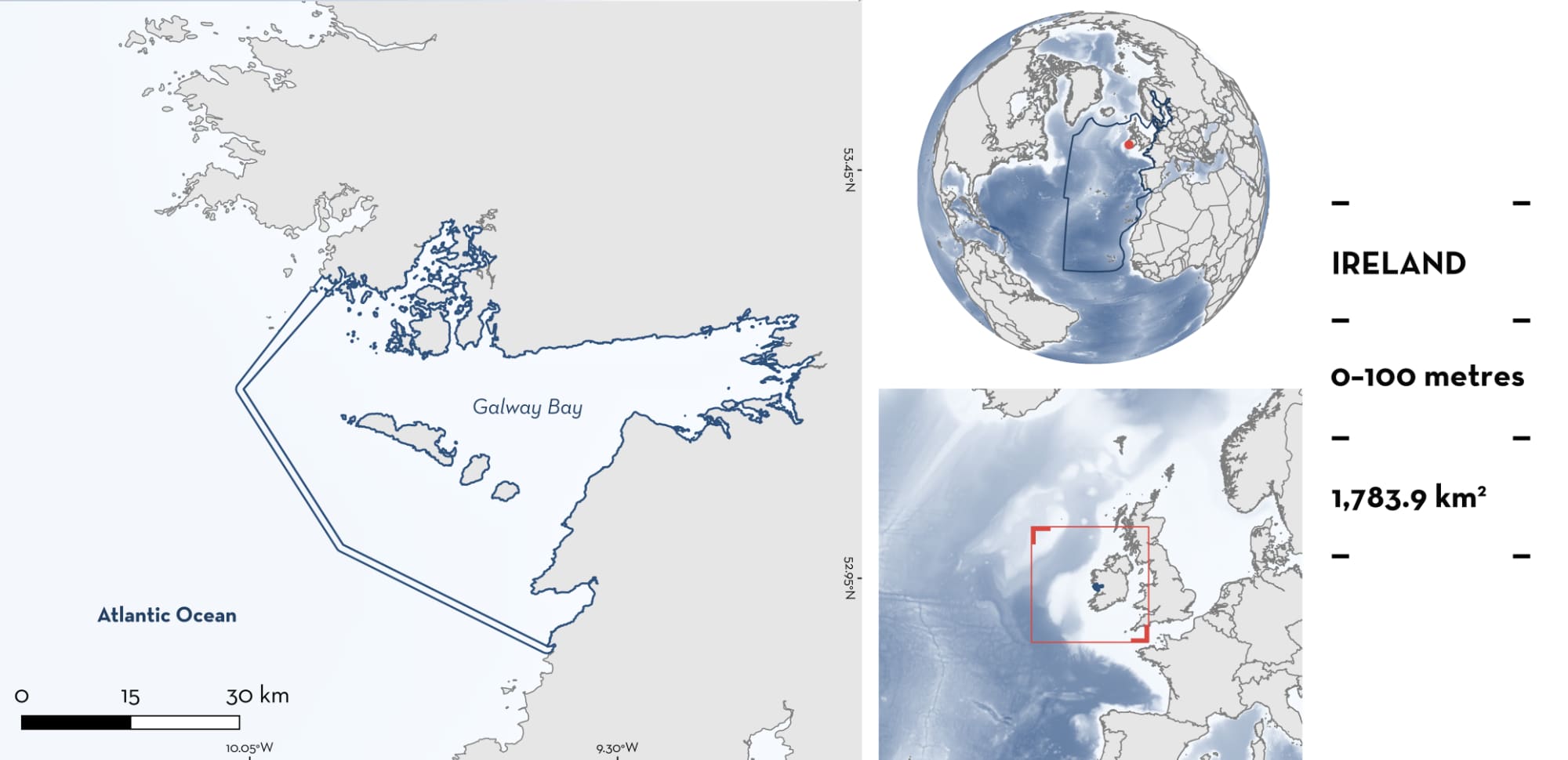
Galway Bay is located on Ireland’s west coast. The area extends from Liscannor Bay, encompassing the shallow waters surrounding Lettermore, Gorumna, and Lettermullan islands, and to the greater Galway Bay area, which is partially sheltered by the Aran Island archipelago. This coastal system encapsulates a mosaic of benthic habitat types and island features, including rock, gravel, fine sand, sandy mud, and deep mud substrates. The shallower waters include numerous estuarine inputs as well as many tidal inlets and lagoons scattered along the coastline supporting saltmarsh areas. The sublittoral zone contains distinctive communities such as some of the most diverse seaweed communities in Ireland, maerl beds, seagrass, and oyster beds (NPWS 2013).
The area receives freshwater input from the Corrib River and experiences semi-diurnal tides with significant ranges. Galway Bay has a mean spring tidal range of 4.5 m (McCullagh et al. 2020).
The area overlaps with four Key Biodiversity Areas (KBAs): Aran Islands (parts), Cliffs of Moher, Connemara Islands, and Inner Galway Bay (KBA 2025a, 2025b, 2025c, 2025d).
This Important Shark and Ray Area is delineated from inshore and surface waters (0 m) to a depth of 100 m based on the bathymetry of the area.
CRITERION A
VULNERABILITY
One Qualifying Species considered threatened with extinction according to the IUCN Red list of Threatened Species regularly occurs in the area. This is the Vulnerable Porbeagle (Rigby et al. 2019).
CRITERION C
SUB-CRITERION C5 – UNDEFINED AGGREGATIONS
Galway Bay is an important area for undefined aggregations of one shark species.
Between 2010–2024, sharks were caught on rod-and-line by sport fishers, tagged with unique conventional tags, released, and reported to the Inland Fisheries Ireland’s Marine Sportfish Tagging Programme (IFI 2023; IFI unpubl. data 2025). Trips were either from shore or from a boat and were limited to a few hours within one day (range 2–8 h). Reports are limited to successful trips (i.e., when one or more sharks were caught and tagged). Catch was reported as the number of individuals of a species per angling trip per day and aggregations are inferred from trips in which >3 individuals were caught. The angling season spans April–October.
Between 2016–2021, 126 Porbeagles were tagged and released around the Irish coast, with almost one third (28%; n = 35) recorded in this area. Porbeagles were recorded on 20 trips in total. Aggregations were inferred on three occasions between 2017–2020, all in July, with a mean group size of 3.7 individuals (maximum = 5). Measured sharks were less than the estimated length-at-maturity (females, 210–230 cm total length [TL]; males, 162–185 cm TL) (Jensen et al. 2002; IFI 2023; IFI unpubl. data 2025). While it is difficult for angling data to show aggregations, Porbeagle are known to be a species that forms aggregations (e.g., Haugen & Papastamatiou 2019). Furthermore, they are known to form these aggregations segregated by age and sex. As the majority of the Porbeagle captured in Galway Bay are juvenile males, it appears as though Irish waters are a persistent aggregation site for juvenile Porbeagles. This is further reflected in a study using angling data from 1970–2017, which found that each boreal summer, juvenile Porbeagles aggregate around the Irish coast (Cameron et al. 2019). The recaptured data from this study indicate long-term site fidelity, with Porbeagle returning to the same sites in different years. Porbeagle have been found in other areas to return to herring grounds annually (JNCC 2019) and Galway Bay is a herring nursery ground (Fair Seas 2022). This might be the reason that juvenile Porbeagles aggregate in this area annually. Porbeagle are depleted within European waters (Rigby et al. 2019), and as such numbers are low overall, but local ecological knowledge has reported Porbeagle returning to the area each year, with charter skippers catching up to fourteen Porbeagles on an individual fishing trip. Further information is required to understand the nature and function of these aggregations.
Download factsheet
SUBMIT A REQUEST
ISRA SPATIAL LAYER REQUEST
To make a request to download the ISRA Layer in either a GIS compatible Shapefile (.shp) or Google Earth compatible Keyhole Markup Language Zipped file (.kmz) please complete the following form. We will review your request and send the download details to you. We will endeavor to send you the requested files as soon as we can. However, please note that this is not an automated process, and before requests are responded to, they undergo internal review and authorization. As such, requests normally take 5–10 working days to process.
Should you have questions about the data or process, please do not hesitate to contact us.