ISRA FACTSHEETS
ISRA FACTSHEETS
EUROPEAN ATLANTIC
North Terceira
Summary
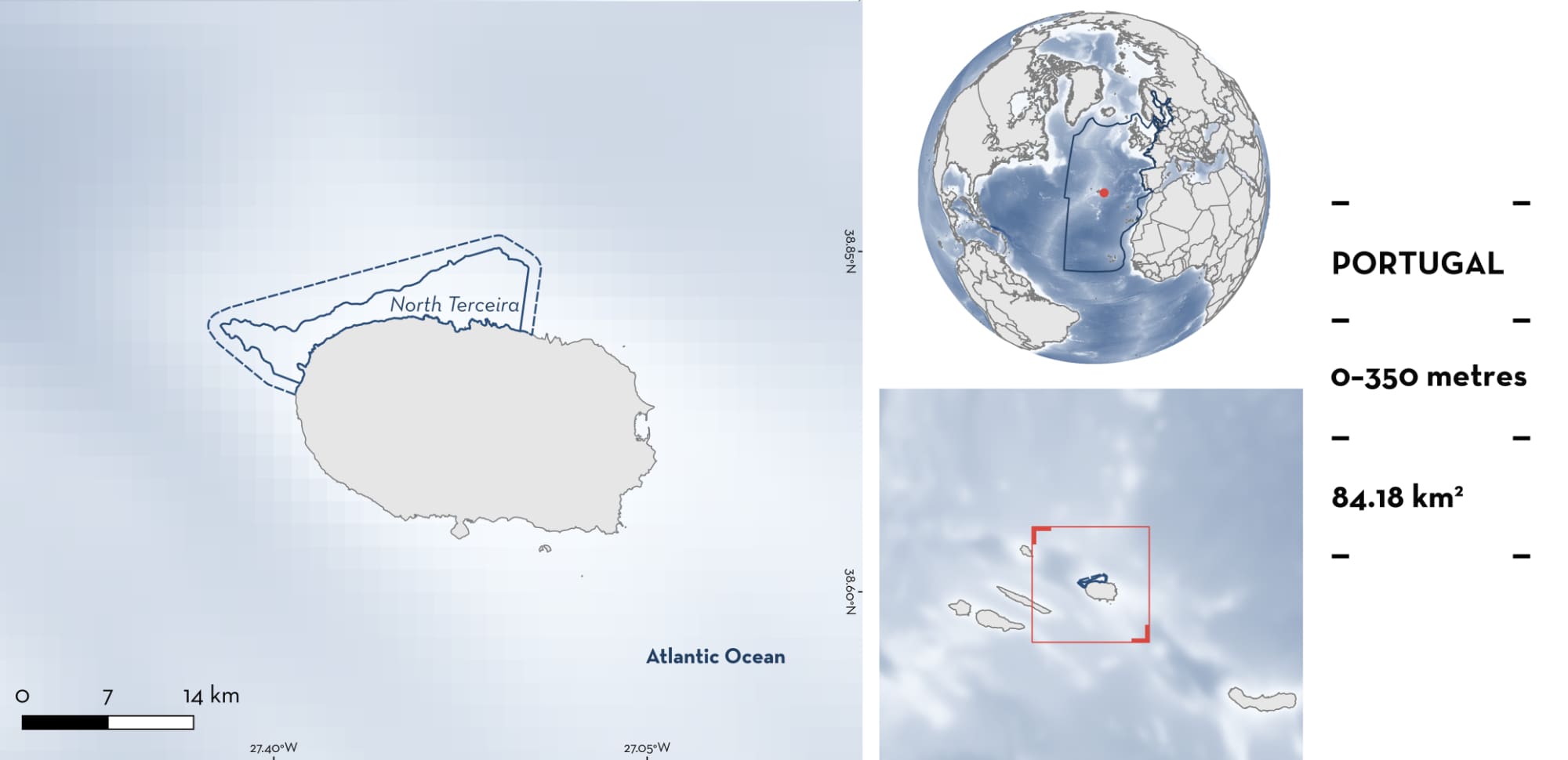
North Terceira is located in the central Azores Archipelago. It is characterised by a coastline with bays, inlets, a narrow shelf, and a steep slope with rocky areas. The area has temperate conditions and is highly influenced by strong currents. It overlaps with the Terceira Key Biodiversity Area. Within this area there are: threatened species and undefined aggregations (Tope Galeorhinus galeus).
Download factsheet
North Terceira
DESCRIPTION OF HABITAT
North Terceira is located in the central Azores Archipelago, an autonomous region of Portugal. It is found on the north side of Terceira Island. The coastline is characterised by the presence of bays and inlets with a narrow shelf and a steep slope with rocky areas (EEA 2025).
The area has temperate conditions as a result of the confluence of the North Atlantic Current and the Azores Current and is highly influenced by strong currents (Afonso et al. 2020). Sea surface temperatures are lower in the boreal winter (~14–15°C) and higher in summer (~23–24°C), with chlorophyll-a concentrations being highest in winter and spring (Narciso et al. 2016; Amorim et al. 2017).
This area overlaps with the Terceira Key Biodiversity Area (KBA 2025).
This Important Shark and Ray Area is benthic and pelagic and is delineated from inshore and surface waters (0 m) to 350 m based on the bathymetry of the area.
CRITERION A
VULNERABILITY
One Qualifying Species considered threatened with extinction according to the IUCN Red List of Threatened Species regularly occurs in the area. This is the Critically Endangered Tope (Walker et al. 2020).
CRITERION C
SUB-CRITERION C5 – UNDEFINED AGGREGATIONS
North Terceira is an important area for undefined aggregations of one shark species.
In the Azores Exclusive Economic Zone, scientific surveys were conducted annually using benthic longlines divided into depth strata of 50 m intervals across 0–1,200 m and consisting of a mainline unit composed of four skate sides ~45 m long with ~30 hooks with soak times between 4–6 hours (Pinho et al. 2020; Das et al. 2022). Between 2010–2017, 256 fishing sets (554,360 hooks) were deployed in the depth range where the species have been recorded regionally in the longline surveys (0–650 m; E Giacomello & D Das unpubl. data 2025). Of the 256 fishing sets deployed, 13 (5.1%) were inside this area and of 286 Tope captured between 2010–2017 in 69 sets, 113 (39.5%) were caught inside this area (E Giacomello & D Das unpubl. data 2025). Six of these fishing sets recorded >10 Tope caught on a single fishing set, of which four were recorded in this area (E Giacomello & D Das unpubl. data 2025). Catch-per-unit-effort (individuals/1,000 hooks) in this area was the highest across the Azores and ranged between 0.7–8.5 (average = 2.9), while outside this area ranged 0–7.9 (average = 0.3; E Giacomello & D Das unpubl. data 2025). Within the Azores, it has been reported that Tope catches increase in shallow waters (<150 m) with larger catches of smaller sharks in nearshore habitats (Santos et al. 2020).
In addition, local ecological knowledge supports the importance of this area for aggregations of Tope. Of 163 fishers interviewed in 2020 on all nine islands of the Azores Archipelago, 56 reported observing Tope aggregations (36 from São Miguel Island and 20 from Terceira Island). Among the 20 that observed aggregations around Terceira Island, 14 identified specific locations, with half of them explicitly indicating this area, while the remaining indicated the west coast (n = 3) and the southwest coast (n = 4). These aggregations were described as occurring year-round, typically involving around 10–20 individuals, including both juveniles and adults (Soares 2021). Fishers reported the presence of aggregations here more frequently than in other islands of the archipelago (Soares 2021). Aggregations of juvenile and adult Tope have been recorded in coastal areas where high catches of the species occur (Lucifora et al. 2004; Nosal et al. 2021). Additional information is required to understand the nature and function of these aggregations.
Download factsheet
SUBMIT A REQUEST
ISRA SPATIAL LAYER REQUEST
To make a request to download the ISRA Layer in either a GIS compatible Shapefile (.shp) or Google Earth compatible Keyhole Markup Language Zipped file (.kmz) please complete the following form. We will review your request and send the download details to you. We will endeavor to send you the requested files as soon as we can. However, please note that this is not an automated process, and before requests are responded to, they undergo internal review and authorization. As such, requests normally take 5–10 working days to process.
Should you have questions about the data or process, please do not hesitate to contact us.