ISRA FACTSHEETS
ISRA FACTSHEETS
AUSTRALIA AND SOUTHEAST INDIAN OCEAN
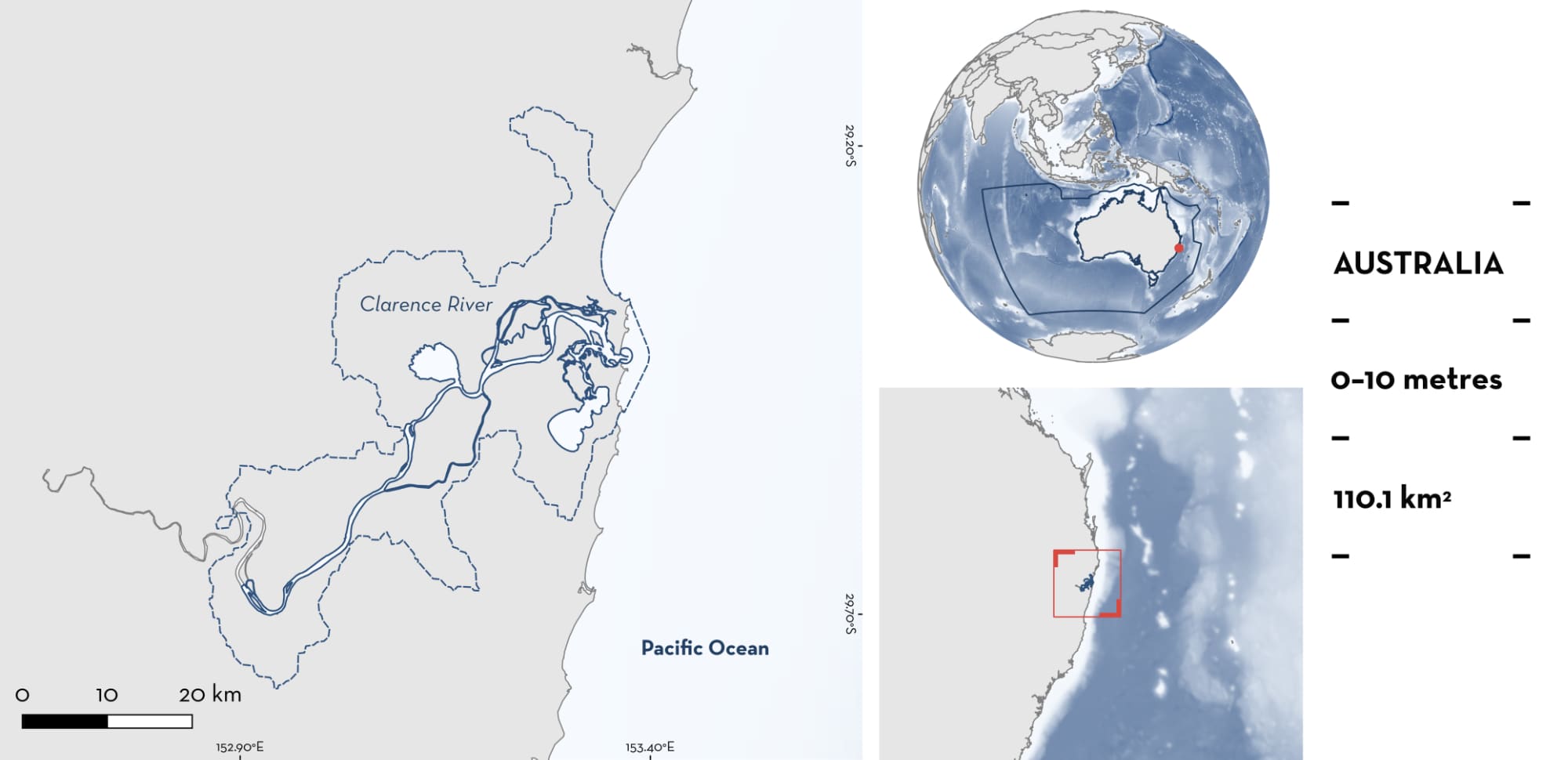
Clarence River
Summary
Clarence River is located in northern New South Wales, Australia. It comprises the lower reaches of the Clarence River with wide and small river channels, the river mouth, and coastal lakes. The habitat is characterised by soft substrates, saltmarsh, and mangroves. It is influenced by freshwater from the river and tidal saltwater input, with seasonally higher river flow during December–March. Within this area there are: threatened species, reproductive areas, and feeding areas (Bull Shark Carcharhinus leucas).
Download factsheet
Clarence River
DESCRIPTION OF HABITAT
Clarence River is located in northern New South Wales, Australia. The area encompasses the lower reaches of the Clarence River, including the river mouth and two coastal lakes. The estuary is the largest in New South Wales and has the largest catchment area (Pollard & Hannan 1994). The habitat is characterised by wide and narrow river channels, coastal lakes, soft substrates, mangroves, and saltmarsh (Taylor & Creighton 2018). Seagrass was historically widespread but has largely been lost (Taylor & Creighton 2018).
The area is influenced by tides up to ~100 km upstream, leading to a mix of freshwater and saltwater (Cu et al. 2023). River flow is highest during the austral summer from December–March.
This Important Shark and Ray Area is benthic and pelagic and is delineated from inshore and surface waters (0 m) to 10 m based on the bathymetry of the area.
CRITERION A
VULNERABILITY
One Qualifying Species considered threatened with extinction according to the IUCN Red List of Threatened Species regularly occurs in the area. This is the Vulnerable Bull Shark (Rigby et al. 2021).
CRITERION C
SUB-CRITERION C1 – REPRODUCTIVE AREAS
Clarence River is an important reproductive area for one shark species.
Neonate, young-of-the-year (YOY), and juvenile Bull Sharks are regularly observed in this area (Niella et al. 2022; Alas et al. 2024). Historically, neonate and YOY Bull Sharks have long been reported from this area, including during trawl surveys in 1988–1990 (West & Walford 2000). A contemporary research study recorded catches on 25 commercial fishing trips between June 2010–July 2011 using overnight benthic-set longlines in this area (Alas et al. 2024). Most Bull Sharks captured (62%; 232 of 377 individuals) were neonates or YOY with a size ranging 75–99 cm total length (TL). The size-at-birth for the species is 56–81 cm TL and YOY can be up to 99 cm TL (Pillans et al. 2020; Ebert et al. 2021). Most of the other sharks were small juveniles (100–124 cm TL; ~30%) and few additional larger juveniles up to 176 cm TL. Bull Sharks in eastern Australia remain in river and estuary habitats for up to five years (Werry et al. 2011), highlighting that juveniles, in addition to neonates and YOY, are still largely restricted to the area, with the larger juveniles potentially making some movements into adjacent marine waters (Smoothey et al. 2023). One captured shark was a pregnant female (Alas et al. 2024).
A passive acoustic tagging study captured and tagged 31 Bull Sharks in the Clarence River between March 2009–January 2013 (Lee et al. 2019). Most (81%) were <200 cm TL and included neonates and YOY. The study mostly focused on marine movements, with many receivers along the New South Wales coast. Additionally, a feeding study using stable isotope analysis of 54 Bull Sharks showed that neonate and YOY individuals consumed prey that derived much of their diet from particulate matter sampled in the upper reaches of this area, and juveniles also consumed prey from within this area, but from the lower reaches in the estuary (Niella et al. 2022). Contemporary social media posts demonstrate that recreational fishers regularly capture Bull Sharks in this area. Combined, the data show that Clarence River is important for the early life stages of Bull Sharks.
CRITERION C
SUB-CRITERION C2 – FEEDING AREAS
Clarence River is an important feeding area for one shark species.
A biochemical study sampled the liver of Bull Sharks (n = 54) as well as particulate matter and several primary producer species of mangrove and saltmarsh in this area in 2010–2011 and analysed the δ13C, δ15N, and δ34S stable isotopes to determine the contribution of different estuarine habitats to Bull Shark diet and identify where in the food web their prey had foraged (Niella et al. 2022). Sampled Bull Sharks were YOY and juveniles ranging in size from 80–176 cm TL. Most individuals (69%) were 1–2.5 years old, with the remaining between 4–6.5 years old. Bull Sharks in eastern Australia remain in river and estuary habitats for up to five years (Werry et al. 2011), highlighting that the larger juvenile age class is still mostly restricted to the area while potentially making some movements into adjacent marine waters. The younger age class had a stable isotope signature that indicated that they mostly feed in the upper reaches of the area. Their isotope mean values (δ13C = -21.47; δ15N = 11.42, and δ34S = 10.55) showed a high contribution of particulate matter supporting the prey of these Bull Sharks. By contrast, larger juveniles (4–6.5 years old) had a diet related strongly to saltmarshes in the lower estuary. Their mean isotope values (δ13C = -20.33; δ15N = 12.18, and δ34S = 12.26) indicated that they feed mainly in the lower reaches of the area. Resources linked to mangrove habitat was limited in both age groups (Niella et al. 2022). The biochemical study showed that this is an important feeding area for young Bull Sharks while they live in the river system (Niella et al. 2022).
Download factsheet
SUBMIT A REQUEST
ISRA SPATIAL LAYER REQUEST
To make a request to download the ISRA Layer in either a GIS compatible Shapefile (.shp) or Google Earth compatible Keyhole Markup Language Zipped file (.kmz) please complete the following form. We will review your request and send the download details to you. We will endeavor to send you the requested files as soon as we can. However, please note that this is not an automated process, and before requests are responded to, they undergo internal review and authorization. As such, requests normally take 5–10 working days to process.
Should you have questions about the data or process, please do not hesitate to contact us.