ISRA FACTSHEETS
ISRA FACTSHEETS
AUSTRALIA AND SOUTHEAST INDIAN OCEAN
Murray Island
Summary
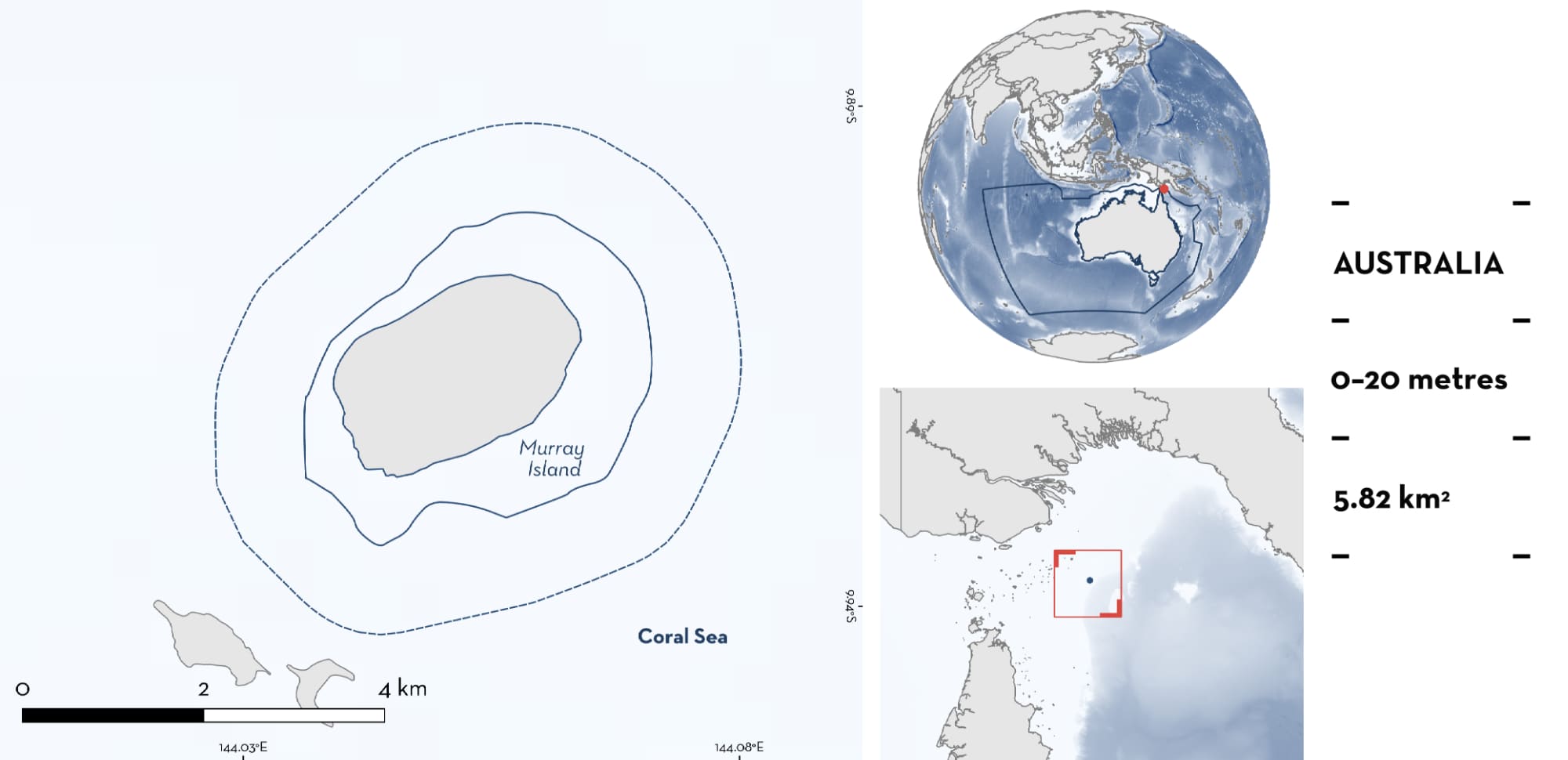
Murray Island is located on the eastern shelf of Torres Strait, Queensland, Australia. The area is characterised by a shallow lagoon surrounded by a coral reef. It is influenced by strong tidal currents, seasonal wind regimes, and surrounding water mass interactions between the Coral Sea and Gulf of Carpentaria. Within this area there are: threatened species and feeding areas (Tawny Nurse Shark Nebrius ferrugineus).
Download factsheet
Murray Island
DESCRIPTION OF HABITAT
Murray Island is located on the eastern shelf of Torres Strait, Queensland, Australia. The area is a basaltic island formed from an extinct volcano. It is characterised by a shallow lagoon surrounded by a coral reef, with its crests often very shallow and sometimes exposed at low tides (P Cogollos pers. obs. 2024). The outer reef crest, outside the area, slopes steeply, descending rapidly to 80 m.
The area is influenced by strong tidal currents, seasonal wind regimes, and surrounding water mass interactions between the Coral Sea and Gulf of Carpentaria (Wolanski et al. 2013). North-westerly monsoon winds in the austral summer and south-easterly trade winds in winter drive low-frequency circulation (Church et al. 1988). The area benefits from seasonal upwelling when the poleward boundary current along the shelf is weakened or reversed by eddies forming in the Gulf of Papua (Condie & Dunn 2006).
This Important Shark and Ray Area is benthic and pelagic and is delineated from inshore and surface waters (0 m) to 20 m based on the bathymetry of the area.
CRITERION A
VULNERABILITY
One Qualifying Species considered threatened with extinction according to the IUCN Red List of Threatened Species regularly occurs in the area. This is the Vulnerable Tawny Nurse Shark (Simpfendorfer et al. 2021).
CRITERION C
SUB-CRITERION C2 – FEEDING AREAS
Murray Island is an important feeding area for one shark species.
Tawny Nurse Shark aggregations of up to 20 individuals have been regularly seen feeding in this area on schools of sardines (family Clupeidae). Between 2012–2024, large schools of sardines aggregating in the inner lagoon of the island, very close to shore, have been recorded and shared across video platforms. Tawny Nurse Shark feeding aggregations (n = 4) were recorded predating on these large schools in 2012 (n = 4 individuals), 2020 (n= >20), and twice in 2021 (n= >10 each time). During feeding aggregations, adult Tawny Nurse Sharks exhibit a near-stranding behaviour, propelling themselves onto the shoreline to capture prey fishes. Individuals frequently expose most or all of their body onto the beach and subsequently return to the water using abrupt movements of the tail and pectoral fins. Additional aggregations of adult Tawny Nurse Sharks (n = 6) ranging between 3–>20 individuals were recorded in 2015, 2016, 2017 (involving a mating event with three adults), 2021, 2023, and 2024 (P Cogollos pers. obs 2024). Murray Islanders have traditionally fished for large schools of sardines in the shallow waters around the area using hand-held conical scoop baskets since before the beginning of the 20th century (Weisler & McNiven 2015). This practice indicates that the presence of the prey has been regular and predictable in the area for centuries.
Download factsheet
SUBMIT A REQUEST
ISRA SPATIAL LAYER REQUEST
To make a request to download the ISRA Layer in either a GIS compatible Shapefile (.shp) or Google Earth compatible Keyhole Markup Language Zipped file (.kmz) please complete the following form. We will review your request and send the download details to you. We will endeavor to send you the requested files as soon as we can. However, please note that this is not an automated process, and before requests are responded to, they undergo internal review and authorization. As such, requests normally take 5–10 working days to process.
Should you have questions about the data or process, please do not hesitate to contact us.