
ISRA FACTSHEETS
ISRA FACTSHEETS
AUSTRALIA AND SOUTHEAST INDIAN OCEAN
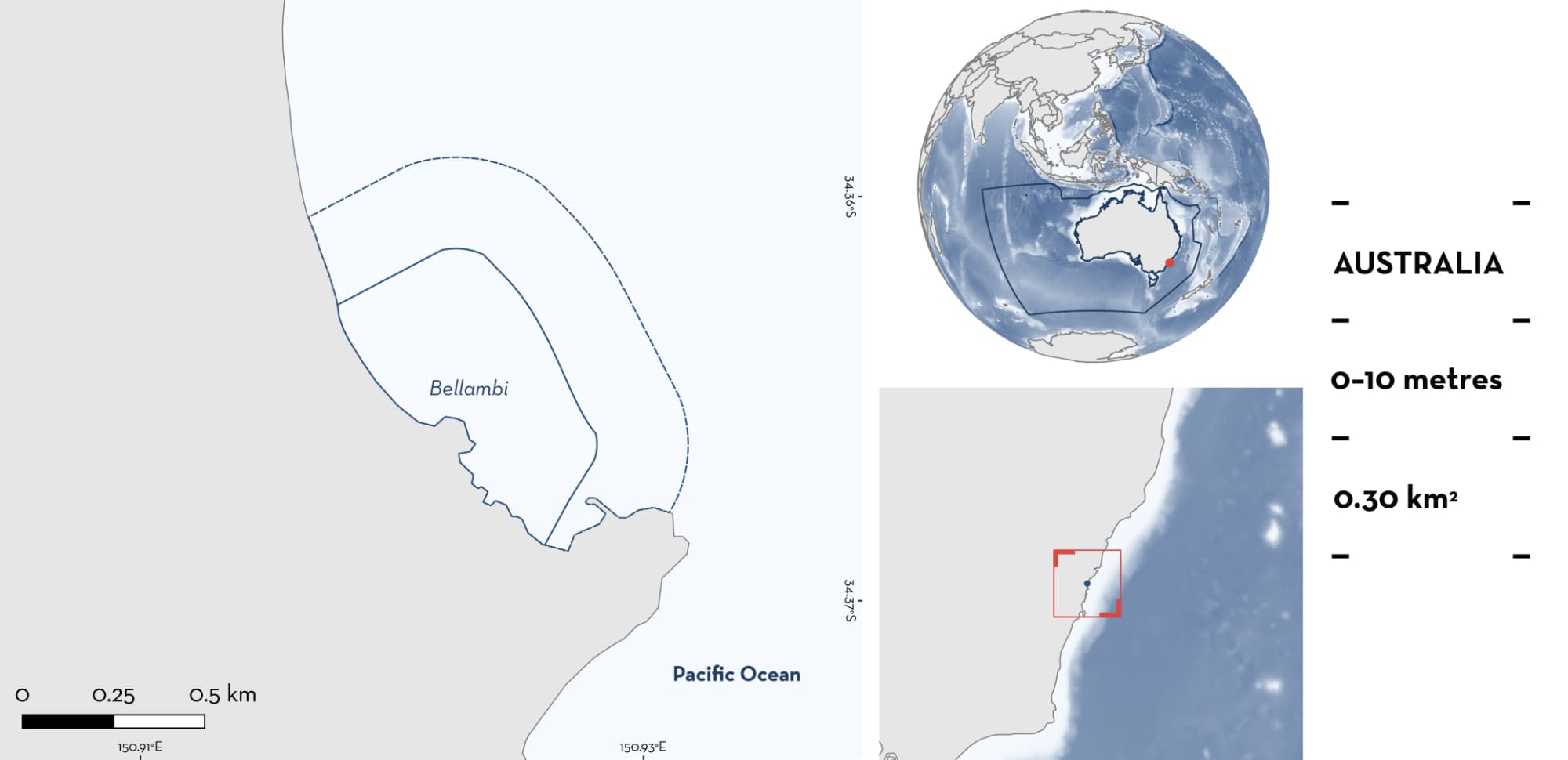
Bellambi
Summary
Bellambi is located on the Illawarra coast of New South Wales, Australia. This shallow area is characterised by rocky outcrops and sandy substrates and is subject to a temperate climate and semidiurnal tidal cycles. Within the area there are: threatened species and undefined aggregations (Dusky Shark Carcharhinus obscurus).
Download factsheet
Bellambi
DESCRIPTION OF HABITAT
Bellambi is located on the Illawarra coast of New South Wales, Australia. This shallow area is characterised by rocky outcrops and sandy substrates and is situated adjacent to a boat ramp and man-made rock pool.
The climate in the broader region is temperate and subject to semidiurnal tidal cycles, with sea surface temperatures in the region ranging between 16.4–24.8°C (Sea Temperature 2025). The area is influenced by the East Australian Current, with the flow strongest in the austral summer and resulting in seasonal fluctuations in eddy formation along the coastline (Ridgeway & Hill 2009).
This Important Shark and Ray Area is benthic and pelagic and is delineated from inshore and surface waters (0 m) to 10 m based on the bathymetry of the area.
CRITERION A
VULNERABILITY
One Qualifying Species considered threatened with extinction according to the IUCN Red List of Threatened Species regularly occurs in the area. This is the Endangered Dusky Shark (Rigby et al. 2019).
CRITERION C
SUB-CRITERION C5 – UNDEFINED AGGREGATIONS
Bellambi is an important area for undefined aggregations of one shark species.
Between 2021–2025, drone surveys were conducted regularly in the Bellambi Beach harbour area, including within this area. Surveys ranged between daily to weekly to monthly flights year-round (R Gorkin unpubl. data 2025). Standardised drone transects focused on a dedicated 1 km stretch of reef adjacent to the shoreline in the area (0–50 m from the swash zone). Drone transects typically lasted 15–20 minutes and followed a standardised track across a broader area.
Dusky Sharks were observed in the area annually between April and July, typically either individuals or in groups of <10 which persisted for only a few days. Sharks were identified by experts from the New South Wales Department of Primary Industries and Regional Development (P Butcher pers. comms. 2025). Extended drone surveys were conducted to investigate areas up to 1–2 km north and south of the standardised drone transect, but few sharks were recorded outside the area. During two non-sequential years (2021 and 2025), large aggregations of at times >50 Dusky Sharks were observed in the same area for multiple consecutive days, peaking between April and July. When present, these large aggregations would be observed most days for up to a few months, with 10–50+ Dusky Sharks observed each day, and numbers influenced by weather conditions and water visibility. Whereas outside aggregation times only 1–2 sharks would be observed and less frequently (monthly rather than daily). Drone surveys were conducted most days when aggregations of Dusky Sharks were observed in the area. These aggregations were concentrated within the area in a shallow section of the reef (<3 m depth) in a sheltered section of the coastline. Small and large schools of fish were frequently observed alongside the sharks, and occasional feeding behaviours were noted (e.g., chasing fish, consumption of fish). More information is needed to understand the nature and function of these aggregations.
Download factsheet
SUBMIT A REQUEST
ISRA SPATIAL LAYER REQUEST
To make a request to download the ISRA Layer in either a GIS compatible Shapefile (.shp) or Google Earth compatible Keyhole Markup Language Zipped file (.kmz) please complete the following form. We will review your request and send the download details to you. We will endeavor to send you the requested files as soon as we can. However, please note that this is not an automated process, and before requests are responded to, they undergo internal review and authorization. As such, requests normally take 5–10 working days to process.
Should you have questions about the data or process, please do not hesitate to contact us.

