
ISRA FACTSHEETS
ISRA FACTSHEETS
AUSTRALIA AND SOUTHEAST INDIAN OCEAN
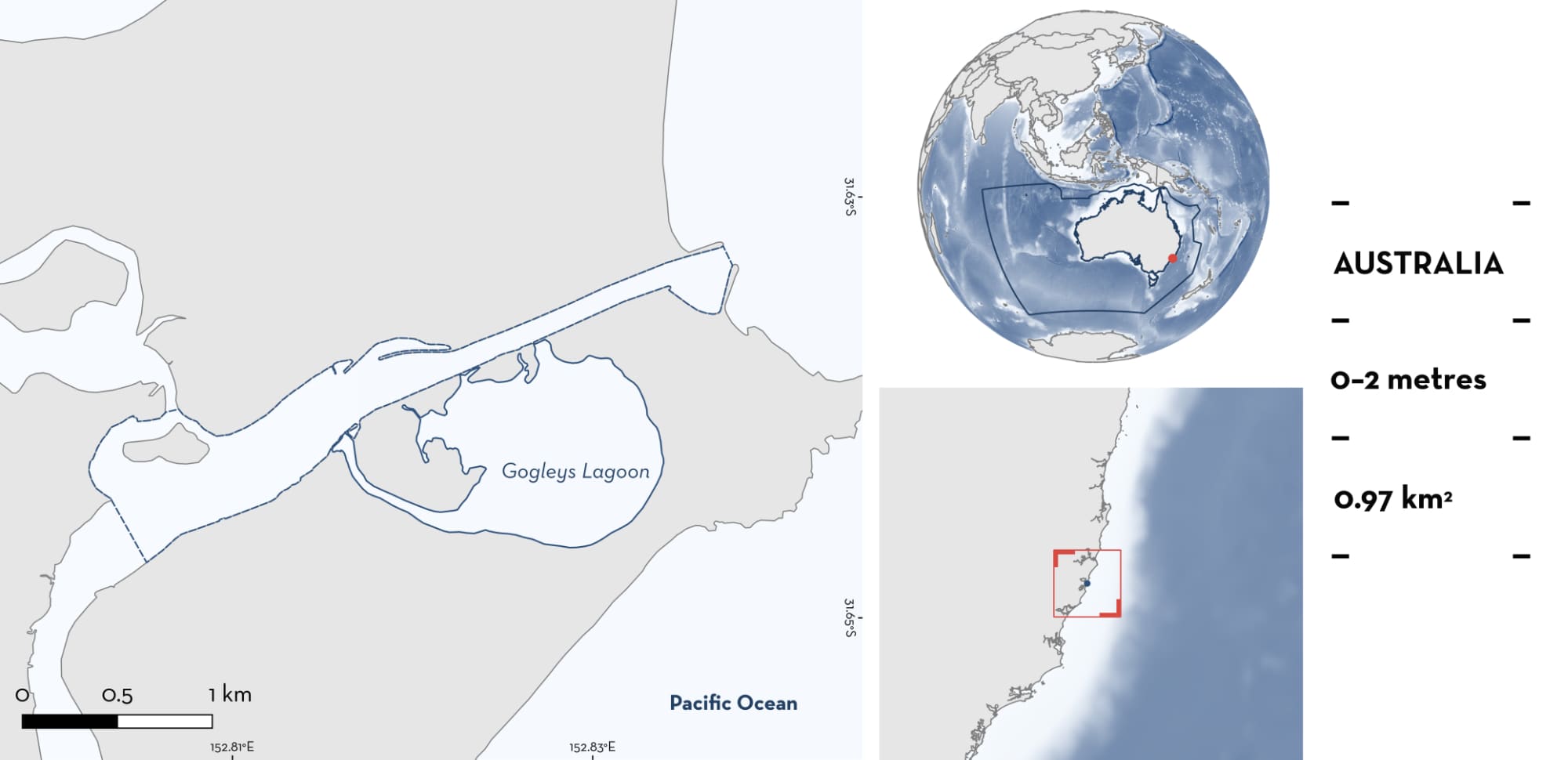
Gogleys Lagoon
Summary
Gogleys Lagoon is located on the mid north coast of New South Wales, Australia. It is a shallow, tidally fed lagoon comprised of sandy sediments. The lagoon is largely intertidal and is lined with mangroves around much of its perimeter. The area is subject to semi-diurnal tides and tidal currents resulting from the narrow entrances to the lagoon. Within this area there are: threatened species and feeding areas (Estuary Stingray Hemitrygon fluviorum).
Download factsheet
Gogleys Lagoon
DESCRIPTION OF HABITAT
Gogleys Lagoon is located on the mid north coast of New South Wales, Australia. It is a shallow, tidally fed lagoon with water depths of 0–2 m. The lagoon is comprised of sandy sediments, which are largely intertidal, and is lined with mangroves around much of its perimeter (Lucieer et al. 2025). There are oyster leases through much of the subtidal areas in the south and east of the area. The area is subject to semi-diurnal tides and tidal currents can result in silt plumes from the flow of water through the narrow entrances to the lagoon (J Pini-Fitsimmons pers. obs. 2025).
This Important Shark and Ray Area is benthic and is delineated from inshore and surface waters (0 m) to 2 m based on the bathymetry of the area.
CRITERION A
VULNERABILITY
One Qualifying Species considered threatened with extinction according to the IUCN Red List of Threatened Species regularly occurs in the area. This is the Vulnerable Estuary Stingray (Hyde et al. 2025).
CRITERION C
SUB-CRITERION C2 – FEEDING AREAS
Gogleys Lagoon is an important feeding area for one ray species.
Estuary Stingrays are abundant in Gogleys Lagoon and commonly observed on intertidal sandflats, where they create feeding pits throughout the lagoon (J Pini-Fitzsimmons pers. obs. 2025). Evidence of feeding include stingray feeding pits, which indicate recent feeding activity (days to weeks old) and silt trails indicating active or very recent feeding (within minutes; J Pini-Fitzsimmons pers. obs. 2025). These silt plumes flow with tidal currents, which are moderate within the lagoon due to its tidal influence and narrow entrances. Remote aerial imagery of the area has been taken on random days between August 2010 and September 2025 and is available on an online repository (average 3.1 days per year; n = 48 total days; Nearmap 2025). Extensive feeding pits, both subtidal and on exposed sand flats depending on tide, were seen on almost all days imaged in the area (97.9%; n = 47; Nearmap 2025). The one day where feeding pits were not observed was during a high tide with very turbid water and wind resulting in no visibility beneath the water’s surface. Active or very recent feeding was observed on 54.2% of days imaged (n = 26 out of 48 total; Nearmap 2025). While available aerial imagery is not at fine enough resolution to confirm species identification, there are multiple instances where a stingray can be seen at the front of silt plumes confirming active feeding (Nearmap 2025).
Further, opportunistic drone surveys in the area between 2019–2022 regularly encountered Estuary Stingrays (J Pini-Fitzsimmons unpubl. data 2025). The only species of shark or ray sighted on all drone surveys was the Estuary Stingray. A total of 25 rays were recorded across all surveys (average 2.5 per survey; J Pini-Fitzsimmons unpubl. data 2025). Species identification, presence of feeding pits, and active feeding has also been confirmed from opportunistic drone surveys of the area conducted in 2019, 2020, 2021, and 2022 (n = 10 total surveys, up to 25 minutes duration; J Pini-Fitzsimmons unpubl. data 2025). At least two Estuary Stingrays were sighted on all surveys, and all observations were of either active foraging (i.e., frequently stopping and conducting short excavations of sediment in search of food; n = 15 rays) or active feeding (extractive feeding creating silt plumes; n = 10) (J Pini-Fitzsimmons unpubl. data 2025). There is minimal evidence of Estuary Stingrays or active foraging by this species from aerial imagery or drone surveys in adjacent areas, and the greatest concentration of this species is found in the lagoon area. Collectively, these data support the importance of this area for Estuary Stingray feeding.
Download factsheet
SUBMIT A REQUEST
ISRA SPATIAL LAYER REQUEST
To make a request to download the ISRA Layer in either a GIS compatible Shapefile (.shp) or Google Earth compatible Keyhole Markup Language Zipped file (.kmz) please complete the following form. We will review your request and send the download details to you. We will endeavor to send you the requested files as soon as we can. However, please note that this is not an automated process, and before requests are responded to, they undergo internal review and authorization. As such, requests normally take 5–10 working days to process.
Should you have questions about the data or process, please do not hesitate to contact us.

