ISRA FACTSHEETS
ISRA FACTSHEETS
AUSTRALIA AND SOUTHEAST INDIAN OCEAN
Jervis Bay
Summary
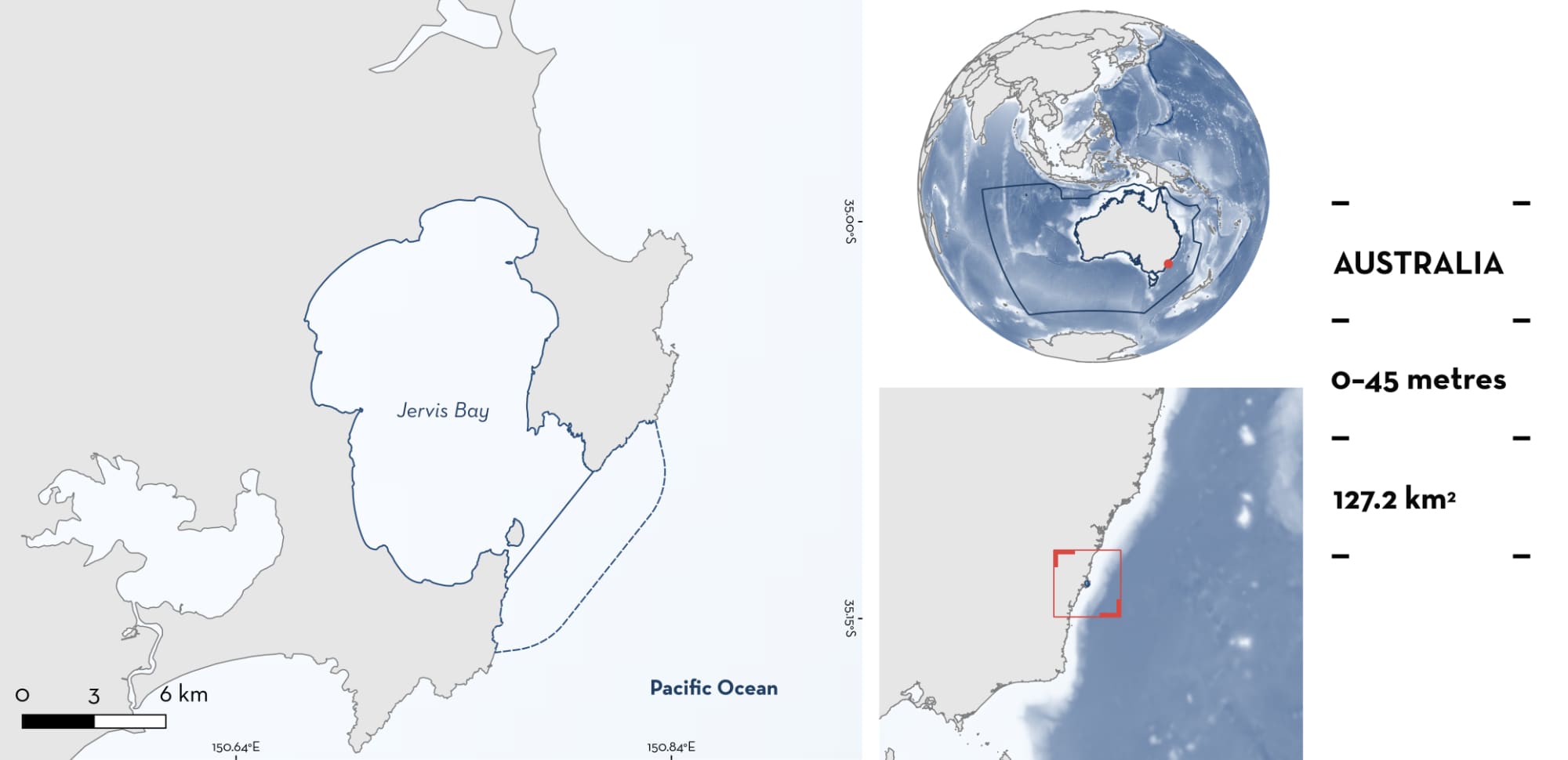
Jervis Bay is located on the southeast coast of New South Wales and Jervis Bay Territory, Australia. This large, sheltered embayment features a gently sloping seafloor and supports a range of benthic habitats such as seagrass beds, rocky reefs, and large areas of mixed soft substrates. It is influenced by the convergence of warm East Australian Current waters and cooler Bass Strait waters, with periodic upwelling of cold, nutrient-rich waters from the continental shelf. The area overlaps the Jervis Bay Marine Park, the Booderee National Park, and the Jervis Bay Key Biodiversity Area. Within the area there are: threatened species (Sand Tiger Shark Carcharias taurus); range-restricted species (Eastern Fiddler Ray Trygonorrhina fasciata); reproductive areas (e.g., Port Jackson Shark Heterodontus portusjacksoni); and resting areas (Sand Tiger Shark).
Download factsheet
Jervis Bay
DESCRIPTION OF HABITAT
Jervis Bay is located on the southeast coast of New South Wales and Jervis Bay Territory, Australia. This large, sheltered embayment features a gently sloping seafloor averaging depths of 15–20 m (maximum 40 m at the entrance). The continental shelf is narrow outside Jervis Bay (~20 km wide). The area supports a range of benthic habitats such as seagrass beds, rocky reefs, and large areas of mixed soft substrates (Lucieer et al. 2017). Seagrass meadows, primarily composed of Ribbon Weed Posidonia australis and Zostera species, and rocky reefs are extensive in shallow nearshore areas, and the majority of the interior of the bay is made up of mixed soft sediments (Lucieer et al. 2017).
Jervis Bay is influenced by the convergence of warm East Australian Current waters and cooler Bass Strait waters, with periodic upwelling of cold, nutrient-rich waters from the continental shelf and clockwise currents that flush the bay every 24 days (NSW DPIRD 2025a). These conditions drive seasonal variability in water temperature, nutrient delivery, and productivity.
The area overlaps with Jervis Bay Marine Park (NSW DPIRD 2025b), Booderee National Park (Parks Australia 2025), and Jervis Bay Key Biodiversity Area (KBA 2025).
This Important Shark and Ray Area is benthic and pelagic and is delineated from inshore and surface waters (0 m) to 45 m based on the bathymetry of the area.
CRITERION A
VULNERABILITY
One Qualifying Species considered threatened with extinction according to the IUCN Red List of Threatened Species regularly occurs in the area. This is the Critically Endangered Sand Tiger Shark (Rigby et al. 2025).
CRITERION B
RANGE RESTRICTED
This area holds the regular presence of Eastern Fiddler Ray as a resident range-restricted species. This species occurs year-round in the area, with high levels of residency and site fidelity demonstrated in Hare Bay and Hyams Beach (Adams 2019). Between 2015–2019, acoustic telemetry was used to assess the residency and space use of Eastern Fiddler Rays in southeastern New South Wales (two sites within Jervis Bay and one site 30 km south; Adams 2019). A total of 30 individuals were tagged across three tagging trips (March 2015, n = 6; December 2015, n = 11; April 2017, n = 13), for which tracking periods were up to two years (Adams 2019). A VEMCO Positioning System (VPS) of 20 acoustic receivers was deployed at Hare Bay (total array size was 1.12 km2). A VPS comprises an array of receivers set up in close proximity to one another to allow for high resolution fine-scale positioning of tagged rays (Espinoza et al. 2011). Within the relatively small area of the array, between 3–12 individuals were detected at the same time for periods spanning between 3–18 months (Adams 2019). Similarly, the five individuals tagged at Hyams Beach were shown to have high levels of residency and co-occurrence across the tracking period (~6 months). These results demonstrate that Eastern Fiddler Rays consistently aggregate in specific areas of Jervis Bay over time (Adams 2019). Citizen science records confirm that, of the Eastern Fiddler Ray sightings reported between Batemans Bay and Wollongong (>150 km, n = 102 sightings), almost half (n = 49; 48.0%) come from Jervis Bay (iNaturalist 2025), highlighting the importance of this area for this range-restricted species. This species occurs primarily in the East Central Australian Shelf Large Marine Ecosystem (LME) and only marginally into the Southeast Australian Shelf LME.
CRITERION C
SUB-CRITERION C1 – REPRODUCTIVE AREAS
Jervis Bay is an important reproductive area for one shark and one ray species.
This area has been documented as a regular and predictable breeding site for Port Jackson Sharks since the 1960s. Historic SCUBA diving surveys, fisheries capture records, and external tagging programs in the 1960s and 1970s identified that Port Jackson Sharks gathered on nearshore rocky reefs in sheltered bays and inlets every year during the austral winter and autumn (June–November) along the east coast of Australia at ‘traditional oviposition sites’ (McLaughlin & O’Gower 1971; O’Gower & Nash 1978). An in-depth analysis of the reproductive status of Port Jackson Sharks during the breeding aggregation period, including sharks sampled from within Jervis Bay, found that females were in reproductive condition (mature oocytes) from July–October and ultimately lay eggs throughout that period (Powter & Gladstone 2008). It has been speculated that Port Jackson Sharks develop an extensive mental map of their breeding aggregation locations (O’Gower 1995). Acoustic telemetry tracking data using 10-year transmitters show that males arrive and depart Jervis Bay two weeks earlier than females (Martin-Podevin et al. 2025), and the peak breeding period is July to November (Bass et al. 2016). These data show that both males and females return to the same reef within Jervis Bay every year, with an average year-to-year return rate of 77% (Bass et al. 2021). A repeatability analysis of migration timing was conducted and found that over a 7-year period, the individual repeatability scores for arrival and departure were 0.51 and 0.40, respectively (Martin-Podevin et al. 2025). The long-term nature of these tags (10-year deployments) demonstrated prolonged use of the same locations in the area, by the same individuals over multiple years, and confirm that the same traditional breeding locations historically identified are still used. In addition, anecdotal observations of Port Jackson Shark breeding behaviours have been reported in the area and include courtship, mating, and egg laying (C Brown & J Pini-Fitzsimmons pers. obs. 2025). The bay represents one of only three known breeding aggregation sites for Port Jackson Sharks along the New South Wales coast (the other two are Port Stephens and Sydney Harbour to the north of the area), confirming its importance for reproduction for this species.
Jervis Bay serves as a gestating area for female Smooth Stingrays. The population within the bay is strongly adult female biased, a pattern consistent across multiple years of acoustic tracking and behavioural observations (2017–2022), with the majority of females present across multiple years (Pini-Fitzsimmons et al. 2018, 2023; Pini-Fitzsimmons 2022). During late winter and spring, adult females are frequently observed from the shore as mid- to late-stage pregnant (~75% of all observations are of pregnant females; J Pini-Fitzsimmons unpubl. data 2025), evidenced by their visibly extended abdomens, indicating that the bay provides a safe area for gestating females. Tracking of 35 female Smooth Stingrays tagged within Jervis Bay across three years (2017–2019) has revealed strong seasonal patterns of habitat use. Individuals are most likely to be present within the bay during late winter and early spring (August–September) and more likely to be absent during summer to early autumn (February–March; Beck 2022). These absences coincided with detections at the mouth of the bay, including both short-term departures and longer absences exceeding one month (Beck 2022). Some females were >200 km along the New South Wales coast before returning to the bay, suggesting the use of broader coastal habitats during these periods (Beck 2022). While the precise function of these departures is unknown, it is hypothesised that this is for the purpose of pupping and subsequent mating. A study in New Zealand documented seasonal offshore breeding aggregations of Smooth Stingrays during the austral summer (Le Port & Lavery 2012), and in Jervis Bay, seasonal movements from inshore to coastal habitats corresponded with spring–summer. One female tracked from Jervis Bay was documented returning to the bay with fresh mating wounds following a ~3-week departure in late-spring (Pini-Fitzsimmons 2022), and long-term monitoring indicates the highest frequency of mating wounds on females within Jervis Bay occurs during spring–summer (J Pini-Fitzsimmons unpubl. data 2025).
In contrast, males are rarely recorded within the bay; only three males have been sighted and tracked compared to 35 females tagged over six years, despite targeted research in the area and concerted efforts to tag and track males (Beck 2022; Pini-Fitzsimmons 2022). This observation is consistent with male-biased dispersal patterns reported for Smooth Stingrays (Roycroft et al. 2019), whereby males are likely more transient than females. Collectively, these findings indicate that Jervis Bay functions as a gestating area for female Smooth Stingrays. Females remain within the bay for most of the year before undertaking seasonal movements outside the bay, likely to seek mating opportunities with more transient males (J Pini-Fitzsimmons pers. obs. 2025). The combination of the observed female-biased population, pregnant individuals, and seasonal absences linked to pupping demonstrates that Jervis Bay is especially important for Smooth Stingray reproduction relative to surrounding areas.
CRITERION C
SUB-CRITERION C3 – RESTING AREAS
Jervis Bay is an important resting area for one ray species.
Sand Tiger Shark sightings have been logged on Sharkbook in Jervis Bay from citizen science submissions, with photo-identification used to identify individuals (Spot a Shark unpubl. data 2025). Between 2014–2025, 93 sightings have been submitted, with 24 individuals identified using photo-identification. Overall, 89% (n = 83/93) of sightings were logged between December to April (Spot a Shark unpubl. data 2025), supporting the seasonality of this species’ aggregation in this area. During the months of June to September there are almost no sightings recorded for this species. This area is located towards the southern extent of the species’ migratory corridor, which runs from Montague Island in the south to Wolf Rock in the north (Otway & Ellis 2011; Reid-Anderson et al. 2019; Dwyer et al. 2023). Sand Tiger Sharks are observed in a resting state within this area, docily swimming over sandy substrates between rocky reef habitats (S Han-de-Beaux pers. obs. 2025). Hovering and milling are characteristic behaviours of resting Sand Tiger Sharks and comprise the majority of swimming behaviours observed at their main aggregation sites on Australia’s east coast (Smith et al. 2015). When hovering, sharks face into the water current and their tail beats allow them to maintain a stationary position, whereas milling involves slow movements and directional changes generally confined to a particular area within a gutter (Smith et al. 2015).
Download factsheet
SUBMIT A REQUEST
ISRA SPATIAL LAYER REQUEST
To make a request to download the ISRA Layer in either a GIS compatible Shapefile (.shp) or Google Earth compatible Keyhole Markup Language Zipped file (.kmz) please complete the following form. We will review your request and send the download details to you. We will endeavor to send you the requested files as soon as we can. However, please note that this is not an automated process, and before requests are responded to, they undergo internal review and authorization. As such, requests normally take 5–10 working days to process.
Should you have questions about the data or process, please do not hesitate to contact us.