ISRA FACTSHEETS
ISRA FACTSHEETS
AUSTRALIA AND SOUTHEAST INDIAN OCEAN
Sunshine Coast Rivers
Summary
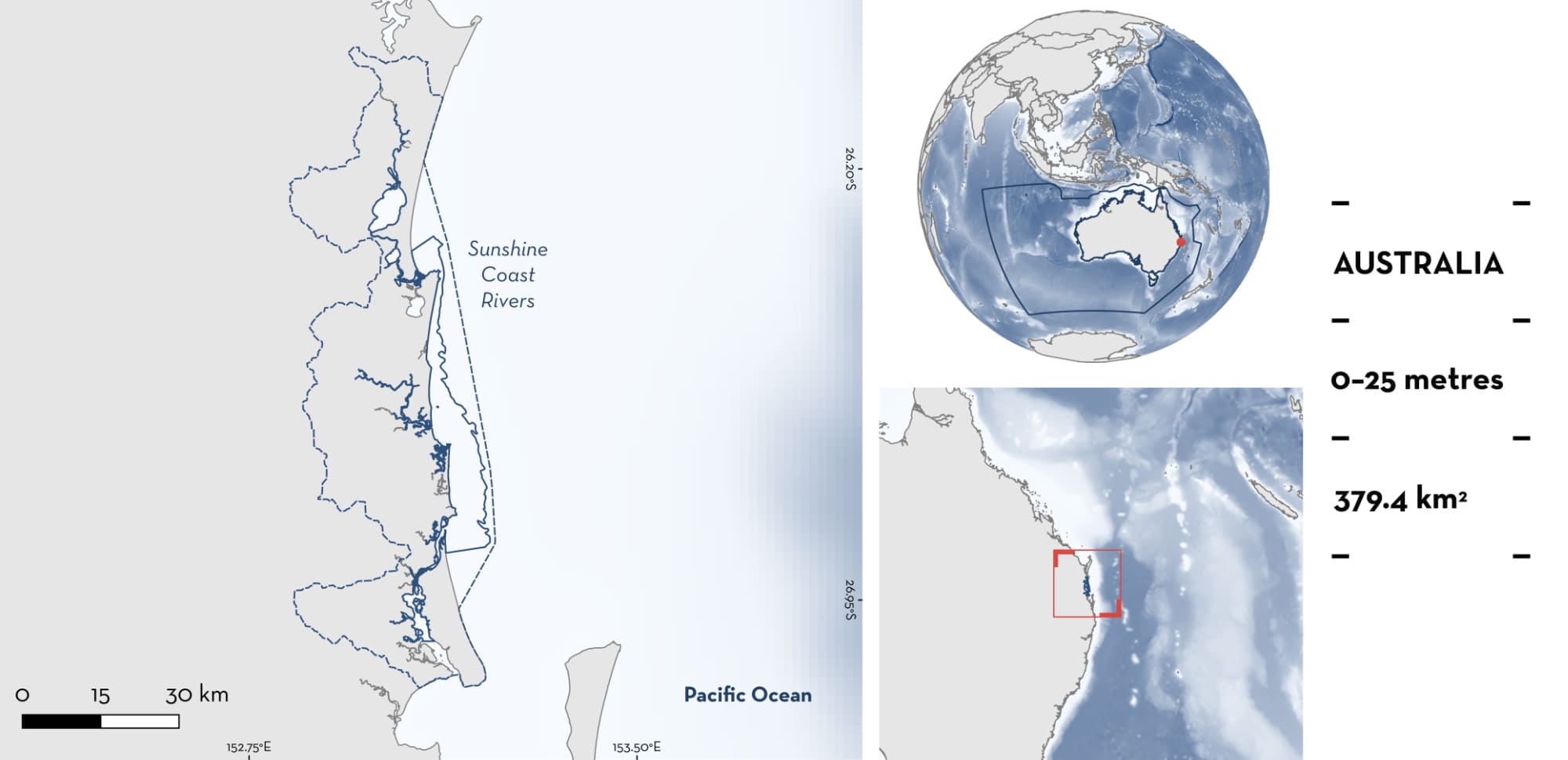
Sunshine Coast Rivers is located in southeast Queensland, Australia. This area encompasses several rivers (Noosa, Maroochy, Mooloolah), associated lakes, Pumicestone Passage, and coastal waters connecting these riverine and estuarine sections. The habitat is characterised by sandy and muddy substrates in the rivers, sandy and rocky substrates in coastal waters, and by mangroves, urbanised river sections, sandy beaches, and coastal rocky headlands. The area is influenced by freshwater and sediment flow from the rivers, tidal saltwater intrusions, and the East Australian Current that dominates the flow off the coast. This area overlaps with Moreton Bay Marine Park and Moreton Bay and Pumicestone Passage Key Biodiversity Area. Within this area there are: threatened species and reproductive areas (Bull Shark Carcharhinus leucas).
Download factsheet
Sunshine Coast Rivers
DESCRIPTION OF HABITAT
Sunshine Coast Rivers is located in southeast Queensland, Australia. This area encompasses the Noosa, Maroochy, and Mooloolah Rivers, associated lakes, and Pumicestone Passage, as well as the coastal waters that connect these riverine and estuarine waters. Habitats near the river mouths tend to be sandy substrates with clear water flushed tidally from the Pacific Ocean, while mid- to upper river areas are brackish, turbid, and dominated by muddy sediments and mangrove wetlands. Each river has strong tidal flows, leading to a gradient of salinity along the riverine parts of the area. Rivers have varying depths, with deep holes to 12 m depth. The coastal section is characterised by sandy beaches and rocky headlands, and sandy and rocky substrates.
The Noosa River exhibits shallow clear saltwater with deep holes within the first 2.3 km from the mouth followed by an increase in turbidity and brackish waters 6 km upstream. The water begins to turn fresh within the shallow (1–2 m) Lake Cootharaba with the northern section of this lake being freshwater, turbid, and mud dominated from the wetland everglades. The tidal flow within the Noosa River is strong between the mouth and Lake Cooroibah, as well as the connecting area between Lake Cooroibah and Cootharaba. However, this inter-lake connection tide varies from the southern part of the river due the head pressures of the two lakes as the lakes buffer the water movement.
The Maroochy River also exhibits shallow, clear saltwater within the first 2 km from the mouth that is dominated by sand and high tidal flows. The southern section is urbanised, and the river becomes natural after 4 km from the mouth. Here, the turbidity is higher, and depths range from 1.5–12 m with high tidal flows and muddy sediments from the surrounding wetlands and mangroves. The banks of the upper river section adjoin developed farmland.
The Mooloolah River is the most developed river, with nearly all sections in this area being urbanised. The first 2.5 km from the mouth is completely urbanised by waterfront property and marine vessels, which give this river high acoustic noise (BJ Holmes & JA Gustafson unpubl. data 2025). The western side of the river (west of Nicklin Way) is dominated by wetlands and mangroves with some urban areas. The upstream part of the river is turbid, displays tidal currents, and varies in depth between 0.5–9 m.
Pumicestone Passage is an estuarine section with constructed canal systems. Originally, the passage had two openings (Kings Beach at Caloundra and north Moreton Bay), however, the ocean has broken through Bribie Island and changed the sand dynamics within the northern section (Kings Beach is closed up) and a new breakthrough has developed. This northern section is dominated by sand and clear water at high tide with strong tidal currents. The passage becomes dominated by wetlands and mangroves 2.5 km from the mouth, with some patches of seagrasses. Sediments closer to river mouths (Bells Creek and Coochin Creek) display tidal mud flats and other areas are a mix of sandy and muddy substrates. The passage tends to be shallow and salty throughout, with brackish water found in the connecting rivers. Recently, Bells Creek mouth has closed over with sand, closing off the system to the passage.
This area is influenced by freshwater and sediment input flowing downstream, and tidally mediated saltwater intrusions upriver. The coastal waters are influenced by the East Australian Current which transports warm water southward along Australia’s east coast (Ridgeway & Hill 2009).
This area overlaps with the Moreton Bay and Pumicestone Passage Key Biodiversity Area (KBA 2025) and Moreton Bay Marine Park (Queensland Government 2019).
This Important Shark and Ray Area is benthic and pelagic and is delineated from inshore and surface waters (0 m) to 25 m based on the bathymetry of the area.
CRITERION A
VULNERABILITY
One Qualifying Species considered threatened with extinction according to the IUCN Red List of Threatened Species regularly occurs in the area. This is the Vulnerable Bull Shark (Rigby et al. 2021).
CRITERION C
SUB-CRITERION C1 – REPRODUCTIVE AREAS
Sunshine Coast Rivers is an important reproductive area for one shark species.
Bull Shark neonates, young-of-the-year (YOY), juveniles, and pregnant females are regularly observed in this area (BJ Holmes & JA Gustafson unpubl. data 2025). A short pilot study captured and tagged six Bull Sharks in this area (three YOY, one juvenile, two adults) in 2018–2020. A passive acoustic tracking study then captured Bull Sharks mainly on baited drumlines in the Noosa River, Maroochy River, Mooloolah River, and Pumicestone Passage between September–May in 2023–2025. Additional adults and sub-adults were captured and tagged in coastal waters of this area. Their total length (TL) was measured, life stage assessed, and tagged internally. Age classes were defined as neonate (open umbilical scar; 50–81 cm TL), YOY (closed umbilical scar; 82–99 cm TL), juvenile (100–200 cm TL; non-calcified claspers in males), and adult (>200 cm TL; calcified claspers in males). A growth rate of 30 cm per year was used to identify potential changes in age classes over time of tagged sharks. Their movements were monitored on 295 receivers (27 in rivers, 268 coastal). Bull Shark movements in this area are wholly confined to a single river system for the first 5–6 years of their lives, highlighting that neonate, YOY, and juveniles can be considered when assessing the area’s importance for the early life stages of the species (Werry et al. 2011; BJ Holmes & JA Gustafson unpubl. data 2025).
In the Noosa River, four YOY and 23 juveniles were captured and tagged seasonally between October–March in 2023–2025 (BJ Holmes & JA Gustafson unpubl. data 2025). All individuals <150 cm TL were only detected in the Noosa River and not in adjacent coastal waters, with detections throughout the year. These YOY and small juveniles were detected up to 20 km upstream, where the last receiver was located, although recreational fishers regularly report catches up to 40 km upstream (JA Gustafson pers. obs. 2025). Six of the small juveniles that were between 130–150 cm TL at the time of tagging have since displayed movements out of the river and into coastal waters of this area (BJ Holmes & JA Gustafson unpubl. data 2025). Most of the large juveniles were captured and detected in the inter-lake region between Lake Cooroibah and Cootharaba. This makes the Noosa River unique compared to the other rivers along the Sunshine Coast. Additionally, commercial fishers operate in the Noosa River and regularly catch Bull Sharks, including neonates and pregnant individuals (JA Gustafson pers. obs. 2025).
In the Maroochy River, three YOY were tagged in May 2018, and they were detected for two years until the receivers were removed in April 2020. They were first detected outside the river in coastal waters in April 2022, when they were ~5 years old. Since receivers were placed again in the river in June 2023, these individuals have been occasionally recorded at the river mouth and estuary of the Maroochy River and also in the Noosa River, Mooloolah River, Pumicestone Passage, and Moreton Bay, highlighting the connectivity within this area. Two of these sharks, both females, were detected in the upper river six years after tagging, during the known pupping season in November–February. This may indicate that they have reached maturity and returned to the river to pup. In 2023–2025, six neonates, 13 YOY, and 11 juveniles were captured and tagged. These have only been detected in the Maroochy River so far, up to 20 km upstream from the river mouth where the last receivers are located (BJ Holmes & JA Gustafson unpubl. data 2025). Reports from recreational fishers indicate that Bull Sharks are captured up to 40 km upstream in this river (JA Gustafson pers. obs. 2025). Additionally, commercial fishers operate in the Maroochy River and regularly catch Bull Sharks, including neonates and pregnant individuals (JA Gustafson pers. obs. 2025).
In Pumicestone Passage, two neonates, five YOY, and 19 juveniles were tagged in 2023–2025. Most of these individuals have only been detected in Pumicestone Passage so far. Detections reached up to 20 km from the passage mouth, and recreational fishers report catches up to 30 km upstream (JA Gustafson pers. obs. 2025). The three largest juveniles tagged (150–167 cm TL) have also been detected in local coastal waters, demonstrating the move away from the river systems at this life stage (BJ Holmes & JA Gustafson unpubl. data 2025).
Only one juvenile was tagged in the Mooloolah River, but receivers in this river also detected Bull Sharks during their staging phase when they start to use coastal marine waters and move between rivers. The coastal waters that link the river systems are important for the juveniles starting to leave rivers but not being fully marine. Bull Sharks in this area appear to acclimate to the novel marine environment before recruiting fully into adult populations. A total of 17 tracked sharks periodically moved in and out of both their home rivers, and neighbouring river mouths, slowly expanding their home range while still seeking the additional shelter that each river mouth provides. This staged movement occurs for up to five times a year, before returning for a similar amount of time, and increasing their time spent outside the home river, venturing up to 445 km away before exiting the rivers completely. This integrated estuarine and coastal habitat use appears to be essential for an additional two to three years, after ~5 years spent in the rivers as neonate, YOY, and small juveniles, before they fully mature and undertake larger migratory movements along the Australian east coast. These larger movements have ranged between 1,600–2,550 km up to Cape York (BJ Holmes & JA Gustafson unpubl. data 2025).
Download factsheet
SUBMIT A REQUEST
ISRA SPATIAL LAYER REQUEST
To make a request to download the ISRA Layer in either a GIS compatible Shapefile (.shp) or Google Earth compatible Keyhole Markup Language Zipped file (.kmz) please complete the following form. We will review your request and send the download details to you. We will endeavor to send you the requested files as soon as we can. However, please note that this is not an automated process, and before requests are responded to, they undergo internal review and authorization. As such, requests normally take 5–10 working days to process.
Should you have questions about the data or process, please do not hesitate to contact us.