ISRA FACTSHEETS
ISRA FACTSHEETS
AUSTRALIA AND SOUTHEAST INDIAN OCEAN
Direction Bank
Summary
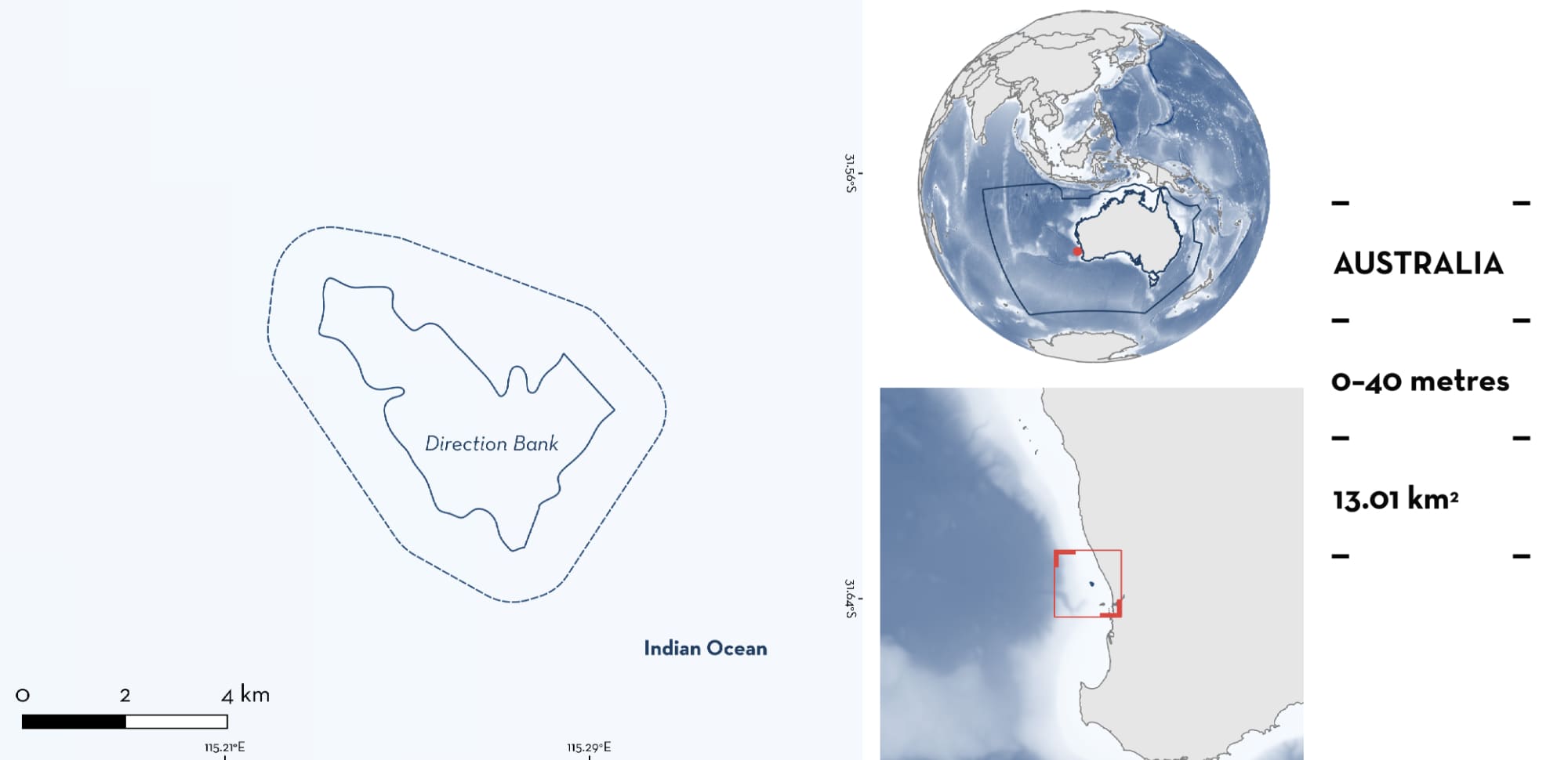
Direction Bank is located off the coast of southwest Western Australia, Australia. It is part of an elongated shoal situated north of Rottnest Island and about 30 km west-southwest of Two Rocks. The area is characterised by kelp-covered limestone reefs with several caves. Within the area there are: threatened species and undefined aggregations (Sand Tiger Shark Carcharias taurus).
Download factsheet
Direction Bank
DESCRIPTION OF HABITAT
Direction Bank is located off the coast of southwest Western Australia, Australia. It is part of an elongated shoal situated north of Rottnest Island and about 30 km west-southwest of Two Rocks. The habitat is characterised by kelp-covered limestone reefs with several caves at depths of 30–40 m (Hoschke et al. 2023).
The southwestern Australian continental shelf margin is influenced by two main current systems. In waters shallower than 50 m, the Capes Current flows along the inner shelf, transporting colder, upwelling-derived waters northward during the austral summer (Gersbach et al. 1999). At the shelf break, the Leeuwin Current flows poleward as a warmer, lower-salinity eastern boundary current, strongest during winter (Ridgway & Condie 2004).
This Important Shark and Ray Area is benthic and pelagic and is delineated from surface waters (0 m) to 40 m based on the bathymetry of the area.
CRITERION A
VULNERABILITY
One Qualifying Species considered threatened with extinction according to the IUCN Red List of Threatened Species regularly occurs in the area. This is the Critically Endangered Sand Tiger Shark (Rigby et al. 2025).
CRITERION C
SUB-CRITERION C5 – UNDEFINED AGGREGATIONS
Direction Bank is important for undefined aggregations of one shark species.
Aggregations of Sand Tiger Sharks are regularly and predictably recorded through the Community Monitoring Program established in 2014 to observe and document marine species across Western Australia (Hoschke et al. 2023). The program has been promoted through a combination of social media, information and education sessions with local dive and fishing organisations, and presentations to marine scientists and the general public. The Community Monitoring Program involved the submission of photographs and videos of Sand Tiger Sharks from 2006–2021. All data (photographs, videos, and accompanying information) were recorded in a database, including date, location, number of sharks, water temperature, and data source. The number of sharks recorded on each dive was determined either as the maximum number visible in a single photograph or video frame (MaxN), or, if no footage was available, as the maximum number observed by the diver at any one time. Only one MaxN value was recorded per location per day to avoid duplication. Between 2006–2021, 2,219 Sand Tiger Sharks were recorded from video footage taken from 838 dives at six dive sites across Western Australia: 132 animals were identified through photo-identification using left flank spot patterns (Hoschke et al. 2023). MaxN ranged between 2 and 30, with mean MaxN (cumulative MaxN divided by the number of dives) per site ranging 1–8.
Within this area, 86 Sand Tiger Sharks were sighted across 10 dives between 2019 and 2021 (January, February, March, May, August, and December), with a maximum MaxN of 30 (mean ~9), representing the highest MaxN and mean MaxN in Western Australia. Aggregations of >5 Sand Tiger Sharks were observed recurrently each year. A total of 10 individuals from this area were identified through photo-identification. One mature female (based on mating scars and distended belly) was photographed in May and again in October, and a mature male (based on clasper size and calcification) was photographed in May. All other observations at the site were of immature sharks, three of which were recorded across multiple years (two in 2019 and 2020, and one in 2019 and 2021). The size-at-maturity for Sand Tiger Sharks is 190–200 cm TL for males and 220–230 cm TL for females (Ebert et al. 2021), although in the Western Australia population there is some evidence of maturation in males occurring at an age of 9–10 years and a size of ~280 cm TL (Hoschke & Whisson 2016; Hoschke et al. 2023). Additional information is required to understand the nature and function of these aggregations.
Download factsheet
SUBMIT A REQUEST
ISRA SPATIAL LAYER REQUEST
To make a request to download the ISRA Layer in either a GIS compatible Shapefile (.shp) or Google Earth compatible Keyhole Markup Language Zipped file (.kmz) please complete the following form. We will review your request and send the download details to you. We will endeavor to send you the requested files as soon as we can. However, please note that this is not an automated process, and before requests are responded to, they undergo internal review and authorization. As such, requests normally take 5–10 working days to process.
Should you have questions about the data or process, please do not hesitate to contact us.