ISRA FACTSHEETS
ISRA FACTSHEETS
AUSTRALIA AND SOUTHEAST INDIAN OCEAN
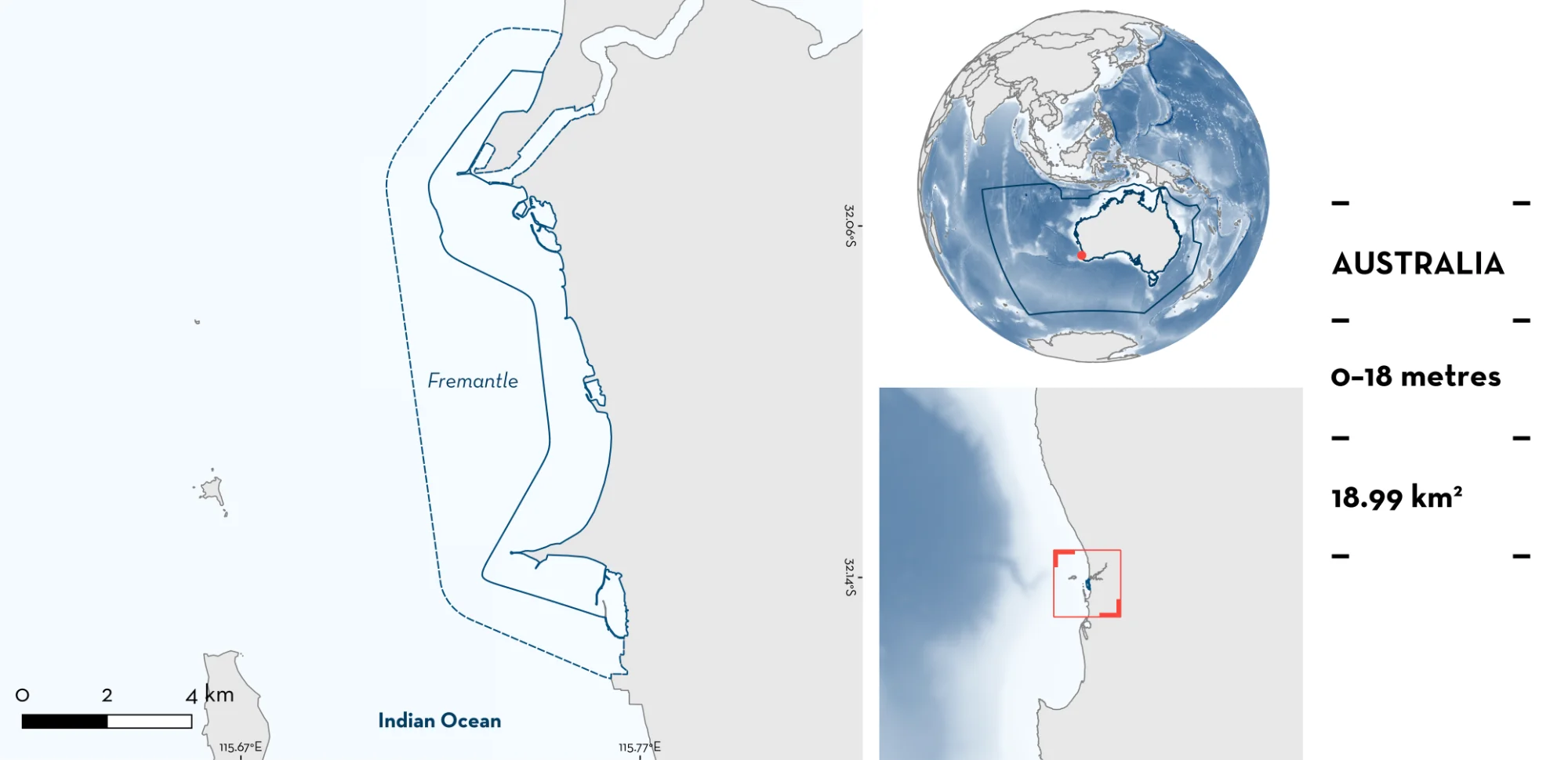
Fremantle
Summary
Fremantle is located in southwest Western Australia, Australia. This area covers ~17 km of coastline interrupted by the Swan Estuary. The habitat is characterised by a combination of sand with a mix of limestone reefs, macroalgae, and seagrass meadows. Nearshore circulation is strongly influenced by wave-driven mechanisms, particularly around coastal groynes, where persistent longshore currents and rip currents are generated by wave set-up variations. Within this area there are: range-restricted species (Masked Stingaree Trygonoptera personata); and reproductive areas (Port Jackson Shark Heterodontus portusjacksoni).
Download factsheet
Fremantle
DESCRIPTION OF HABITAT
Fremantle is located in southwest Western Australia, Australia. This area covers ~17 km of coastline interrupted by the Swan Estuary. The habitat is characterised by a combination of soft sediments with a mix of limestone reefs, macroalgae, and seagrass meadows (Lemmens et al. 1996; Wakefield et al. 2013). Several human structures are also encompassed in this area, such as shipwrecks, artificial reefs, piers and rock walls, and shipping channels (Hammond et al. 2020).
Nearshore circulation is strongly influenced by wave-driven mechanisms, particularly around coastal groynes, where persistent longshore and rip currents are generated (Olson & Pattiaratchi 2005; Pattiaratchi et al. 2009). In addition, the Leeuwin Current exerts a significant regional influence by transporting warm, low-salinity tropical waters southward (Benthuysen et al. 2014; Rennie et al. 2009). The nutrient dynamics are driven by a combination of upwelling and submarine groundwater discharge, resulting in higher nutrient levels, particularly for nitrate, in austral winter and autumn (Johannes et al. 1994; Hamilton et al. 2006; Machado & Imberger 2013). Temperature, salinity, and wave dynamics also vary seasonally, with thermal stratification in summer and enhanced mixing during winter (Zaker et al. 2007; Zhu et al. 2025).
This Important Shark and Ray Area is benthic and pelagic and is delineated from inshore and surface waters (0 m) to a depth of 18 m based on the bathymetry of the area.
CRITERION B
RANGE RESTRICTED
This area holds the regular presence of Masked Stingaree as a resident range-restricted species.
Of 305 Masked Stingaree records available on iNaturalist from across the species’ entire geographic range, 201 observations (65.9%) are from within this area (iNaturalist 2025). Records show the species occurrence every year between 2015–2025 (except in 2017), highlighting regular occurrence across years. When compared to the broader surrounding region, this area had a far higher proportion of records than elsewhere, with Cape Naturaliste having 3.9% (n = 12) of records and Rottnest Island 1% (n = 3) (iNaturalist 2025). These citizen science records include at least six animals visually estimated as pregnant based on their distended abdomens. Pregnant females were reported from February 2021 (n = 2), 2022 (n = 2), and 2024 (n = 2), suggesting that this area might be important for the reproduction of Masked Stingaree (iNaturalist 2025). Masked Stingaree mating occurs in late autumn and mid-winter and parturition occurs in April and May (White et al. 2002). Masked Stingaree is restricted to the South West Australia Shelf Large Marine Ecosystem (LME) and the West Central Australian Shelf LME.
CRITERION C
SUB-CRITERION C1 – REPRODUCTIVE AREAS
Fremantle is an important reproductive area for one shark species.
Between 2018–2025, recreational divers from the University of Western Australia (UWA) Underwater Dive Club visited this area at least once a month year-round and frequently observed ~3 neonate/young-of-the-year (YOY) Port Jackson Sharks (Nico Fassbender unpubl. data). Sharks were observed on sandy substrates interspersed between patches of seagrass. Individuals were visually estimated to measure ~20–30 cm total length (TL), with the largest individuals observed at ~30 cm TL. Size-at-birth for this species is 23–24 cm TL (Ebert et al. 2021). Neonates and YOY were present in the area year-round.
Citizen science records also highlight the importance of this area for early life-stages of Port Jackson Sharks (iNaturalist 2025). In addition to four egg case records, all 108 Port Jackson Shark observations reported from this area between 2016–2025 consist of individuals visually identified as neonates or YOY. These individuals were recorded every year in this period (average = 11 per year) and every month but July (average = 9 per month). Life-stage was determined by their characteristic slender bodies and whitish colouration at these smaller sizes. The importance of this area for reproductive purposes is highlighted by the exclusive observations of neonate/YOY individuals compared to other life-stages (iNaturalist 2025).
Download factsheet
SUBMIT A REQUEST
ISRA SPATIAL LAYER REQUEST
To make a request to download the ISRA Layer in either a GIS compatible Shapefile (.shp) or Google Earth compatible Keyhole Markup Language Zipped file (.kmz) please complete the following form. We will review your request and send the download details to you. We will endeavor to send you the requested files as soon as we can. However, please note that this is not an automated process, and before requests are responded to, they undergo internal review and authorization. As such, requests normally take 5–10 working days to process.
Should you have questions about the data or process, please do not hesitate to contact us.