ISRA FACTSHEETS
ISRA FACTSHEETS
AUSTRALIA AND SOUTHEAST INDIAN OCEAN
Montague Island
Summary
Montague Island is located on the south coast of New South Wales, Australia. The area is characterised by clear waters and sheltered bays, with large boulders and kelp reefs dominating the habitat. The area is influenced by semi-diurnal tides and is influenced by seasonal fluctuations in the East Australian Current. This area overlaps with Batemans Marine Park. Within this area there are: threatened species and resting areas (Sand Tiger Shark Carcharias taurus).
Download factsheet
Montague Island
DESCRIPTION OF HABITAT
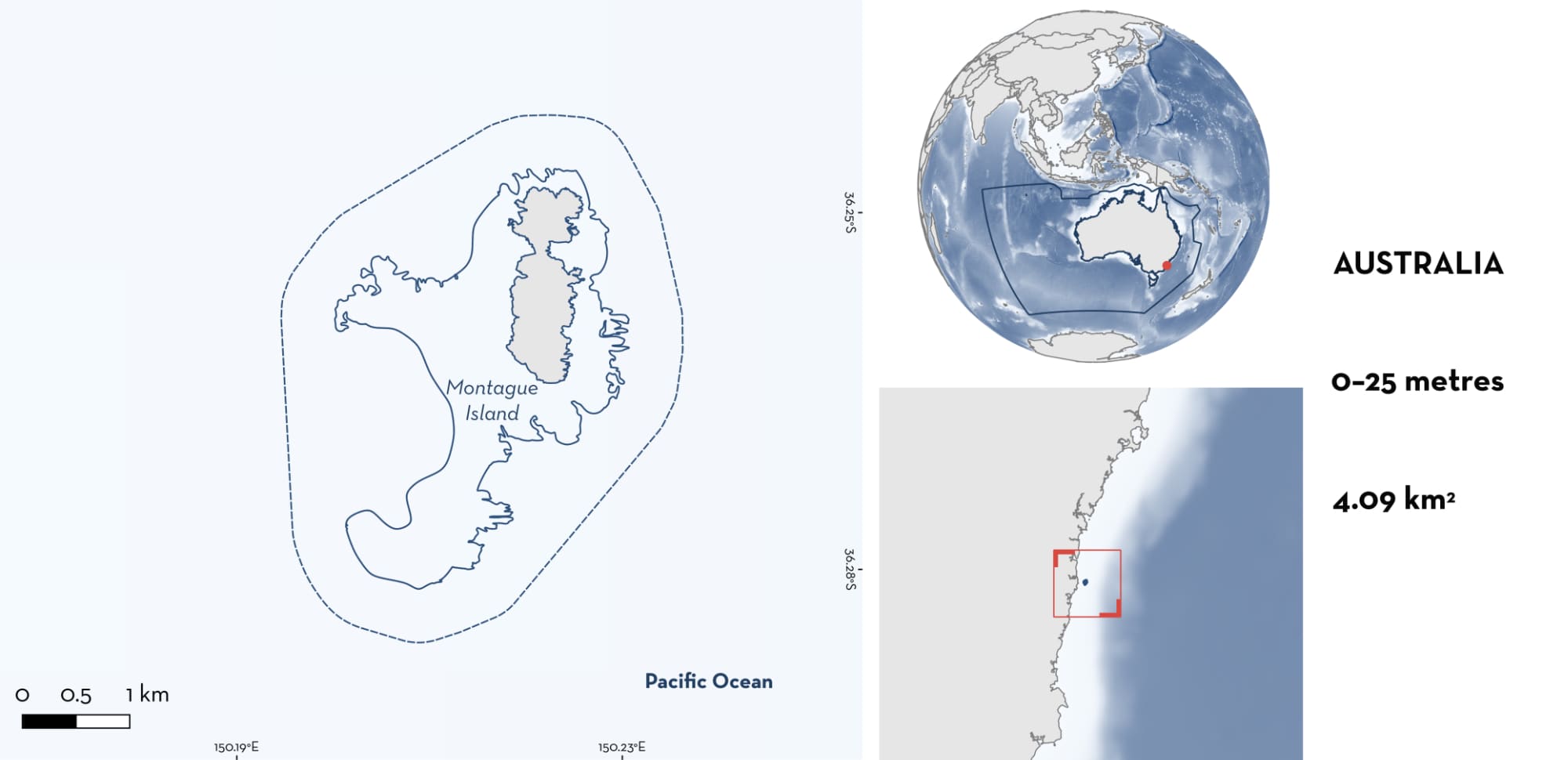
Montague Island is located in southern New South Wales (NSW), Australia. The area is situated ~9 km offshore of the township of Narooma and surrounds the second largest island in this state. The habitat is characterised by shallow clear waters and sheltered bays, with water temperatures ranging between 16–24°C (Underwater Safaris 2025). The substrates are comprised of large boulders and kelp reefs.
Montague Island is influenced by the East Australian Current, the poleward flowing western boundary current of the South Pacific Gyre (Suthers et al. 2011). The East Australian Current flow is strongest in the austral summer, and the formation of eddies along this coastline also fluctuate seasonally (Ridgway & Hill 2009).
This area overlaps with Batemans Marine Park (NSW DPIRD 2025).
This Important Shark and Ray Area is benthic and pelagic and is delineated from inshore and surface waters (0 m) to 25 m based on the bathymetry of the area.
CRITERION A
VULNERABILITY
One Qualifying Species considered threatened with extinction according to the IUCN Red List of Threatened Species regularly occurs in the area. This is the Critically Endangered Sand Tiger Shark (Rigby et al. 2025).
CRITERION C
SUB-CRITERION C3 – RESTING AREAS
Montague Island is an important resting area for one shark species.
There are multiple lines of evidence to support Sand Tiger Sharks regularly and predictably resting in this area. Evidence includes scientific surveys and acoustic tracking conducted by the New South Wales (NSW) Department of Primary Industries and Regional Development (Bradford et al. 2025; Otway & Louden 2025), and submissions and observations from a citizen science photo-identification catalogue (Sharkbook 2025).
Between 2011–2021, 10-year acoustic transmitters were used to track Sand Tiger Sharks and determine their preferred habitats based on residency rates (Otway & Louden 2025), and this information was used alongside scientific dive surveys to determine aggregation sites. Nineteen Sand Tiger Shark aggregation sites were highlighted in eastern Australia (Bradford et al. 2025). These were defined as a site where five or more Sand Tiger Sharks were observed together at one time, continuously or seasonally. Sites were classified as resting areas for the species based on shark behaviour and habitat use at the sites. During this period, three of the 31 tagged individuals were detected in the area (38,088 detections; Bradford et al. 2025). Observed residence periods lasted up to 15 days (Otway & Louden 2025). This is the southernmost location of their migratory corridor on their east coast of Australia (Bradford et al. 2025).
Scientific dive surveys in the area confirmed Sand Tiger Sharks were observed at Montague Island year-round, but more prevalent from spring to winter. Juvenile females were the most prevalent age class, with no adult males observed in the area (Bradford et al. 2025). Up to eight Sand Tiger Sharks were recorded resting in the area on a single scientific dive survey (B Louden pers. comms. 2025), highlighting the importance of this area for this species. Sand Tiger Sharks were observed swimming slowly close to the seabed, characteristic resting behaviour for the species (Bradford et al. 2025). They exhibited diurnal habitat use at this site, spending more time in the area during the day (Otway & Louden 2025).
The diel patterns in behaviour that the sharks exhibit at these sites is characteristic of Sand Tiger Sharks resting during the day and being active at night (presumably for foraging) (D Harasti pers. obs. 2025). Hovering and milling are also characteristic behaviours of resting Sand Tiger Sharks and comprise the majority of swimming behaviours observed at their main aggregation sites on Australia’s east coast (Smith et al. 2015). When hovering, sharks face into the water current and their tail beats allow them to maintain a stationary position, whereas milling involves slow movements and directional changes generally confined to a particular area within a gutter (Smith et al. 2015).
Between 2004–2025, 644 Sand Tiger Shark sightings were submitted from recreational divers in the area (Spot a Shark unpubl. data 2025). From these sightings, 130 individuals were identified using photo-identification, with <40 individuals observed over multiple years. Sightings of Sand Tiger Sharks were year-round at Montague Island, with a seasonal peak between December and April. Most of the sharks were assessed as adult females (67%) (S Han-de-Beaux unpubl. data 2025). Sand Tiger Sharks are observed swimming slowly between the gullies and rocky structures in the area, characteristic resting behaviour for the species (S Han-de-Beaux pers. obs. 2025).
Download factsheet
SUBMIT A REQUEST
ISRA SPATIAL LAYER REQUEST
To make a request to download the ISRA Layer in either a GIS compatible Shapefile (.shp) or Google Earth compatible Keyhole Markup Language Zipped file (.kmz) please complete the following form. We will review your request and send the download details to you. We will endeavor to send you the requested files as soon as we can. However, please note that this is not an automated process, and before requests are responded to, they undergo internal review and authorization. As such, requests normally take 5–10 working days to process.
Should you have questions about the data or process, please do not hesitate to contact us.