
ISRA FACTSHEETS
ISRA FACTSHEETS
AUSTRALIA AND SOUTHEAST INDIAN OCEAN
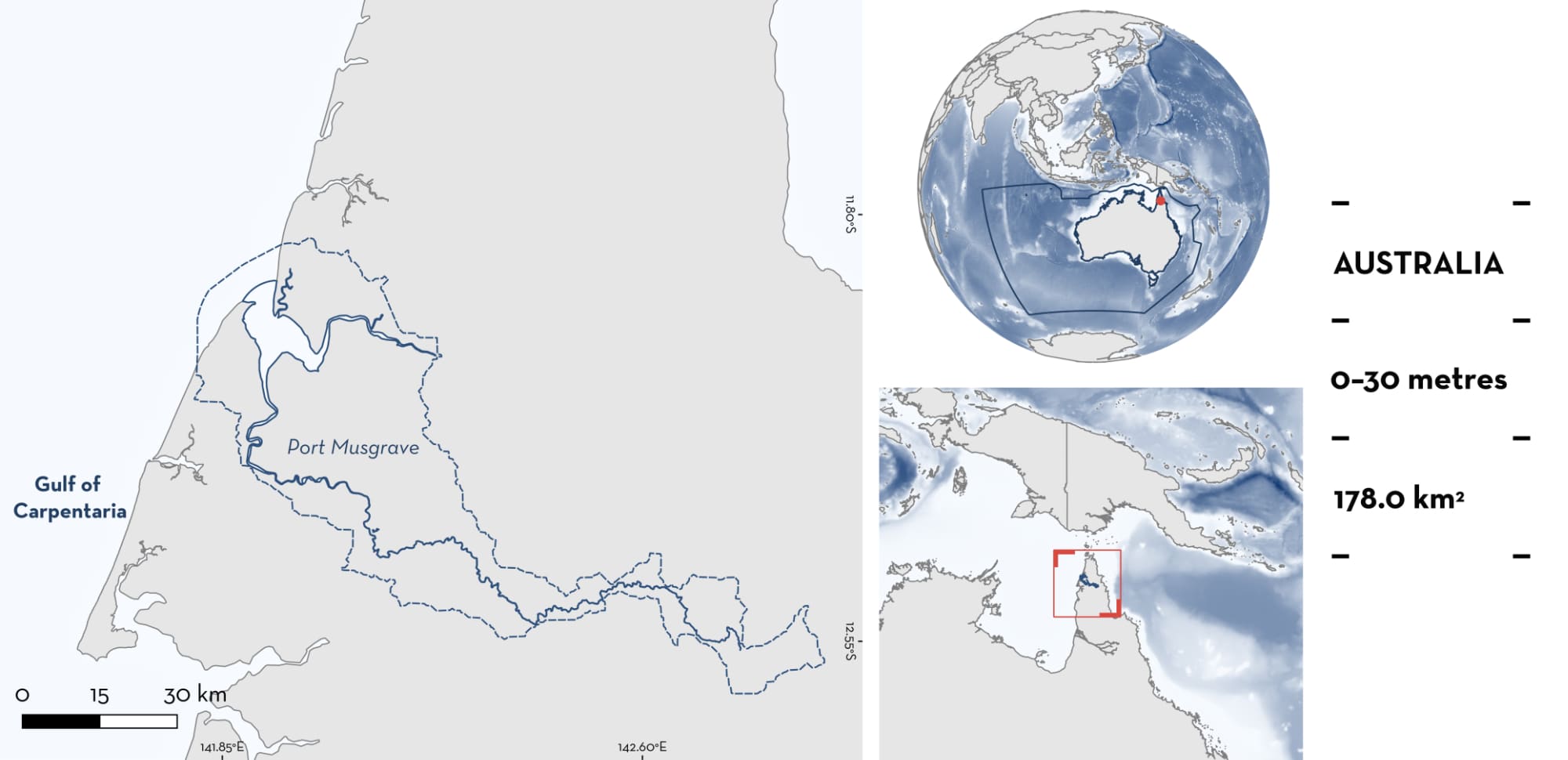
Port Musgrave
Summary
Port Musgrave is located on the west coast of Cape York, Queensland, Australia. This area encompasses the Wenlock and Ducie River systems which flow into Port Musgrave, a coastal embayment within the Gulf of Carpentaria, including the mouth of Namaleta Creek. The area is characterised by muddy enclosed bays, estuaries, brackish river waters, mangroves, sandy and muddy substrates, and freshwater habitats. The area is influenced by strong seasonal rainfall during tropical monsoons and daily salinity fluctuations. Within the area there are: threatened species (e.g., Speartooth Shark Glyphis glyphis); and reproductive areas (e.g., Narrow Sawfish Anoxypristis cuspidata).
Download factsheet
Port Musgrave
DESCRIPTION OF HABITAT
Port Musgrave is located on the west coast of Cape York, Queensland, Australia. This area encompasses the Wenlock and Ducie River systems up to 150 km upstream which flow into Port Musgrave, a coastal embayment within the Gulf of Carpentaria, including the mouth of Namaleta Creek. The area is characterised by muddy enclosed bays, estuaries, brackish river waters, sandy and muddy substrates, and freshwater habitats.
The area is influenced by strong seasonal rainfall during tropical monsoons extending between January–April (Pillans et al. 2022). The dry season extends from April/May until October (Pillans et al. 2022). As tropical tidal rivers, the area experience daily salinity fluctuations and substantial increases in freshwater inflow with the onset of the wet season (Lyon et al. 2017).
This Important Shark and Ray Area is benthic and pelagic and is delineated from inshore and surface waters (0 m) to 30 m depth based on the bathymetry of the area.
CRITERION A
VULNERABILITY
Seven Qualifying Species considered threatened with extinction according to the IUCN Red List of Threatened Species regularly occur in the area. Threatened sharks comprise one Critically Endangered species and two Vulnerable species; threatened rays comprise three Critically Endangered species and one Endangered species (IUCN 2025).
CRITERION C
SUB-CRITERION C1 – REPRODUCTIVE AREAS
Port Musgrave is an important reproductive area for three shark and four ray species.
Between 2012–2025, two scientific surveys per year were conducted using a combination of gillnets (stretched mesh size 6” or 8”, length = 25–100 m, drop = 2 m), rod-and-line, and baited crab pots. Species captured were sexed and measured for total length (TL) or disc width (DW) (Lyon et al. 2017; Dwyer et al. 2019, 2020; Pillans et al. 2022). Additionally, between 2016–2025 photos and capture details of sharks and rays were submitted to the Sharks and Rays Australia (SARA) database, from recreational fishers during the dry season (austral winter) and year-round in partnership with the Mapoon Land and Sea Rangers (SARA 2025). Size (TL or DW) were either reported or estimated through rostrum morphometrics for sawfishes (Biskis et al. 2025; SARA 2025). Since the SARA database has been in operation (2016), it has received 484 reputable sightings of sharks and rays in Queensland. Of these, 22 are attributed to this area (BE Wueringer & VN Biskis unpubl. data 2025).
Between 2014–2017, 65 Bull Sharks ranging in size between 70–144 cm TL (average = 90 cm TL) were captured in the upstream Wenlock River between 55–103 km from the river mouth (Dwyer et al. 2020). Of these, 52 (87%) were neonates or young-of-the-year (YOY; 70–98 cm TL) (Dwyer et al. 2020). Size-at-birth of the species is 56–81 cm TL (Ebert et al. 2021) and YOY showing umbilical scars of up to 99 cm have been captured in the region (Pillans et al. 2020). A subset of 22 individuals with a size of 94 ± 15 cm TL (mean ± standard deviation; SD) were tracked with acoustic tags across the area between September 2014–August 2018 (Dwyer et al. 2020). During the wet season (November–April), due to increases in freshwater inflow and low salinity levels, Bull Shark neonate, YOY, and juveniles migrated towards the lower estuary before returning upstream during September–December (late dry season) when they occupied areas between 60–110 km upstream. Tracked Bull Sharks remained within salinity levels ranging between 0.0–26.1 psu (Dwyer et al. 2020). Additionally, between 2018–2023, a total of 38 neonate and YOY Bull Sharks (70–98 cm TL) were captured in April–November in Port Musgrave, representing 67% of individuals captured during this period. Half of the remaining individuals were small juveniles (100–118 cm TL).
Between 2017–2019, a total of 60 neonate and YOY Winghead Sharks ranging in size between 45–65 cm TL were captured in the area (BE Wueringer & RG Dwyer unpubl. data 2025). These represented 86% of the 70 Winghead Sharks captured in the area. Size-at-birth of the species is 32–45 cm TL (Ebert et al. 2021) and YOY sizes are estimated at 45–65 cm TL, based on growth curves (Smart et al. 2013). Neonates and YOY were captured during April–May of 2017 (n = 37; 88% of total captures), 2018 (n = 4; 44%), and April 2019 (n = 19; 86%). Pregnant females (n = 17) were also captured in the area during November 2023 and 2024, representing 80% of the total mature individuals captured (BE Wueringer & RG Dwyer unpubl. data 2025). Pregnant females were inferred based on distended abdomens, presence of unborn pups inside deceased specimens, and reddish coloration around the cloaca. Only females were caught inside the mouth of the Ducie and Wenlock rivers (within the area) during November 2024, suggesting possible aggregation behaviour in deep estuarine holes as gestation sites (BE Wueringer & RG Dwyer unpubl. data 2025).
Between 2012–2013, 65 Speartooth Sharks ranging in size between 53–139 cm TL were captured in the area, of which 24 (37%) were neonates and YOY (53–80 cm TL) (Lyon et al. 2017). Size-at-birth for the species is ~50–65 cm TL (Pillans et al. 2009) and YOY are estimated to grow 16 ± 8 cm (mean ± SD) in their first year and were identified based on size and presence of umbilical scars (Lyon et al. 2017; Pillans et al. 2022). Additionally, between 2013–2020, a total of 224 immature Speartooth Sharks ranging in size from 52–91 cm TL (68.4 ± 8.9 cm TL; mean ± SD) were captured upstream between 15–55 km from the river mouth (Pillans et al. 2022). Neonates and YOY were captured during October, November, December, March, April, May, and July with the abundance highest immediately after pupping which is thought to occur from early September to late October (Pillans et al. 2022). In November 2024, pregnant females (n = 3) were captured in the area representing 100% of the total individuals captured this month (RG Dwyer unpubl. data 2025). Pregnant females were inferred based on distended abdomens and reddish coloration in the cloaca. Between August 2013–December 2020, 224 individuals including neonate, YOY, and juveniles were acoustically tagged and tracked (n = 37 acoustic receivers; Pillans et al. 2022). Speartooth Sharks were detected up to 62 km upstream in Tentpole Creek from May–January while during February–April sharks performed a seasonal downstream movement to the Wenlock River, related to freshwater influx (Pillans et al. 2022). Connectivity among these two rivers with the Ducie River (all within the area) up to 45 km upstream was recorded (Pillans et al. 2022). Tracked Speartooth Sharks remained within salinity levels ranging between 0.4–25.3 psu (Dwyer et al. 2020). Port Musgrave is the only area within Queensland with contemporary records of Speartooth Sharks, and limited genetic exchange exists among rivers exceeding 100 km distance (Feutry et al. 2014).
Between 2017–2025, a total of 27 neonate and YOY Spotted Eagle Rays were captured in the area, ranging in size between 25–47 cm DW (BE Wueringer unpubl. data 2025). These represented 26% of the 104 Spotted Eagle Rays captured in the area. Size-at-birth for this species is 18–50 cm DW (Last et al. 2016), indicating that captured individuals were neonates or YOY. Individuals were captured during May 2017 (n = 1) and 2018 (n = 4), April 2018–2019 (n = 10), March 2023 (n = 5), and April 2024 (n = 7) (BE Wueringer unpubl. data 2025). No pregnant females were captured. Port Musgrave in conjunction with Albatross Bay hosts the largest number of neonates and YOY for the species on the east coast of the Gulf of Carpentaria.
Between 2017–2021, a total of 24 neonate and YOY Narrow Sawfish were captured (n = 16) or reported (n = 8) in the area ranging in size between 80–132 cm TL (SARA 2025; BE Wueringer & VN Biskis unpubl. data 2025; CSIRO unpubl. data 2025). Size-at-birth of the species is 43–70 cm TL (Last et al. 2016) and YOY sizes are estimated at <150 cm TL, based on growth curves (Peverell 2009). Of the 17 captured individuals, eight were from field surveys in the area during May 2017 (n = 6), April 2019 (n = 1), and 2022 (n = 1) ranging in size between 96–124 cm TL (BE Wueringer & VN Biskis unpubl. data 2025). Additionally, eight YOY Narrow Sawfish were captured at the mouth of Namaleta Creek (within the area) during a different survey in March 2018 (eight days), ranging in size between 87–97 cm TL (CSIRO unpubl. data 2025). Citizen scientists reported the remaining eight YOY Narrow Sawfish ranging between 80–132 cm TL caught in May of 2019 and 2021, representing 88% of submitted encounters for this species in the area (SARA 2025). The area holds the highest number of records for neonate and YOY Narrow Sawfish on the east coast of the Gulf of Carpentaria.
Between 2012–2025, a total of ten YOY Largetooth Sawfish were captured and reported in the area (SARA 2025; BE Wueringer & VN Biskis unpubl. data 2025). Of these, three YOY Largetooth Sawfish were captured during field surveys, ranging in size 105–108 cm TL (BE Wueringer & VN Biskis unpubl. data 2025). Size-at-birth of the species is 72–91 cm TL and YOY sizes are estimated at <130 cm TL, based on growth curves (Peverell 2009). YOY were captured during June and November in 2015 (n = 2) and 2022 (n = 1) (BE Wueringer & VN Biskis unpubl. data 2025). The remaining seven YOY Largetooth Sawfish were sightings reported in the upstream regions of the Wenlock River, up to Moreton Telegraph Station within the area, ranging in size between 90–130 cm TL between 2016–2024 during the months of August–November (SARA 2025; BE Wueringer & VN Biskis unpubl. data 2025). The area is also important for adult Largetooth Sawfish with three individuals ranging in size between 310–560 cm TL being reported in the area in 2019, 2020, and 2024 (BE Wueringer & VN Biskis unpubl. data 2025).
Between 2018–2025, a total of seven neonate and YOY Green Sawfish were captured in the area, ranging in size between 93–97 cm TL (iNaturalist 2025; BE Wueringer & VN Biskis unpubl. data 2025; CSIRO unpubl. data 2025). These represented 42% of the 12 Green Sawfish captured in the area. Size-at-birth of the species is 77–97 cm TL (Morgan et al. 2015) and YOY sizes are estimated at <117 cm TL, based on growth curves (Lear et al. 2023). Neonates and YOY were captured in November 2018 (n = 5) and 2025 (n = 2) (iNaturalist 2025; BE Wueringer & VN Biskis unpubl. data 2025). Juveniles ranging between 141–292 cm TL were also captured in the area in 2019 (n = 2), 2023 (n = 2), and 2024 (n = 2). Of these, in 2018, five YOY Green Sawfish ranging between 93–97 cm TL were captured by an Aboriginal Land and Sea Ranger in the same cast net, indicating that these pups rested together before their capture (BE Wueringer & VN Biskis unpubl. data 2025). Port Musgrave hosts all early life-stages of Green Sawfish, from neonates to sub-adults. Although only low numbers are recorded in the area, this may be explained by the species’ pattern of low abundance and highly variable frequency of occurrence within the Gulf of Carpentaria (Peverell 2009). Sexually mature Green Sawfish are also present in the area, with animals caught in April 2019 (471 cm TL) and one reported through citizen science in 2020 (400 cm TL; SARA 2025; BE Wueringer & VN Biskis unpubl. data 2025).
Download factsheet
SUBMIT A REQUEST
ISRA SPATIAL LAYER REQUEST
To make a request to download the ISRA Layer in either a GIS compatible Shapefile (.shp) or Google Earth compatible Keyhole Markup Language Zipped file (.kmz) please complete the following form. We will review your request and send the download details to you. We will endeavor to send you the requested files as soon as we can. However, please note that this is not an automated process, and before requests are responded to, they undergo internal review and authorization. As such, requests normally take 5–10 working days to process.
Should you have questions about the data or process, please do not hesitate to contact us.

