ISRA FACTSHEETS
ISRA FACTSHEETS
AUSTRALIA AND SOUTHEAST INDIAN OCEAN
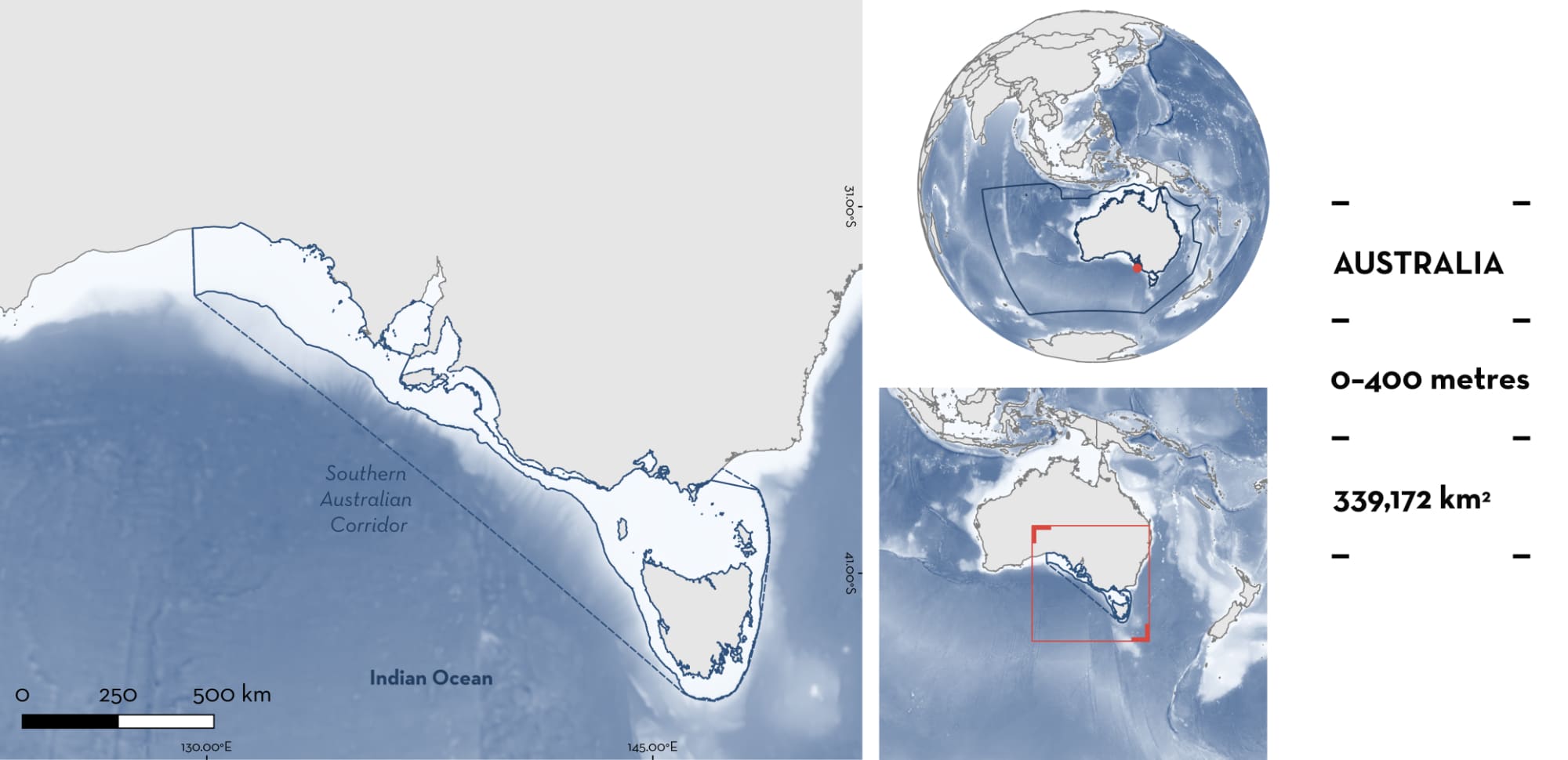
Southern Australian Corridor
Summary
Southern Australian Corridor is located along the southern coast of Australia. It extends across waters of South Australia, Victoria, and Tasmania. The area is characterised by an extended continental shelf in the Great Australian Bight and Bass Strait and includes multiple bays and islands with seagrass beds as well as sandy and rocky substrates. It is influenced by multiple currents that produces upwelling along the coast during the austral winter. Within this area there are: threatened species and movement areas (Tope Galeorhinus galeus).
Download factsheet
Southern Australian Corridor
DESCRIPTION OF HABITAT
Southern Australian Corridor is located along the southern coast of Australia. It extends from the Great Australian Bight in the west to Tasmania in the east and expands across waters of South Australia, Victoria, and Tasmania. The area is characterised by an extended continental shelf in the Great Australian Bight and Bass Strait and includes multiple bays and islands with seagrass beds as well as sandy and rocky substrates. The Great Australian Bight is a large oceanic bight with minimal freshwater input. Bass Strait is a shallow body of water (~60 m deep) that separates Tasmania from the coast of Victoria.
In the west, the oceanography and ecology of the Great Australian Bight are influenced by the Leeuwin and Flinders currents. The warm Leeuwin Current flows from the west during the austral winter, while the Flinders Current brings cooler water from the southeast and enhances upwelling during the winter (Richardson et al. 2019). Furthermore, seasonal upwellings of cold nutrient-rich water occur along the western side of Kangaroo Island and the Eyre Peninsula (Richardson et al. 2020). This mixing of currents and upwelling provides nutrient-rich waters. In the east, off the northeast Victorian coast, upwellings occur sporadically most of the year (except May and June). These waters are nutrient-low so increases in productivity are minimal except during El Niño events when nutrient levels are high (Sheperd & Edgar 2013). Currents are mostly influenced by the West Wind Drift, local winds, and the winter coastal current. Easterly flow dominates during winter while in summer currents tend westwards (Sheperd & Edgar 2013). Off eastern Australia, The East Australian Current flows down past Bass Strait to eastern Tasmania bringing warm and salty water southwards with a stronger influence in summer (Sheperd & Edgar 2013). In winter, the Zeehan Current flows around southern Tasmania and up the east coast. Upwelling is present along the east coast of Tasmania during winter as a result of Antarctic waters coming to the surface due to cyclonic eddies (Sheperd & Edgar 2013).
This Important Shark and Ray Area is benthic and pelagic and is delineated from inshore and surface waters (0 m) to 400 m based on the depth range of Qualifying Species in the area.
CRITERION A
VULNERABILITY
One Qualifying Species considered threatened with extinction according to the IUCN Red List of Threatened Species regularly occurs in the area. This is the Critically Endangered Tope (Walker et al. 2020).
CRITERION C
SUB-CRITERION C4 – MOVEMENT
Southern Australian Corridor is an important movement area for one shark species.
Between 1945–2012, a number of tagging studies (using conventional and satellite tags) focused on Tope indicated that this area was regularly used as a movement corridor (Olsen 1953, 1954, 1959; Walker 1989; Stevens & West 1997; West & Stevens 2001; Walker et al. 2008; Rogers et al. 2017; McMillan et al. 2019). Tope undertake seasonal migrations exceeding 1,000 km, primarily between aggregation sites for gestating females in the Great Australian Bight in South Australia, and reproductive areas in Bass Strait and Tasmania (Olsen 1954; Stevens & West 1997; West & Stevens 1997; Walker 2005; Walker et al. 2008; Rogers et al. 2017; McMillan et al. 2018, 2019). In addition, once mature, Tope move across bays and estuaries (and between them) that function as nursery areas in Victoria and Tasmania before moving to Bass Strait after they are two-years old and then to the Great Australian Bight as they grow older. Archival tagging indicates that these movements are restricted to the shelf and the shelf break where Tope spend ~80% of their time (Olsen 1954; West & Stevens 2001).
Between 1947–1954, Tope were caught for tagging and biological studies during fishing operations and research surveys across southeast Australia (Olsen 1953, 1954, 1959). During this period, 5,862 Tope were tagged with conventional tags with the majority (n = 4,755, 81.1%) being tagged in inshore areas of Tasmania (e.g., Port Sorell, Pittwater) and Victoria (e.g., Port Phillip Bay) while the rest (n = 1,107, 18.9%) were tagged in offshore areas in Bass Strait and Tasmania. Up until 1953, 237 tags (4%) were recovered. Based on recaptures and fishing data, neonate and young-of-the-year (YOY) Tope (YOY size = 55 cm total length [TL]; Olsen 1954; Moulton et al. 1992) tagged in bays and estuaries (inshore areas) stayed there during summer months and moved to the open seas in Bass Strait during early autumn, returning to bays and estuaries across Tasmania and Victoria during spring (Olsen 1954, 1959). In addition, five individuals tagged in Victoria and Tasmania were recaptured in South Australia, around Kangaroo Island and in the shelf off Spencer Gulf and Gulf St Vincent (Olsen 1954). One of these individuals was a large female tagged 18 months earlier in Tasmania during the pupping season. Tope tagged in offshore areas were adults and showed more extended movements along the area with females moving from nursery areas around Victoria and Tasmania where they occur during late spring and summer to areas off South Australia during late summer and winter months (Olsen 1954). These movements were supported by catches from commercial fishers across southern Australia (Olsen 1959).
Tope (n = 631) were also tagged with conventional tags between 1973–1976 during commercial fishing operations (Walker 1989). Individuals were tagged at 150 sites on the continental shelf between Streaky Bay in South Australia, Gabo Island in Victoria, and Hobart, Tasmania. Up until 1999, 117 individuals (16.5%) were recaptured with the maximum time-at-liberty being 25.3 years (Brown et al. 2000).
Between 1991–1997, 404 YOY Tope were tagged with conventional tags in nursery areas around Tasmania (Stevens & West 1997). Of these, 50 individuals (12.4%) were recaptured. The majority of recaptured Tope (n = 28, 69.3%) moved up to 100 km from the tagging site while the rest moved between 350 and >1,850 km from the tagging site to areas around Bass Strait and South Australia. Individuals that travelled greater distances from tagging sites were more than two years old based on their size-at-recapture (West & Stevens 1997). Movements showed the same patterns from tagging experiments conducted during the 1940s and 1950s and described above (Olsen 1954, 1959). In addition, between 1990–1999, tagging experiments were conducted in Bass Strait and South Australian waters (mostly in the Great Australian Bight; Brown et al. 2000). During this period, 2,686 Tope were tagged (including those YOY tagged in Tasmania) and 541 (20.1%) were recaptured. Recaptures occurred across South Australia, Victoria, and Tasmania with 50% of these occurring outside the tagging locations. Movements between Tasmania and the Great Australian Bight were more common despite the probability of recapture being lower there as fishing effort was higher in Bass Strait (Brown et al. 2000).
In general, of 9,819 Tope tagged across multiple studies with conventional tags between 1947–1999, 1,255 animals (12.8%) were recaptured by 1999 (Brown et al. 2000; Walker et al. 2008). The probability of annual movement to different areas across southern Australia was estimated based on a subset of the >65 cm TL individuals tagged (n = 2,054) and recaptured (n = 434) (Walker et al. 2008). For juvenile Tope (65–119 cm TL), the probability of individuals moving from Tasmania to South Australia was estimated at 41.4% and moving from Tasmania to Bass Strait at 20.2% (Walker et al. 2008). For adult females, it was estimated that 43.3% move from Tasmania to South Australia, 24.9% from South Australia to Tasmania, and 44.1% from Bass Strait to Tasmania (Walker et al. 2008).
A tagging experiment with archival tags focusing on describing the movements of pregnant females was conducted in October 1997 (West & Stevens 2001). The experiments looked to tag pregnant females prior to the known pupping season (November–January) to understand if they moved to known pupping areas in Victoria and Tasmania or stayed in the Great Australian Bight. However, catches of Tope were very low as population declines were recorded since before the 1960s across Australia (Braccini et al. 2009). Only 23 females (one pregnant) measuring 125–165 cm TL and 7 males measuring 131–141 cm TL were tagged (West & Stevens 2001). Of these individuals, 15 were tagged in shelf habitats in the Great Australian Bight and eight were tagged on the shelf break off Beachport, South Australia. Nine sharks were recaptured with time-at-liberty ranging between 0.3–17.7 months. Of these sharks, five were recaptured east of the tagging location with distances ranging between 284–648 km. Movements were mostly restricted to depths <200 m with sporadic excursions to the upper slope at depths between 200–600 m (West & Stevens 2001).
More contemporary tagging experiments also recorded the movements of adult and pregnant females in the area (Rogers et al. 2017; McMillan et al. 2019). In January 2012, 32 Tope were tagged with satellite tags in the central Great Australian Bight (Rogers et al. 2017). Of these, ten were females measuring 147–170 cm TL caught at depths of 40–49 m. Another two females were dead when landed and dissection showed that they were pregnant (Knuckey et al. 2014). Sizes of pregnant females were like those of tagged individuals, suggesting that those were potentially pregnant. In addition, one neonate Tope with an open umbilical scar was caught. Deployment duration was between 5–44 days and distances covered were between 51–409 km (Rogers et al. 2017). Five of the ten tagged females stayed in mid-shelf waters (50–100 m) in the inshore Great Australian Bight while another four moved to the outer shelf in the Great Australian Bight (100–150 m depths). The largest tracking duration was 44 days and some of the sharks moved to eastern locations which coincides with the hypothesis that pregnant Tope move to parturition sites in Bass Strait and Tasmania (Rogers et al. 2017). In December 2015 and October–November 2017, 15 pregnant females were tagged with satellite transmitters in the Great Australian Bight and southwest of Kangaroo Island, South Australia. Pregnancy was determined visually based on the triangular shape of late-term pregnant females and in-utero movements of embryos that could be felt externally. In addition, in 2017 pregnancy was validated with ultrasound. All pregnant females tagged in 2015 and tagged in Great Australian Bight stayed up to one year after tagging (McMillan et al. 2018). From the individuals tagged in 2017 (n = 5), >1 month prior to the pupping season, three migrated to Bass Strait and Tasmania. The information of both tagging studies suggest that some pregnant female may pup in the area while others move to the known pupping areas in Victoria and Tasmania (McMillan et al. 2018, 2019).
A recent study integrated migratory connectivity data and developed a network model demonstrating the transboundary migrations of Tope across the Great Australian Bight, South Australia, Bass Strait, and Tasmania (Bezerra et al. 2025). All lines of evidence indicate that Tope are moving between areas where pregnant females gestate in the Great Australian Bight to pupping areas across the coast of Victoria and Tasmania.
Download factsheet
SUBMIT A REQUEST
ISRA SPATIAL LAYER REQUEST
To make a request to download the ISRA Layer in either a GIS compatible Shapefile (.shp) or Google Earth compatible Keyhole Markup Language Zipped file (.kmz) please complete the following form. We will review your request and send the download details to you. We will endeavor to send you the requested files as soon as we can. However, please note that this is not an automated process, and before requests are responded to, they undergo internal review and authorization. As such, requests normally take 5–10 working days to process.
Should you have questions about the data or process, please do not hesitate to contact us.