ISRA FACTSHEETS
ISRA FACTSHEETS
AUSTRALIA AND SOUTHEAST INDIAN OCEAN
Wallis Lake
Summary
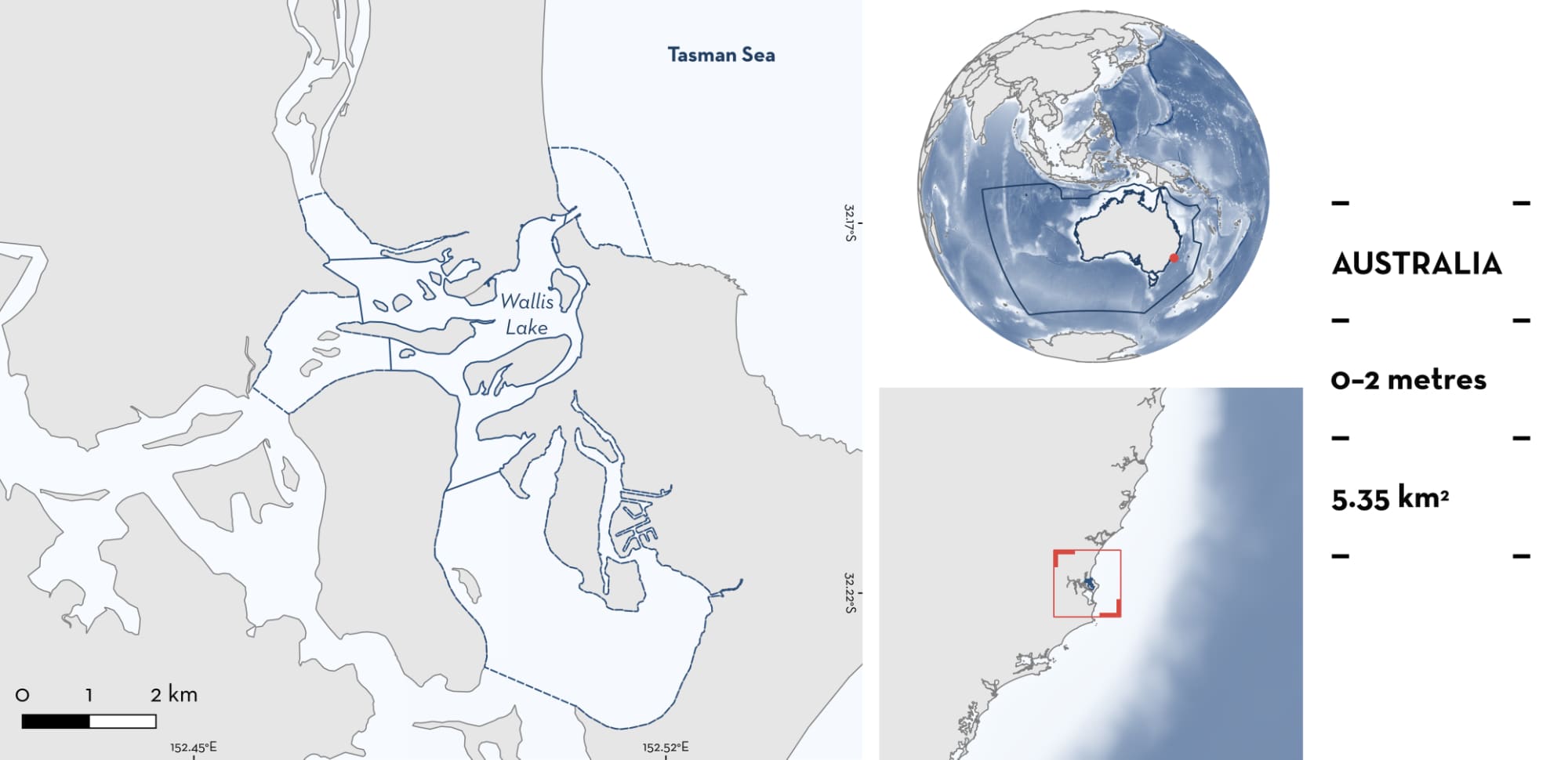
Wallis Lake is located on the central coast of New South Wales, Australia. The area is an estuarine system that encompasses multiple islands and is characterised by sandy and muddy substrates and seagrass beds. The area is influenced by freshwater input from multiple rivers. Within this area there are: threatened species and feeding areas (Estuary Stingray Hemitrygon fluviorum).
Download factsheet
Wallis Lake
DESCRIPTION OF HABITAT
Wallis Lake is located on the central coast of New South Wales, Australia. It is found on the northern part of the Wallis Lake estuary, a large and shallow estuarine lake. The area receives freshwater input from Wallis Creek, Coolongolook River, and Wallamba River mostly during the rainy season in the austral summer (Hutchings et al. 1978). The area includes Breckenridge Channel and multiple islands (e.g., Wallis Point, Leon, Miles) and is characterised by the presence of seagrass beds and bare (sandy and muddy) substrates (Dekker et al. 2003). The area is important for oyster production with multiple oyster leases found in it (Ajani et el. 2022).
The area is permanently open to the sea with a tidal range of <0.3 m (Hutchings et al. 1978). Sea surface temperature ranges from ~13°C in August to ~27°C in January (Ajani et al. 2022).
This Important Shark and Ray Area is benthic and is delineated from inshore and surface waters (0 m) to 2 m based on the bathymetry of the area.
CRITERION A
VULNERABILITY
One Qualifying Species considered threatened with extinction according to the IUCN Red List of Threatened Species regularly occurs in the area. This is the Vulnerable Bull Shark (Rigby et al. 2021).
CRITERION C
SUB-CRITERION C2 – FEEDING AREAS
Wallis Lake is an important feeding area for one ray species.
Estuary Stingrays regularly and predictably feed in Wallis Lake (Grew 2025). Targeted drone surveys (transects and tracking of individual rays) were conducted between January 2022–May 2024 (Grew 2025). Transects (450 m straight) were conducted across the estuary at 30 m altitude and covering multiple habitats (oyster leases, seagrass, and bare substrates). A maximum of 16 transects were conducted per day. Estuary Stingrays were also tracked individually when located. Locations identified during transect surveys were searched for rays and when an individual was sighted the drone was moved to 5 m altitude and the individual was followed until it was lost, or the battery ran out. Multiple observations were recorded for a single individual tracked. Between 30–50 individual tracks were conducted per season (Grew 2025).
During these surveys, 93 Estuary Stingrays were observed during transect surveys while 278 were individually tracked. In transects, individuals were observed mostly swimming (61 instances, 67.8%) followed by foraging (21 instances, 23.3%) and resting (8 instances, 8.9). Most of the observations (n = 77) were recorded on bare substrates, followed by seagrass (n = 13) and oyster leases (n = 3). The most common behaviours for Estuary Stingrays during individual tracking were swimming (n = 242 observations, 39.1%) and foraging (n = 211 observations, 34.1%) on bare substrates (Grew 2025). Bare substrates seem to be preferred due to a higher accessibility to prey compared to other substrates (Grew et al. 2024).
In addition, Estuary Stingray samples (n = 21) and potential prey were collected between February–September 2024 for stable isotope analysis (Grew 2025). Mixing models revealed that benthic fish and the crustaceans Blue Swimmer Crab Portunus armatus and School Prawn Metapenaeus macleaya contributed most to the diet of Estuary Stingrays (M Grew unpubl. data 2025). Some of these are important commercial species and are known to aggregate and spawn in this area (Raoult et al. 2022; Grew 2025), highlighting the importance of this area for feeding purposes of Estuary Stingrays.
Download factsheet
SUBMIT A REQUEST
ISRA SPATIAL LAYER REQUEST
To make a request to download the ISRA Layer in either a GIS compatible Shapefile (.shp) or Google Earth compatible Keyhole Markup Language Zipped file (.kmz) please complete the following form. We will review your request and send the download details to you. We will endeavor to send you the requested files as soon as we can. However, please note that this is not an automated process, and before requests are responded to, they undergo internal review and authorization. As such, requests normally take 5–10 working days to process.
Should you have questions about the data or process, please do not hesitate to contact us.