ISRA FACTSHEETS
ISRA FACTSHEETS
AUSTRALIA AND SOUTHEAST INDIAN OCEAN
Elizabeth Reef
Summary
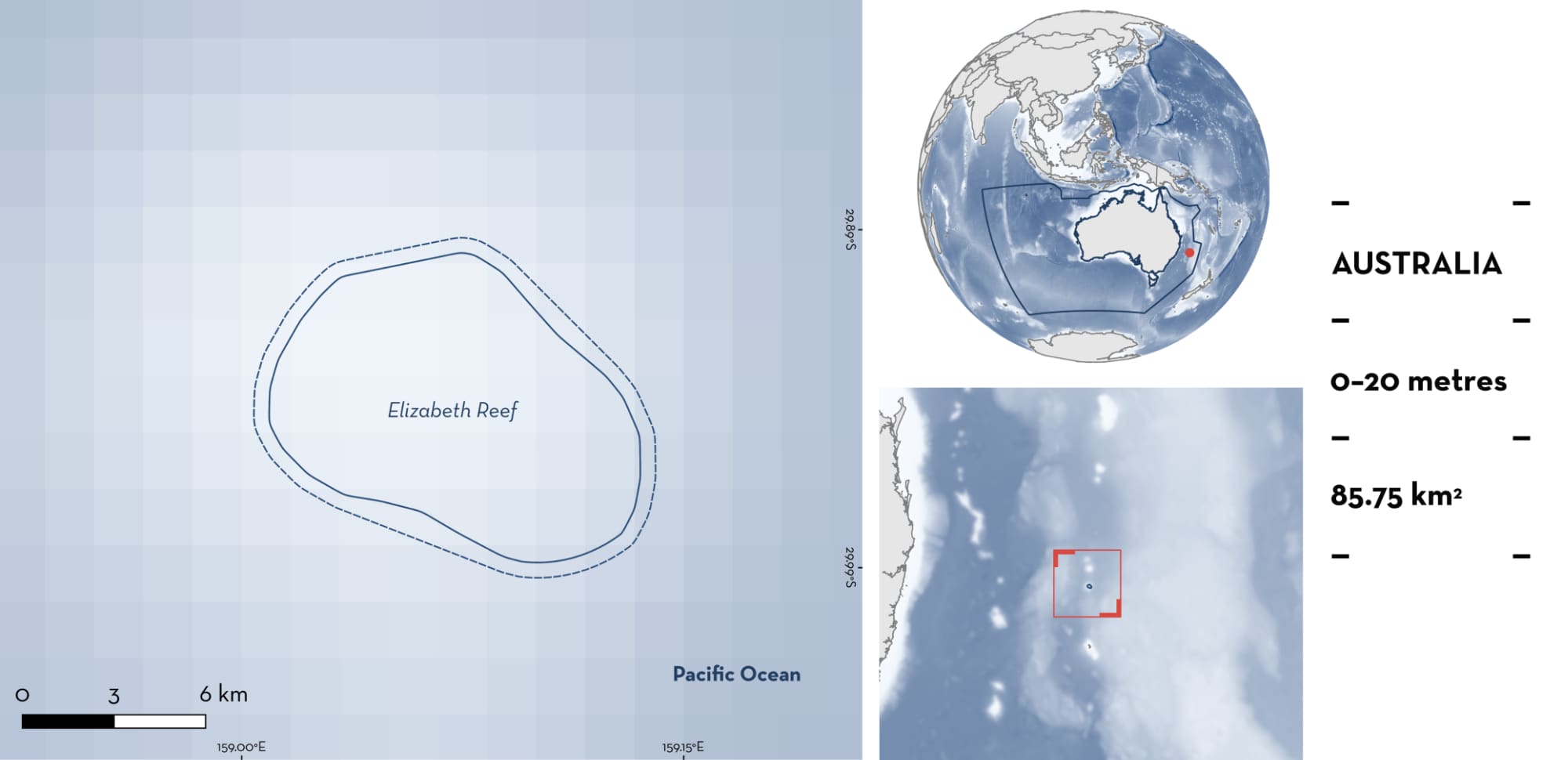
Elizabeth Reef is located in the southwest Pacific, ~560 km from mainland New South Wales, Australia. This remote area encompasses an atoll-like reef structure sitting on a seamount. It is characterised by a deep inner lagoon, coral ridges, sand flats, hard coral coverage, and macroalgae. The area is influenced by the Eastern Australian Current and by seasonal variation in sea surface temperature, upwelling, and Chlorophyll-a. The area overlaps with Lord Howe Marine Park. Within this area there are: reproductive areas (Galapagos Shark Carcharhinus galapagensis).
Download factsheet
Elizabeth Reef
DESCRIPTION OF HABITAT
Elizabeth Reef is located in the southwest Pacific, ~560 km from mainland New South Wales, Australia. This remote area encompasses an atoll-like reef structure sitting on a seamount. It is one of the two southernmost platform reefs in the world, alongside Middleton Reef (Carroll et al. 2021). The area includes exposed reef, inner lagoon, and back reef. It is characterised by a deep (130 m) lagoon, coral ridges, and depressions. There are sand flats with coarse sand and gravel substrates, and rhodoliths that only occur in waters >50 m depth. There is a high proportion of turfing macroalgae that covers the benthos, and sponges on substrate at >90 m depth (Carroll et al. 2021). The area has higher coverage of hard coral compared to nearby seamounts.
Elizabeth Reef is influenced by moderate wave action, with a mean tidal range of 2.6 m and the mean wave height is 2.0–2.5 m. The area is influenced by warm waters circulated to the area by the East Australian Current. It experiences seasonal upwelling in austral summer months, particularly on the east side of the reef. In spring and winter, southeasterly winds dominate. There is also seasonal variation in Chlorophyll-a concentrations, which are highest in winter and early autumn. Seasonal variation in mean sea surface temperature peaks in February (24.6°C) and troughs in August (19.5°C) (Carroll et al. 2021).
This area overlaps with Lord Howe Marine Park (Parks Australia 2025).
This Important Shark and Ray Area is benthic and pelagic and is delineated from inshore and surface waters (0 m) to 20 m based on the bathymetry of the area.
CRITERION C
SUB-CRITERION C1 – REPRODUCTIVE AREAS
Elizabeth Reef is an important reproductive area for one shark species.
Galapagos Sharks have been regularly recorded during scientific surveys in this area undertaken in 2006, 2011, 2014, and 2020 (Hoey et al. 2014; Carroll et al. 2021; GlobalArchive 2025; The Fish Collective 2025). Data are available for Galapagos Sharks from the two latest survey years. Across five days in March 2014, underwater visual census field surveys using 250–500 m transects were undertaken in this area (Hoey et al. 2014). In total, 70 Galapagos Sharks were recorded, measuring 94.8 cm total length (TL) on average. Of these, at least 37 (52.9%) were neonate/young-of-the-year (YOY) measuring up to 100 cm TL (Hoey et al. 2014). The size-at-birth of this species is 57–80 cm TL (Ebert et al. 2021) and YOY measure up to 110 cm TL (Morales-Serrano & Gonzalez-Pestana 2024).
Synthesised data from the GlobalArchive and The Fish Collective for Baited Remote Underwater Video Station (BRUVS) surveys were extracted after quality control was undertaken using CheckEM (GlobalArchive 2025; The Fish Collective 2025; Gibbons et al. in press). In January and February 2020, 68 Galapagos Sharks estimated to measure 67.9–198.6 cm TL were observed between 2.1–97.7 m depth from 28 BRUVS deployed in this area (Carroll et al. 2021; GlobalArchive 2025; The Fish Collective 2025). Of these, 53 (77.9%) were neonate/YOY measuring 67.9–108.8 cm TL. Neonate/YOY individuals were recorded on every day of the surveys in 2020 (GlobalArchive 2025; The Fish Collective 2025).
This is one of the few known locations in the world where neonate/YOY Galapagos Sharks regularly and predictably occur across numerous years (Carroll et al. 2021; Morales-Serrano & Gonzalez-Pestana 2024; GlobalArchive 2025; The Fish Collective 2025; Gibbons et al. in press). Elizabeth Reef has the second largest number of observations in Australia after Middleton Reef, ~50 km away (n = 116 individuals from similar surveys; GlobalArchive 2025; The Fish Collective 2025). Genetic sampling of the Galapagos Shark population at Elizabeth Reef suggests that it is distinct from the adjacent Lord Howe Island population (van Herwerden et al. 2009). Immature (possibly neonate/YOY) Galapagos Sharks have also been observed in aggregations with photographic evidence shared online by recreational snorkellers and anglers (e.g., Instagram 2021).
Download factsheet
SUBMIT A REQUEST
ISRA SPATIAL LAYER REQUEST
To make a request to download the ISRA Layer in either a GIS compatible Shapefile (.shp) or Google Earth compatible Keyhole Markup Language Zipped file (.kmz) please complete the following form. We will review your request and send the download details to you. We will endeavor to send you the requested files as soon as we can. However, please note that this is not an automated process, and before requests are responded to, they undergo internal review and authorization. As such, requests normally take 5–10 working days to process.
Should you have questions about the data or process, please do not hesitate to contact us.