ISRA FACTSHEETS
ISRA FACTSHEETS
AUSTRALIA AND SOUTHEAST INDIAN OCEAN
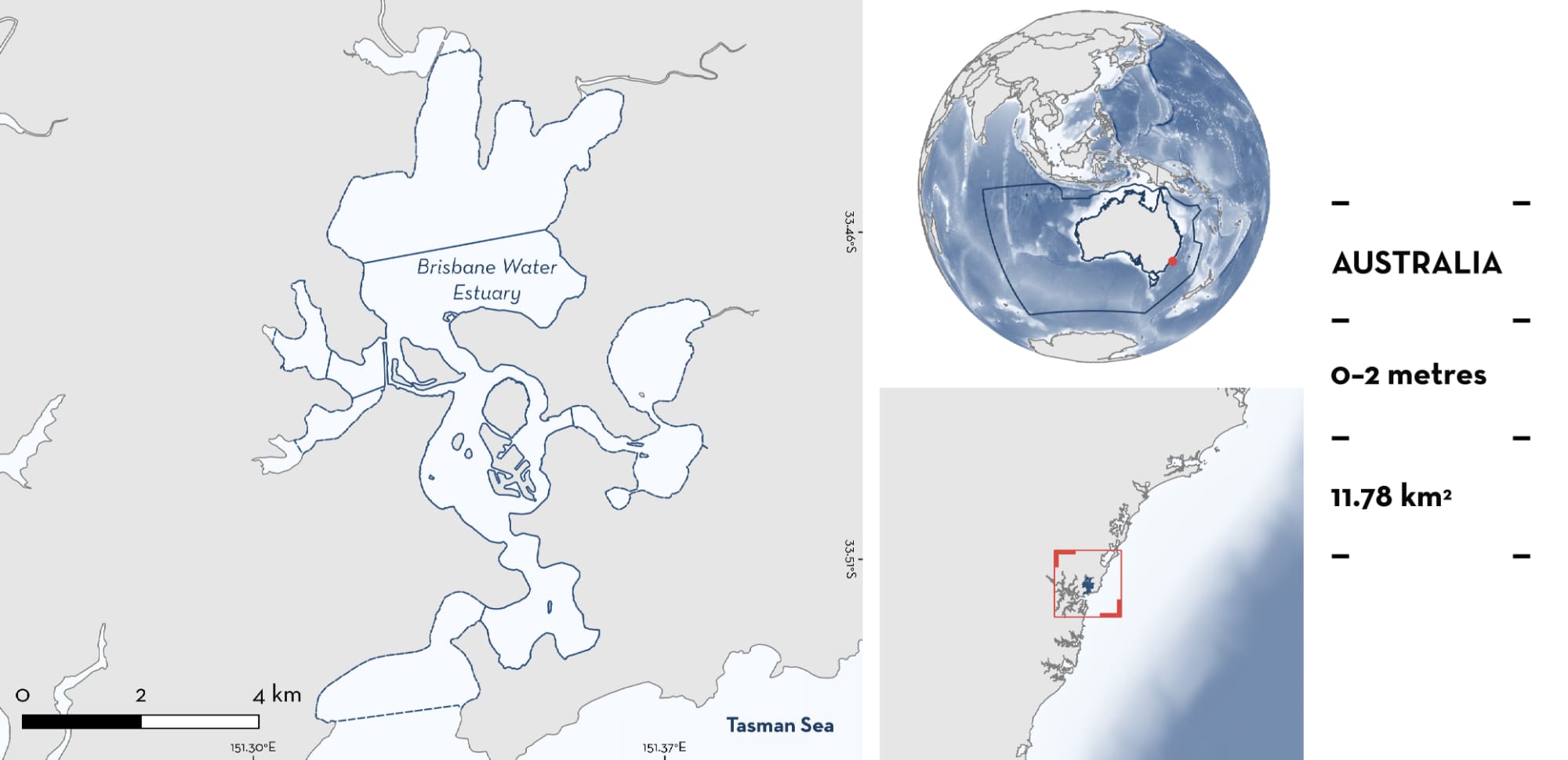
Brisbane Water Estuary
Summary
Brisbane Water Estuary is located on the central coast of New South Wales, Australia. This estuary includes small bays, beaches, islands, and channels and is characterised by extensive intertidal sandy and muddy flats and seagrass beds (Zostera spp.). Within this area there are: threatened species and feeding areas (Estuary Stingray Hemitrygon fluviorum).
Download factsheet
Brisbane Water Estuary
DESCRIPTION OF HABITAT
Brisbane Water Estuary is located on the central coast of New South Wales, Australia. It is a barrier estuary found in the northern arm of Broken Bay to which it is connected by a narrow entrance to the south. It is characterised by extensive intertidal sandy and muddy flats and seagrass beds (Zostera spp.). The area includes small bays (e.g., Hardy’s), beaches (e.g., Ettalong), islands (e.g., St Huberts), and channels (e.g., Woy Woy). It is influenced by wave dynamics with tidal changes of 0.4 m on average (Roberts & Sainty 2005; Gladstone 2006).
This Important Shark and Ray Area is benthic and is delineated from inshore and surface waters (0 m) to 2 m based on the bathymetry of the area.
CRITERION A
VULNERABILITY
One Qualifying Species considered threatened with extinction according to the IUCN Red List of Threatened Species regularly occurs in the area. This is the Vulnerable Estuary Stingray (Hyde et al. 2025).
CRITERION C
SUB-CRITERION C2 – FEEDING AREAS
Brisbane Water Estuary is an important feeding area for one species of ray.
Estuary Stingrays regularly and predictably feed in the area according to foraging observations and the presence of feeding pits (Bourke et al. 2023; Grew et al. 2025). Between October 2021–March 2022, drone surveys were conducted in the area to evaluate behavioural responses of Estuary Stingray to drone presence (Bourke et al. 2023). During these surveys, 50 Estuary Stingrays were tracked, with 23 observed actively foraging in the area (ingesting food or flapping pectoral fins to excavate food in the substrate; Bourke et al. 2023). In addition, the presence of feeding pits was assessed from drone surveys conducted over a 7-day period in May 2023 during low tide conditions (Grew et al. 2025). In these surveys, 1,090 feeding pits were identified in the area with newly excavated pits observed daily and ranging from 74–329. Evaluation of feeding pits was extrapolated to the whole estuary based on satellite imaging from 2021 and revealed that while feeding pits were found across the whole estuary, this area concentrated the largest number of feeding pits (Grew et al. 2025). The diet of Estuary Stingrays was not assessed in this area but in other regions like Wallis Lake (170 km north) and Burril Lake (225 km south) this species uses bare substrate habitats for feeding on highly abundant benthic fish and crustaceans that aggregate to spawn. Bare substrates may be a preferred habitat for this species due to the higher accessibility to prey compared to other substrates (Grew et al. 2025). No other nearby estuaries have been monitored in the region. While Common Stingaree Trygonoptera testacea also occurs in the area, feeding pits were attributed to Estuary Stingray as it was the only confirmed ray residing in the estuary during the study and feeding pits were found in the same locations where Estuary Stingrays were recorded foraging during 2021–2022. Brisbane Water Estuary has extensive sand flats and seagrass that have been found to be the main habitats where Estuary Stingrays forage (Grew 2025).
Download factsheet
SUBMIT A REQUEST
ISRA SPATIAL LAYER REQUEST
To make a request to download the ISRA Layer in either a GIS compatible Shapefile (.shp) or Google Earth compatible Keyhole Markup Language Zipped file (.kmz) please complete the following form. We will review your request and send the download details to you. We will endeavor to send you the requested files as soon as we can. However, please note that this is not an automated process, and before requests are responded to, they undergo internal review and authorization. As such, requests normally take 5–10 working days to process.
Should you have questions about the data or process, please do not hesitate to contact us.