ISRA FACTSHEETS
ISRA FACTSHEETS
AUSTRALIA AND SOUTHEAST INDIAN OCEAN
Byron Bay-Bass Strait Corridor
Summary
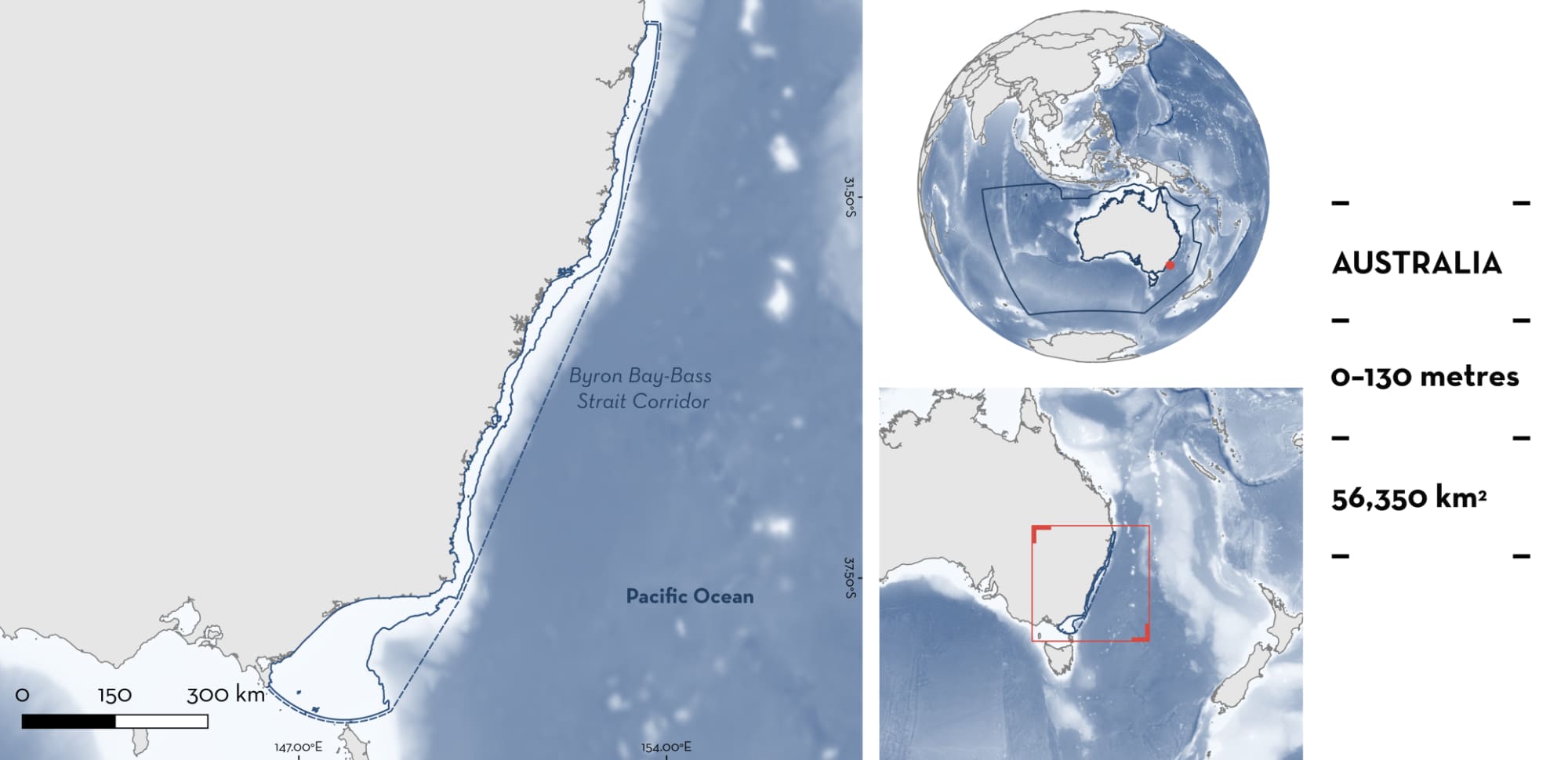
Byron Bay-Bass Strait Corridor is located along the coast of eastern Australia, in the states of New South Wales, Victoria, and Tasmania. This area comprises continental shelf waters from Byron Bay in the north to Bass Strait in the south. The habitat is characterised by pelagic shelf waters, rocky reefs, and sandy substrates. It is influenced by the East Australian Current that transports warm water southwards through much of the area, and by tide and wind driven surface currents in Bass Strait. Within this area there are: threatened species and areas important for movement (White Shark Carcharodon carcharias).
Download factsheet
Byron Bay-Bass Strait Corridor
DESCRIPTION OF HABITAT
Byron Bay-Bass Strait Corridor is located along the eastern coast of Australia, spanning waters of New South Wales, southeast Victoria, and northeast Tasmania. This area extends from Byron Bay in the north to Bass Strait in the south. It is a coastal area with a narrow continental shelf in the north and a wider shelf in Bass Strait. The habitat is characterised by pelagic shelf waters, rocky reefs, and sandy substrates (Harris et al. 2003).
The area is influenced by the East Australian Current that carries warm water southward along Australia’s east coast (Ridgeway & Hill 2009). The East Australian Current is a dynamic western boundary current, with mesoscale eddies influencing current strength and direction. The flow is seasonally stronger in the austral summer, and the separation location, where the current turns eastward into the Tasman Sea, also moves seasonally (Ridgeway & Hill 2009). In Bass Strait, wind and tide driven surface currents influence the area (Jones 1980).
This Important Shark and Ray Area is pelagic and is delineated from inshore and surface waters (0 m) to 130 m based on the bathymetry of the area.
CRITERION A
VULNERABILITY
One Qualifying Species considered threatened with extinction according to the IUCN Red List of Threatened Species regularly occurs in the area. This is the Vulnerable White Shark (Rigby et al. 2022).
CRITERION C
SUB-CRITERION C4 – MOVEMENT
Byron Bay-Bass Strait Corridor is an important movement area for one shark species.
Multiple tagging studies have confirmed the regular movements of immature White Sharks along this corridor (Bruce et al. 2019; Spaet et al. 2020, 2022; Lee et al. 2021; Butcher et al. 2023). Between 2008–2015, White Sharks (n = 43) were tagged inside this area, in Port Stephens (n = 39) on the central coast of New South Wales, and in Corner Inlet (n = 4) in southeast Victoria. Individuals were tagged with satellite tags (n = 22) and acoustic tags (n = 43) and the latter were monitored on receiver arrays deployed across the whole eastern coast of Australia and across international boundaries (Bruce et al. 2019). Of these White Sharks, 40 provided enough data to explore large-scale movements. Mean time-at-liberty was 623 days with most tagged sharks (n = 24, 60%) monitored for more than one year. White Sharks moved regularly from northern New South Wales to Bass Strait in southeast Victoria with a marked west limit around Wilsons Promontory. Southern movements in the area were most common between December–May while northern movements were most common between June–November. Eleven (25.6%) of the acoustically tagged White Sharks moved to the northernmost acoustic array in the area (Coffs Harbour) while 16 sharks (37.2%) moved to the southernmost array inside the area (Narooma). Residency was higher around Stockton-Forster in New South Wales and southeast Victoria, two proposed nursery areas for White Sharks and where immature individuals aggregate (Bruce & Bradford 2012; Harasti et al. 2017; Bruce et al. 2019). Multiple sharks visited the proposed nursery area around Stockton-Forster for at least five consecutive years (Bruce et al. 2019).
In addition, between 2007–2019, 103 immature White Sharks were tagged between Byron Bay, New South Wales and Corner Inlet, Victoria with acoustic and satellite transmitters (Spaet et al. 2020, 2022; Lee et al. 2021). Of these sharks, 87 provided enough information, covering 38–1,816 days-at-liberty with 65% tracked for more than one year (Spaet et al. 2020, 2022). Individuals tagged showed the same movement patterns described above, with 73 (85%) moving inside this area. Sharks occurred in New South Wales waters mostly between August–February while Victorian waters were occupied mostly between December–April with southwards movements starting in September and extending into March (Spaet et al. 2020, 2022). Occurrence was higher in three areas, the two proposed nursery areas in New South Wales and southeast Victoria and a third aggregation area around Byron Bay, on the north coast of New South Wales (Lee et al. 2021). Movements of White Sharks were mostly related to depths <130 m and sea surface temperatures between 17–23°C (Lee et al. 2021). While some White Sharks moved to northern Tasmania, South Australia, and New Zealand, these movements were not regular and did not form part of their core movement area.
Download factsheet
SUBMIT A REQUEST
ISRA SPATIAL LAYER REQUEST
To make a request to download the ISRA Layer in either a GIS compatible Shapefile (.shp) or Google Earth compatible Keyhole Markup Language Zipped file (.kmz) please complete the following form. We will review your request and send the download details to you. We will endeavor to send you the requested files as soon as we can. However, please note that this is not an automated process, and before requests are responded to, they undergo internal review and authorization. As such, requests normally take 5–10 working days to process.
Should you have questions about the data or process, please do not hesitate to contact us.