ISRA FACTSHEETS
ISRA FACTSHEETS
AUSTRALIA AND SOUTHEAST INDIAN OCEAN
Cow and Calf Islands
Summary
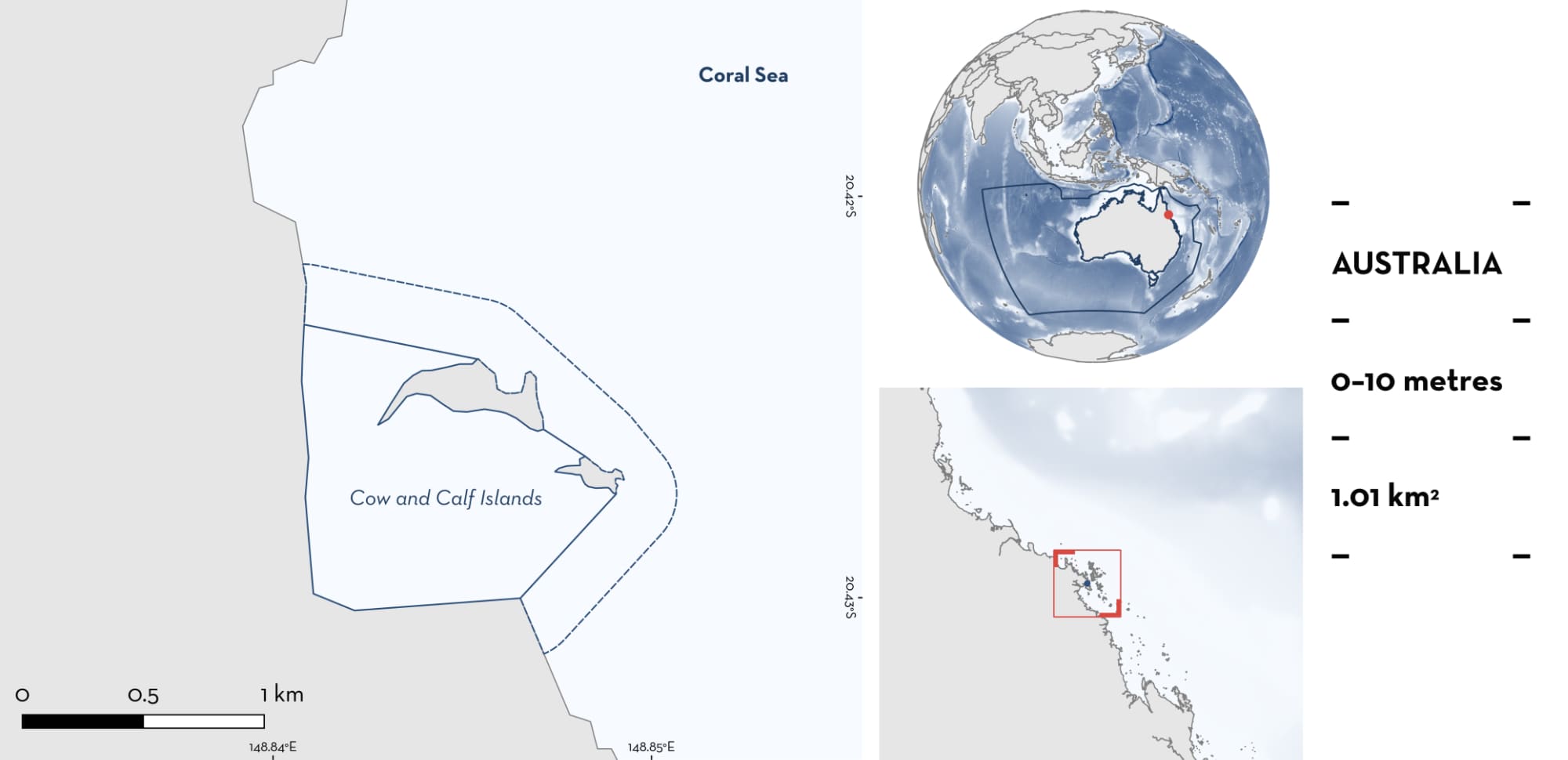
Cow and Calf Islands is located in the Whitsunday Coast region of north Queensland, Australia. It encompasses a shallow coastal shelf and shares a continuous fringing reef flat that extends from the mainland past Cow Island to Calf Island. The area is influenced by a tropical climate with a wet season in the austral summer, and strong reversing currents that flood predominantly southward and ebb northward through the island passages. The area overlaps with the Great Barrier Reef Marine Park. Within this area there are: threatened species and undefined aggregations (Giant Guitarfish Glaucostegus typus).
Download factsheet
Cow and Calf Islands
DESCRIPTION OF HABITAT
Cow and Calf Islands is located in the Whitsunday Coast region of north Queensland, Australia. It encompasses a shallow coastal shelf and shares a continuous fringing reef flat that extends from the mainland past Cow Island to Calf Island. The area is characterised by a patch of mangroves, high macroalgal cover (predominantly Sargassum), low hard-coral cover, and a fringing reef flat (Sweatman et al. 2007). The reef slope has a shallow to moderate gradient and consists mostly of small granite boulders with rubble and silt substrates (Sweatman et al. 2007).
The area is influenced by a tropical climate with a wet season in the austral summer from January–March and by southeasterly winds. The tidal range in the area typically spans from ~1.3 m on neap tides to ~3.8 m on spring tides, generating strong reversing currents that flood predominantly southward and ebb northward through the island passages (Sweatman et al. 2007). These energetic tidal flows, together with the shallow reef flat and boulder–rubble substrate, create a high-energy, well-flushed nearshore environment around Cow and Calf Islands, leading to frequent resuspension of fine sediments across the lower reef slope and sand–silt seabed, as well as episodic disturbance from cyclones, flood plumes, and runoff (Sweatman et al. 2007).
Cow and Calf Islands overlap the Great Barrier Reef Marine Park – Marine National Park Zone (UNEP-WCMC & IUCN 2025).
This Important Shark and Ray Area is benthic and pelagic and is delineated from inshore and surface waters (0 m) to 10 m based on the bathymetry of the area.
CRITERION A
VULNERABILITY
One Qualifying Species considered threatened with extinction according to the IUCN Red List of Threatened Species regularly occurs in the area. This is the Critically Endangered Giant Guitarfish (Kyne et al. 2019).
CRITERION C
SUB-CRITERION C5 – UNDEFINED AGGREGATIONS
Cow and Calf Islands is an important area for undefined aggregations of one ray species.
Giant Guitarfish have been observed aggregating in the shallows of the area. Between 2017–2024, aggregations (n = 3) of 10–20 individuals, with sizes of up to 200 cm total length (TL), based on visual size estimations, were opportunistically recorded by scientists and on iNaturalist in the area (iNaturalist 2025; J Gaskell & K Lawrence pers. obs. 2025). Size-at-maturity for the species is 150–180 cm TL (Last et al. 2016) indicating that the individuals observed were adults. In November 2017 and 2018, at least 20 Giant Guitarfish, mainly females (based on the lack of visible claspers when observed in the water), were observed resting a few meters from shore in very shallow water (<50 cm depth; J Gaskell & K Lawrence pers. obs. 2025). Additionally, in November 2024, 10 Giant Guitarfish were sighted in very shallow water within the area (iNaturalist 2025). Due to the remoteness of the area, observations are opportunistic, but the large numbers of individuals during the same months reported across three different years indicate regular use of the area. Further information is required to understand the nature and function of these aggregations.
Download factsheet
SUBMIT A REQUEST
ISRA SPATIAL LAYER REQUEST
To make a request to download the ISRA Layer in either a GIS compatible Shapefile (.shp) or Google Earth compatible Keyhole Markup Language Zipped file (.kmz) please complete the following form. We will review your request and send the download details to you. We will endeavor to send you the requested files as soon as we can. However, please note that this is not an automated process, and before requests are responded to, they undergo internal review and authorization. As such, requests normally take 5–10 working days to process.
Should you have questions about the data or process, please do not hesitate to contact us.