ISRA FACTSHEETS
ISRA FACTSHEETS
AUSTRALIA AND SOUTHEAST INDIAN OCEAN
Dampier
Summary
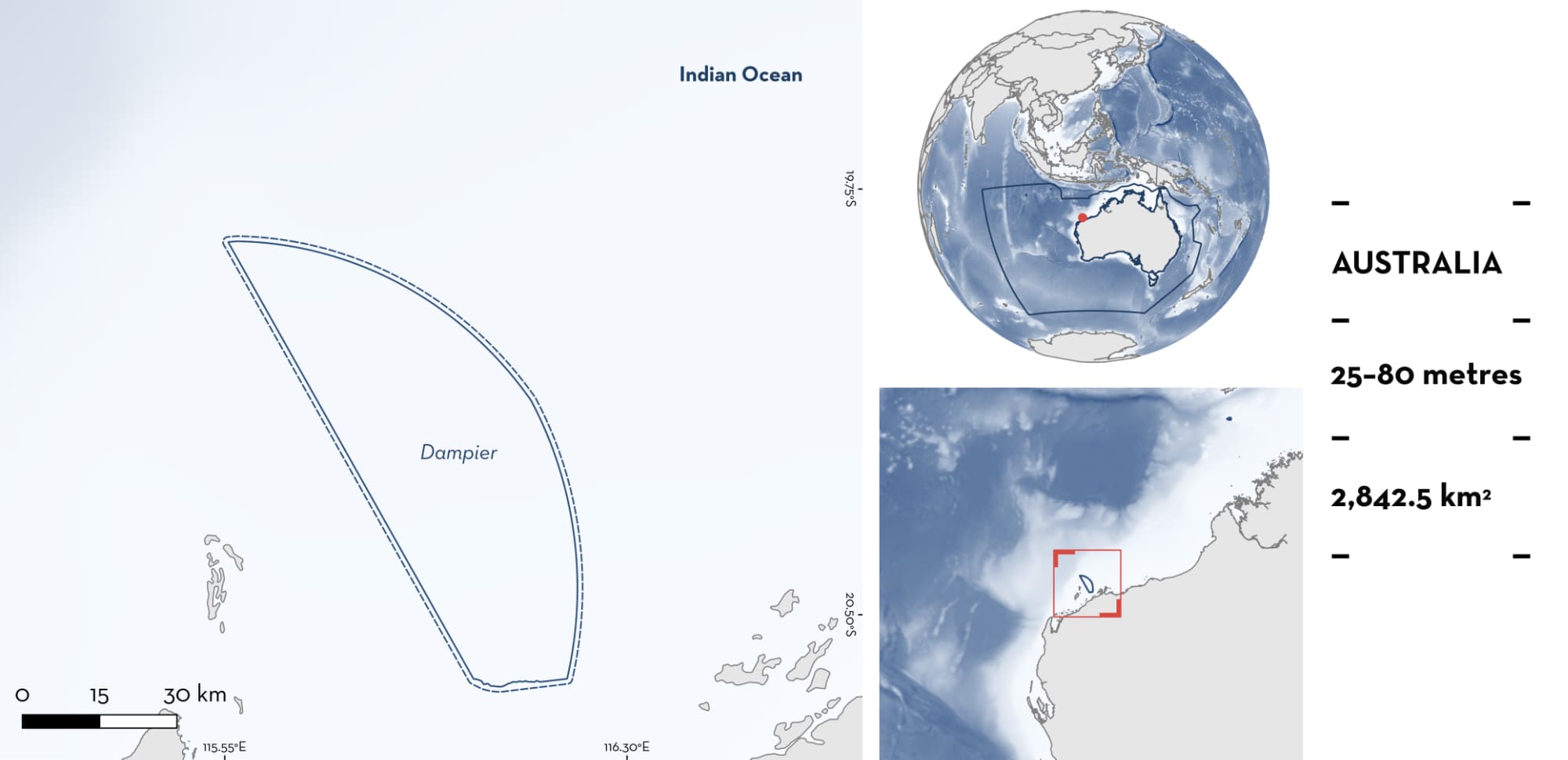
Dampier is located in the Pilbara region of Western Australia, Australia. This area is situated on the continental shelf and supports a high diversity of sponges which are a dominant component of benthic communities. Seasonal circulation is driven by the Leeuwin Current and dynamic shelf processes of the North West Shelf. This area overlaps with Dampier Marine Park. Within this area there are: range-restricted species (Banded Catshark Atelomycterus fasciatus).
Download factsheet
Dampier
DESCRIPTION OF HABITAT
Dampier is located in the Pilbara region of Western Australia, Australia. This area sits on the continental shelf and supports the highest sponge species richness and the second-highest endemism in the Pilbara region (Fromont et al. 2016). Sponges are a dominant component of the Dampier Marine Park benthic fauna, with more than 150 recorded species making up 20–50% of trawl catches (Keesing 2019). They form extensive, diverse assemblages that constitute a key element of benthic biodiversity in the region.
Benthic communities here are adapted to high turbidity, elevated austral summer temperatures often coupled with hypersaline conditions, and disturbance from tropical cyclones that cause freshwater influx and sediment erosion or deposition (Fromont et al. 2016). The region lies within arid tropical northwestern Australia, where seasonal circulation is driven by the Leeuwin Current and dynamic shelf processes of the Northwest Shelf.
This area overlaps with Dampier Marine Park (Parks Australia 2025).
This Important Shark and Ray Area is benthic and subsurface and is delineated from 25–80 m based on the depth range of Qualifying Species in the area.
CRITERION B
RANGE RESTRICTED
This area holds the regular presence of the Banded Catshark as a resident range-restricted species.
This species has been poorly studied, but individuals have been reported from captures in fishery-independent trawl surveys (Compagno & Stevens 1993; O’Neill et al. 2024). Across studies where the species has been documented, a total of 145 individuals and three egg cases have been recorded: (1) 79 individuals, including three egg-bearing females, recorded between 1973 and 1988 (Compagno & Stevens 1993); (2) four egg-bearing females reported in 1982, 1983, and 2017 (O’Neill et al. 2020); and (3) 62 individuals and three egg cases recorded in 2017 and 2022 (O’Neill et al. 2024). Geolocation data were available for 126 individuals (87% of all records). This area accounts for ~28% (n = 35) of all observations with known locations across the species’ range, composed of both sexes and multiple life-stages, including contemporary records of an egg-bearing female and an egg case. It also contained two aggregations, with at least 18 individuals found inside a large sponge. This species is restricted to the Northwest Australian Shelf Large Marine Ecosystem.
Download factsheet
SUBMIT A REQUEST
ISRA SPATIAL LAYER REQUEST
To make a request to download the ISRA Layer in either a GIS compatible Shapefile (.shp) or Google Earth compatible Keyhole Markup Language Zipped file (.kmz) please complete the following form. We will review your request and send the download details to you. We will endeavor to send you the requested files as soon as we can. However, please note that this is not an automated process, and before requests are responded to, they undergo internal review and authorization. As such, requests normally take 5–10 working days to process.
Should you have questions about the data or process, please do not hesitate to contact us.