ISRA FACTSHEETS
ISRA FACTSHEETS
AUSTRALIA AND SOUTHEAST INDIAN OCEAN
Eastern Recherche Archipelago
Summary
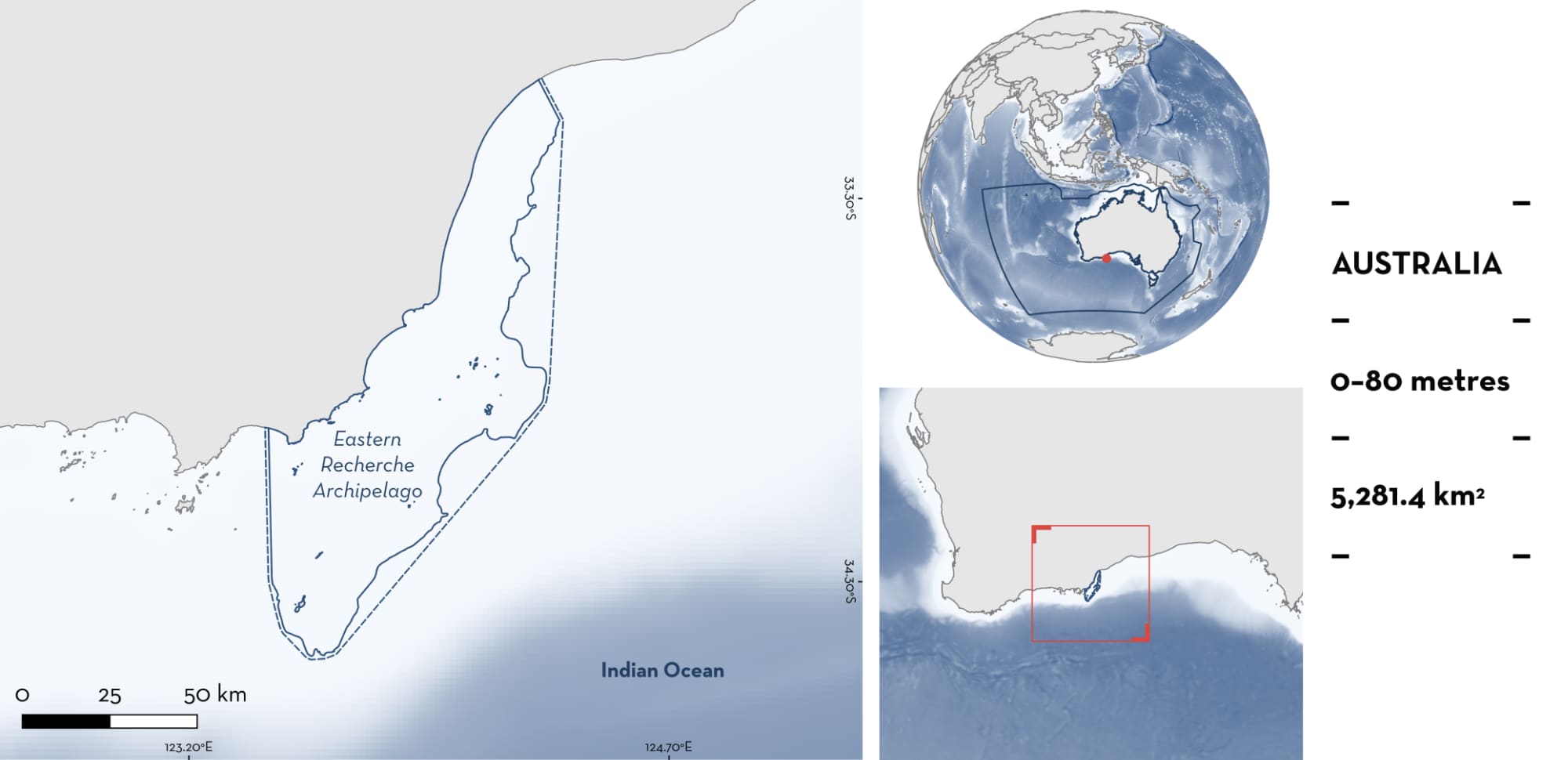
Eastern Recherche Archipelago is located in southwest Western Australia, Australia. It is situated ~250 km east of Esperance in the eastern portion of the Recherche Archipelago and encompasses the Land and Sea Country of both the Kepa Kurl Wudjari people and the Ngadju people. The area is characterised mostly by sand substrates, sand-inundated reefs dominated by sponge and macroalgae, and macroalgal forests. It is influenced by the Cresswell Current, a seasonal wind-driven current inshore of the Leeuwin Current, creating cross-shelf upwelling. This area overlaps with the Eastern Recherche Marine Park. Within this area there are: threatened species and reproductive areas (White Shark Carcharodon carcharias).
Download factsheet
Eastern Recherche Archipelago
DESCRIPTION OF HABITAT
Eastern Recherche Archipelago is located in Western Australia, Australia. It is situated ~250 km east of Esperance and also encompasses Israelite Bay and Cocklebiddy. The region encompasses the Land and Sea Country of both the Kepa Kurl Wudjari people represented by the Esperance Tjaltjraak Native Title Aboriginal Corporation and the Ngadju people represented by the Ngadju Native Title Aboriginal Corporation. The islands within the Eastern Recherche Archipelago are scattered across the continental shelf and represent the last major offshore structures >1,000 km before entering the Great Australian Bight. The geomorphology of the archipelago and adjacent coastline is characterised by exposed granite headlands and islands, steep rocky slopes, and submerged granite reefs and carbonate sands (Sanderson et al. 2000), however, long expanses of shallow sandy beaches prevail east of Israelite Bay. Habitats comprise a mixture of bare sand, sand-inundated reefs dominated in sponge and macroalgal cover and dense macroalgal (Ecklonia spp.) forests (Kendrick et al. 2005). Seagrass meadows are common in the shallow waters adjacent to the mainland east of Israelite Bay (Kendrick et al. 2005).
The islands of the Eastern Recherche Archipelago are subject to high wave energy, with frequent large swells and severe storms common throughout austral winter (James et al. 1994). The Leeuwin Current moves eastward along the edge of the continental shelf having a seasonal effect on the Recherche Archipelago, elevating inshore water temperatures during winter and transporting subtropical marine species into the archipelago (Kendrick et al. 2009). The Cresswell Current, a seasonal wind-driven current inshore of the Leeuwin Current, moves cooler waters westward throughout most of the year and creates some cross-shelf upwelling (Harvey et al. 2013).
This area overlaps with the Eastern Recherche Marine Park (Parks Australia 2025).
This Important Shark and Ray Area is benthic and pelagic and is delineated from inshore and surface waters (0 m) to 80 m based on the bathymetry of the area.
CRITERION A
VULNERABILITY
One Qualifying Species considered threatened with extinction according to the IUCN Red List of Threatened Species regularly occurs in the area. This is the Vulnerable White Shark (Rigby et al. 2022).
CRITERION C
SUB-CRITERION C1 – REPRODUCTIVE AREAS
Eastern Recherche Archipelago is an important reproductive area for one shark species.
Eastern Recherche Archipelago is the only area in Western Australia where young-of-the-year (YOY) and juvenile White Sharks are regularly encountered across multiple years. The size-at-birth of the species is 107–160 cm TL, young-of-the-year (YOY) range from 150–175 cm TL, and juveniles from 175–300 cm TL (Bruce & Bradford 2012; Ebert et al. 2021).
Although some research suggests that Australian White Sharks may be part of one large population (Clark et al. 2025), other population genetics research has also suggested that Australia has two distinct populations that are seemingly reproductively divided by Bass Strait (Blower et al. 2012). For the eastern Australia population, there are two identified nursery areas: Port Stephens, New South Wales and Corner Inlet/Ninety Mile Beach, Victoria (Bruce & Bradford 2012). For the western population, the available evidence does not fully meet the three shark nursery area criteria proposed by Heupel et al. (2007). However, the area has been repeatedly used over several years by YOY and juveniles, with some remaining in the region for up to four days, as recorded by Baited Remote Underwater Video Systems (BRUVS) surveys. This may reflect a temporary influence of baited surveys on shark presence, thereby casting doubt on the fulfillment of the nursery criteria (O’Connell et al. 2023). Nonetheless, surveys across broader Western Australia also identify this area as a cluster for early life-stages of White Sharks (Marine Futures Lab unpubl. data 2006–2024; Species Distribution Modeling Project [SDMP], unpubl. data 2025). From the seven most studied populations of White Sharks (i.e., Southern-Western Australia, Western North Atlantic, Northeastern Pacific, Eastern Australian and New Zealand, Mediterranean, South Africa, and Northwest Pacific), there are 36 relevant captures or confirmed sightings (totalling ~155 individuals) of neonate and YOY White Sharks (O’Connell et al. 2024). Of these, seven are from Southern-Western Australia, six of which are from within this area (85.7% of the total captures/sightings for the Southern-Western Australia population). Of these six, two had a rounded apex of the first dorsal fin, which has been observed in embryonic and neonate White Sharks (O’Connell et al. 2023).
Between 2020–2021, opportunistic laser photogrammetry, stereo-photogrammetry, and BRUVS were deployed within this area with ~34 hours of footage collected. Distinctive characteristics (e.g., presence/absence of scars, tags, pigmentation patterns, and dorsal fin notch characteristics) were used to identify White Sharks at the individual-level (O’Connell et al. 2023). In 2020 (n = 5 days of deployments), a total of seven different White Sharks were successfully identified and measured using laser photogrammetry. All sharks were male, one of which was YOY (158 cm TL), six were juveniles (280–370 cm TL), and one was adult (390 cm TL). In 2021 (n = 8 days), a total of 10 White Sharks were observed: seven males, two females, and two unidentified. Sharks ranged in size from 170–370 cm TL and were considered YOY (n = 1) and juveniles (n = 9; 180–370 cm TL). Six sharks were reported as remaining at the site for at least two days, and one juvenile shark (270 cm TL) was observed on four consecutive days. Additionally, anonymous fishers provided broad and anecdotal sightings reports from 2018 to 2020 from this area (O’Connell et al. 2023). They reported sightings of small White Sharks (<200 cm TL) as numerous (i.e., multiple YOY-juvenile sharks per trip) throughout the year and data on the capture of two female White Sharks measuring 140 and 170 cm TL in June 2020 and November 2020.
Between 2006–2024, benthic and pelagic BRUVS surveys were conducted in southwest Australia spanning from Houtman Abrolhos to Eastern Recherche Archipelago (Marine Futures Lab unpubl. data 2006–2024). Of 5,318 benthic stereo-BRUVS deployments at 13 sites of southwest Australia (~390 deployments per site ranging 120-1,013), 311 were within the Eastern Recherche Archipelago (2019 = 140, 2022 = 40, 2023 = 65, 2024 = 66) (Marine Futures Lab unpubl. data 2006–2024). Of 1,908 pelagic stereo-BRUVS deployments in six sites of southwest Australia (~318 deployments per site ranging 97–509), 140 were within the Eastern Recherche Archipelago, all from 2019 (Marine Futures Lab unpubl. data 2006–2024). White Sharks were observed in nine deployments, both benthic and pelagic, six of which (66.7%) were observed in the Eastern Recherche Archipelago (males n = 3, females n = 3) in 2019, 2023, and 2024 (Marine Futures Lab unpubl. data 2006–2024). All White Shark observations in the Eastern Recherche Archipelago were juveniles (200–350 cm TL), with the exception of one sub-adult male (380 cm TL). The remaining three White Sharks were recorded in Western Recherche Archipelago (~150 km west of this area) in 2019 (380 cm TL), Geographe Bay in 2022 (440 cm TL), and Rottnest Island in 2007 (390 cm TL). This highlights that this area had the most records of early life-stage animals compared to other sites surveyed.
A comprehensive database of shark, ray, and chimaera occurrences across Western Australia (WA) using fisheries data has been compiled (SDMP unpubl. data 2025). Data were obtained from (1) logbook and observer programs from the Australian Fisheries Management Authority (AFMA) and Department of Primary Industries and Regional Development (DPIRD) Western Australia (WA), covering all commercial sectors, multiple gear types, and both targeted and incidental catch records; (2) survey data that encompassed heterogeneous sources, including institutional surveys (DPIRD WA, Australian Ocean Data Network [AODN], Commonwealth Scientific and Industrial Research Organisation [CSIRO], and IMOS [Integrated Marine Observing System]). At least 33 White Sharks ranging from 200–300 cm TL were reported from this area, out of 160 interactions (recorded annually between 2013–2025) with White Sharks (SDMP unpubl. data 2025). These included 100 interactions from fisheries (n = 25,624 shots; gillnet = 24,105; longline = 1,515; trawl = 4) and 60 from surveys (39 longline shots), supporting the importance of this area for early life-stages and the repeated use by juveniles.
Download factsheet
SUBMIT A REQUEST
ISRA SPATIAL LAYER REQUEST
To make a request to download the ISRA Layer in either a GIS compatible Shapefile (.shp) or Google Earth compatible Keyhole Markup Language Zipped file (.kmz) please complete the following form. We will review your request and send the download details to you. We will endeavor to send you the requested files as soon as we can. However, please note that this is not an automated process, and before requests are responded to, they undergo internal review and authorization. As such, requests normally take 5–10 working days to process.
Should you have questions about the data or process, please do not hesitate to contact us.