ISRA FACTSHEETS
ISRA FACTSHEETS
AUSTRALIA AND SOUTHEAST INDIAN OCEAN
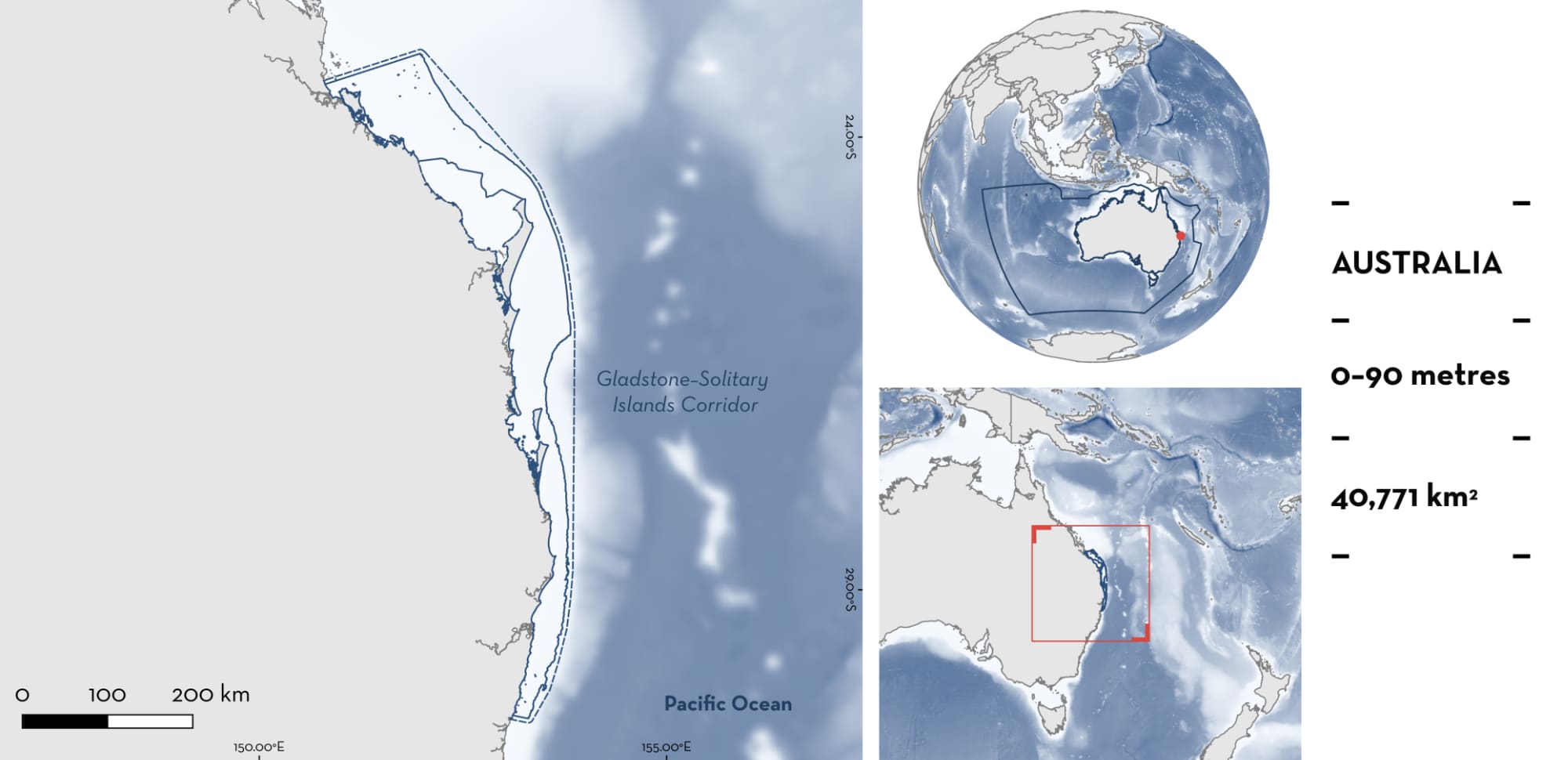
Gladstone-Solitary Islands Corridor
Summary
Gladstone–Solitary Islands Corridor is located on the east coast of Australia. It spans coastal waters from Gladstone, Queensland in the north to the Solitary Islands, New South Wales in the south. The habitat is characterised by sandy and rocky substrates, coral and rocky reefs, sandy beaches, rocky headlands, and pelagic waters. It is influenced by the East Australian Current that carries warm water southward along Australia’s east coast. Within the area there are: threatened species and areas important for movement (Indo-Pacific Leopard Shark Stegostoma tigrinum).
Download factsheet
Gladstone-Solitary Islands Corridor
DESCRIPTION OF HABITAT
Gladstone–Solitary Islands Corridor is located on the east coast of Australia. It spans coastal waters from Gladstone, Queensland in the north to the Solitary Islands off Coffs Harbour, New South Wales in the south. It includes popular dive sites, such as Wolf Rock near Rainbow Beach, The Group off North Stradbroke Island (Minjerribah), Nguthungulli Julian Rocks near Byron Bay, and the Solitary Islands off Coffs Harbour. The habitat is characterised by sandy and rocky substrates, coral and rocky reefs, sandy beaches, rocky headlands, and pelagic waters.
The area is influenced by the East Australian Current that carries warm water southward along Australia’s east coast (Ridgway & Hill 2009). The East Australian Current is a dynamic western boundary current, with mesoscale eddies influencing current strength and direction. The flow is seasonally stronger in the austral summer.
This Important Shark and Ray Area is benthic and pelagic and is delineated from inshore and surface waters (0 m) to 90 m based on the global depth range of Qualifying Species.
CRITERION A
VULNERABILITY
One Qualifying Species considered threatened with extinction according to the IUCN Red List of Threatened Species regularly occurs in the area. This is the Endangered Indo-Pacific Leopard Shark (Rigby et al. 2024).
CRITERION C
SUB-CRITERION C4 – MOVEMENT
Gladstone–Solitary Islands Corridor is an important movement area for one shark species.
Indo-Pacific Leopard Sharks use this area to move seasonally between sites along the subtropical coast of eastern Australia (CL Dudgeon unpubl. data 2025). This seasonal movement has been documented regularly and predictably since 2014, with Indo-Pacific Leopard Sharks moving southward during the summer, and northward during autumn and winter. Individuals were tagged with acoustic transmitters at Point Lookout, North Stradbroke Island (Minjerribah) during 2012–2015 (n = 16 individuals), 2021 (n = 21), and 2024 (n = 2). These sharks were subsequently tracked on the Integrated Marine Observing System (IMOS) receiver array: IMOS is enabled by the National Collaborative Research Infrastructure Strategy (NCRIS). Seven individuals had <100 detections and these were excluded from the movement analysis (CL Dudgeon unpubl. data 2025). Movement segments were extracted using a speed filter of 1 km h-1 and only displaying movements between receiver stations that were >10 km apart. This approach means that movement segments are indicative of relatively direct and fast movements. Since most of the receivers are near the coast, and that a strict speed filter was used, these movement segments suggest that the sharks were mostly swimming along the coast.
There were 132,815 detections of Indo-Pacific Leopard Sharks and 545 movement segments within this area. These grouped into 159 unique movement pathways used between 1–16 times by 1–8 individual Indo-Pacific Leopard Sharks. The receivers were then grouped into five broader regions within this area: Gladstone, Hervey Bay, southeast Queensland, northern New South Wales, and Solitary Islands. A total of 28 individuals made 38 inter-regional movements. The strongest connection was between southeast Queensland and northern New South Wales (n = 9 movements, and n = 6 in the opposite direction), Gladstone to southeast Queensland (n = 6), and Hervey Bay to southeast Queensland (n = 5, and n = 4 in the opposite direction). Tracked individuals also moved to and from the Solitary Islands (n = 3 in each direction). There was a seasonal signal to the movement direction, with most southward movements detected from October–February and most northward movement detected from March–September. Two Indo-Pacific Leopard Sharks tagged with archival satellite tags in Byron Bay in April 2025 further support this movement corridor (D Robinson unpubl. data 2025). One female used the entire area (~800 km along the coast) for a return journey, going past the northern boundary at Gladstone to south of Mackay before heading south past the southern boundary and on to Port Macquarie. A male used this area for a northward journey also to around Mackay where the tag popped up (D Robinson unpubl. data 2025).
Additionally, between 2003–2025, 2,695 sightings of 1,032 individuals were recorded within the area in an online photographic identification (photo-ID) database for Indo-Pacific Leopard Sharks (Sharkbook 2025). From south to north, collectively these sightings were from the Solitary Islands (n = 28), Byron Bay (n = 1,875), Gold Coast (n = 7), North Stradbroke Island (Minjerribah; n = 756), the Sunshine Coast (n = 2), and Wolf Rock (n = 27). Using photo-ID, there were 33 movements recorded between these sites. From these, five movements were recorded between the Solitary Islands and Byron Bay (17.9% of the sightings from the Solitary Islands), 28 were recorded between Byron Bay and North Stradbroke Island (Minjerribah; 3.7% of sightings from North Stradbroke Island), and one was recorded between the Gold Coast and North Stradbroke Island (14.3% of sightings from the Gold Coast; Sharkbook 2025). Importantly, most research effort at North Stradbroke Island (Minjerribah) occurred in the early 2010s while most effort at Byron Bay occurred more recently (2018–2025), meaning that movements are likely to be underestimated. The timing of photo-ID encounters and acoustic telemetry detections further support the seasonal migration within this movement corridor. In the southernmost location at the Solitary Islands, all Indo-Pacific Leopard Sharks were encountered and detected during February–April. By contrast, in the northernmost location off Gladstone, they were detected between July–November. In the intermediate site off southeast Queensland, encounters and detections were concentrated between November–May (Sharkbook 2025). The seasonal pattern highlights that individuals move southward during spring and summer, and northwards during autumn and winter, potentially in response to their preferred thermal habitat. This movement corridor connects important aggregation sites for the species (e.g., Nguthungulli Julian Rocks, The Group, North Stradbroke Island [Minjerribah], and Wolf Rock), which may be important for different vital functions such as breeding, resting, or feeding.
Download factsheet
SUBMIT A REQUEST
ISRA SPATIAL LAYER REQUEST
To make a request to download the ISRA Layer in either a GIS compatible Shapefile (.shp) or Google Earth compatible Keyhole Markup Language Zipped file (.kmz) please complete the following form. We will review your request and send the download details to you. We will endeavor to send you the requested files as soon as we can. However, please note that this is not an automated process, and before requests are responded to, they undergo internal review and authorization. As such, requests normally take 5–10 working days to process.
Should you have questions about the data or process, please do not hesitate to contact us.