
ISRA FACTSHEETS
ISRA FACTSHEETS
AUSTRALIA AND SOUTHEAST INDIAN OCEAN
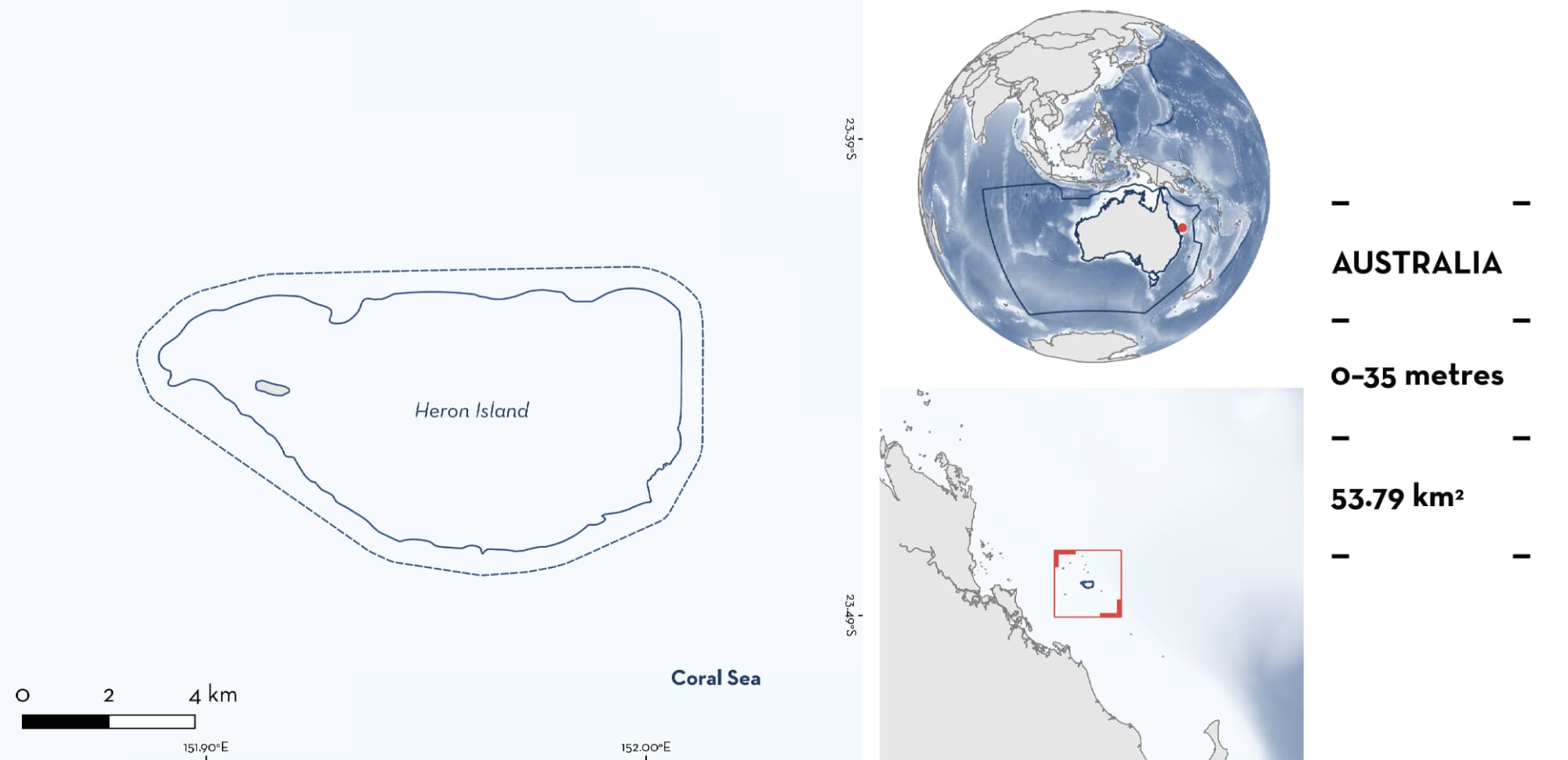
Heron Island
Summary
Heron Island is located in Queensland, Australia. It is situated ~75 km northeast of Gladstone and is part of the Capricorn-Bunker group of islands and reefs in the southern Great Barrier Reef. The habitat is characterised by a reef slope, a vast reef flat and lagoon, sandy beaches with some beach rock, sandy substrates, seagrass, and rubble. It is influenced by the East Australian Current, by tides, and by southeast trade winds and waves. This area overlaps with the Great Barrier Reef Marine Park and with the Capricornia Cays Key Biodiversity Area. Within this area there are: threatened species (e.g., Porcupine Ray Urogymnus asperrimus); range-restricted species (Epaulette Shark Hemiscyllium ocellatum); reproductive areas (Giant Guitarfish Glaucostegus typus); resting areas (Whitetip Reef Shark Triaenodon obesus); and undefined aggregations (e.g., Spotted Eagle Ray Aetobatus ocellatus).
Download factsheet
Heron Island
DESCRIPTION OF HABITAT
Heron Island is located in Queensland, Australia. It is situated ~75 km northeast of Gladstone and is part of the Capricorn-Bunker group of islands and reefs in the southern Great Barrier Reef. Heron Island is a coral cay situated on a platform reef. The island is near the western end of the reef and is surrounded by a vast reef flat that varies in depth from 0.5–2.5 m, depending on the tide (Nay et al. 2020). The outer reef crest dries at low tide, isolating the lagoon (Heupel & Simpfendorfer 2015). The reef slope is steep and drops to sandy substrates at ~30 m depth. A man-made channel cuts through the reef to the southwestern corner of the island and is known as the harbour. Other notable sites are Shark Bay, off the eastern tip of the island, and North Beach. The habitat around the island is characterised by a reef slope, a reef flat and lagoon, sandy beaches with some beach rock, sandy substrates, seagrass, and rubble.
This area is influenced by the East Australian Current, the poleward flowing western boundary current of the South Pacific Gyre (Suthers et al. 2011). The East Australian Current flow is strongest in the austral summer, and the formation of eddies along this coastline also fluctuates seasonally (Ridgway & Hill 2009). Tides also influence the local currents in this area. The tidal amplitude is up to ~3 m (Heupel & Simpfendorfer 2015). Southeast trade winds are strongest in winter from April–October, when the eastern part of the reef is more exposed to wind and waves than the western part.
This area overlaps with the Great Barrier Reef Marine Park – Scientific Research Zone and Marine National Park Zone (UNEP-WCMC & IUCN 2025) and with the Capricornia Cays Key Biodiversity Area (KBA 2025).
This Important Shark and Ray Area is benthic and pelagic and is delineated from inshore and surface waters (0 m) to 35 m based on the bathymetry of the area.
CRITERION A
VULNERABILITY
Nine Qualifying Species considered threatened with extinction according to the IUCN Red List of Threatened Species regularly occur in the area. Threatened sharks comprise one Endangered species and two Vulnerable species; threatened rays comprise one Critically Endangered species, two Endangered species, and three Vulnerable species (IUCN 2025).
CRITERION B
RANGE RESTRICTED
Heron Island holds the regular presence of Epaulette Sharks as a resident range-restricted species. A capture-mark-recapture study conducted in 1994–1997 tagged 80 Epaulette Sharks and estimated a total population size of 559–2,224 individuals, depending on the model (Heupel & Bennett 2007). There are also ~200 observations recorded on the citizen science database iNaturalist between 2010–2025, which is ~50% of the total entries (n = 383) for the species in Queensland (iNaturalist 2025), indicating that this area stands out regionally. In addition, dive centre staff counted 180 individuals on 52 reef walking tours during July–October 2025 when they took detailed notes (E Peters pers. obs. 2025). Epaulette Sharks occur year-round in this area and were regularly observed by dive staff between 2022–2025 (E Peters pers. obs. 2025). Although sharks were not individually identified, there is only a small chance of re-counting the same individual twice as reef walks occur at low tide when Epaulette Sharks do not move far. It is likely that this area is important for reproduction, feeding, and resting, as the species is resident with limited movements (Heupel & Bennett 2007; Nay et al. 2020) and likely undergo their full life cycle within the area. Reports of small individuals of ~25 cm total length (TL) on the reef flat, mating attempts, and foraging support this (Heupel & Bennett 1998; E Peters pers. obs. 2025). The size-at-birth for the species is 14–16 cm TL (Ebert et al. 2021). The species occurs primarily in the Northeast Australian Shelf Large Marine Ecosystem (LME) and the East Central Australian Shelf LME.
CRITERION C
SUB-CRITERION C1 – REPRODUCTIVE AREAS
Heron Island is an important reproductive area for one ray species.
Neonate Giant Guitarfish are regularly observed in this area (Gaskins et al. 2020). Surveys were conducted around the whole island in March/April 2019 and January–March 2020 by walking 4 m wide belt transects in shallow <0.5 m) along the shoreline. Surveys started within 90 min of low tide and occurred during the day (n = 14) and at night (n = 14). Giant Guitarfish were counted and measured using a ruler when stationary, or the size was visually estimated using corals or rocks as markers for moving individuals. A total of 552 Giant Guitarfish ranging from 27–59 cm TL were observed in the survey. Most were neonates (n = 436; 79%) measuring <40 cm TL. The size-at-birth for the species is 38–40 cm TL and the size-at-maturity is 150–180 cm TL (Last et al. 2016). Many of the remaining individuals were likely to be young-of-the-year (YOY) or small juveniles (Gaskins et al. 2020). More Giant Guitarfish were observed at night than during the day, and the mean water depth at observations was just 0.16 m. Larger juveniles and adults were also seen in deeper waters within this area, but outside the specific survey (Gaskins et al. 2020). Additionally, the species was regularly observed by local dive staff between 2022–2025, with 32 observations recorded in a logbook between July–October 2025, and small pups seasonally observed in the austral summer (E Peters pers. obs. 2025). These records included groups of 20 and 35 individuals that comprised mostly small individuals. Neonates, YOY, and small juveniles likely use the shallow water along the island’s shoreline to avoid predation (Gaskins et al. 2020).
CRITERION C
SUB-CRITERION C3 – RESTING AREAS
Heron Island is an important resting area for one shark species.
Whitetip Reef Sharks regularly rest in aggregations in this area (E Peters pers. obs. 2025). Dive staff report that the species is often seen resting in different locations within the area, with recorded observations between 2022–2025. A detailed logbook recorded the number and behaviour of all sharks and rays seen in this area by dive staff between July–October 2025, with observations made on dives and snorkelling trips, and from land, boats, or kayaks. A total of 236 observations of 510 Whitetip Reef Sharks were recorded. Approximately half of the observations were of resting individuals (n = 113 observations [48%]; 230 individuals [45%]), and an additional five records were described as aggregations for which the behaviour was not specified. Among these observations of resting and aggregating Whitetip Reef Sharks, 31 aggregations (26%) of 3–12 individuals were observed, highlighting that the species regularly aggregates to rest. They rested either on sandy or rubble patches and under overhangs on the reef slope, or on sandy substrate inside the harbour, while elsewhere in the area they are often seen actively swimming (E Peters pers. obs. 2025).
CRITERION C
SUB-CRITERION C5 – UNDEFINED AGGREGATIONS
Heron Island is an important area for undefined aggregations of two shark and five ray species.
Passive acoustic telemetry data show that Grey Reef Sharks and Blacktip Reef Sharks regularly aggregate in this area (IMOS unpubl. data 2025). Data were sourced from Australia’s Integrated Marine Observing System (IMOS); IMOS is enabled by the National Collaborative Research Infrastructure Strategy (NCRIS). Aggregations were defined as three or more tagged individuals detected on a receiver within five minutes. The detection range of receivers was a minimum of 300 m (Heupel & Simpfendorfer 2014). Aggregations in consecutive 5-min bins were grouped into an event, and its duration was calculated.
A total of 37 Grey Reef Sharks tagged with acoustic transmitters were detected >100 times in Heron Island between March 2011 and June 2017 (IMOS unpubl. data 2025). There were ~2,178,000 detections recorded at this reef, but 10 stations were deployed for only a short time, and these were excluded. The remaining 32 receiver locations were used in the analyses. There were 14,122 five-minute bins with aggregations recorded within the area, grouped into 8,810 aggregation events that lasted between 0.2–170.0 min (mean = 6.3 min). Aggregations comprised 3–8 individuals at a time (mean = 3.1 individuals). As aggregations lasted up to several hours, these events comprised up to 10 unique tagged sharks (27% of total), but a maximum of eight individuals (22% of total) were recorded at the same time. There was a weak seasonal signal, with more aggregations recorded from January–June. Slightly more aggregations were recorded during the night (56%) than during the day (44%). Aggregations were recorded on 45% of monitoring days, highlighting their regular occurrence. No aggregations were recorded on the adjacent Sykes Reef that had five receiver locations, further supporting the importance of Heron Island for aggregations of the species (IMOS unpubl. data 2025). A passive acoustic study tracking 29 Grey Reef Sharks between 2011–2014 showed a high residency index, indicating that they remain within the area for most of the tracking days (Heupel & Simpfendorfer 2015).
A total of 25 Blacktip Reef Sharks tagged with acoustic transmitters were detected >100 times in Heron Island between March 2011 and June 2017 (IMOS unpubl. data 2025). There were ~345,000 detections recorded on 35 receiver locations at this reef. There were 499 five-minute bins with aggregations recorded within the area, grouped into 279 aggregation events that lasted between 0.3–134.0 min (mean = 7.3 min). Aggregations comprised 3–5 individuals at a time (mean = 3.1 individuals). A maximum of five individuals (20% of total) were recorded at the same time. Aggregations were detected on 16 receivers, with a concentration in the western part of the area. There was a seasonal signal, with more aggregations recorded from May–October. The diurnal signal showed that most aggregations occurred between 4–6 pm. Aggregations were recorded on 11% of monitoring days. Additionally, aggregations of Blacktip Reef Sharks are often observed by dive staff operating in the western part of the area (E Peters pers. obs. 2025). A detailed logbook from July–October 2025 recorded 21 aggregations of 3–15 individuals, mostly in the harbour, Shark Bay, and North Beach. Active hunting behaviour was recorded and small individuals were observed (E Peters pers. obs. 2025).
Spotted Eagle Ray aggregations are regularly observed in this area (E Peters pers. obs. 2025). Long-term dive staff report that Spotted Eagle Rays are almost always seen in the harbour, with observations recorded between 2022–2025. A detailed logbook recorded all sharks and rays seen in this area by dive staff between July–October 2025, with observations made on dives and snorkelling trips, and from land, boats or kayaks. A total of 119 observations of 705 individual Spotted Eagle Rays were recorded. Most individuals were recorded in the harbour (n = 612; 87%), where 61 aggregations ranged from 3–32 individuals (mean = 9.8 individuals). Observations suggest that this area may be important for the reproduction of the species, with potential mating reported. Additionally, one of four specimens captured in a scientific study in February 2007 aborted four live embryos >35 cm disc width (DW) (Schluessel et al. 2010), supporting that the area may be important for reproduction. The same study also reported aggregations of feeding Spotted Eagle Rays (Schluessel et al. 2010). Additionally, dive staff have reported Spotted Eagle Rays getting cleaned at cleaning stations (E Peters pers. obs. 2025).
Reef Manta Rays regularly use cleaning stations and aggregate in this area (E Peters pers. obs. 2025; Project Manta unpubl. data 2025). Between 2008–2025, a citizen science project catalogued opportunistic photo-identification submissions of Reef Manta Rays in the area (Project Manta unpubl. data 2025). A total of 163 sightings were submitted, comprising 148 individuals. Behaviour was recorded for 39 sightings, and cleaning was observed in 92.3% of the time (n = 36), with courtship observed twice (5.1% of sightings). Aggregations were recorded seven times, comprising 3–5 Reef Manta Rays (average = 3.4 individuals). Pregnancies (classified by visibly distended abdomens) were recorded four times, and a neonate was recorded in 2008 with an estimated size of ~120 cm DW (Project Manta unpubl. data 2025). The size-at-birth for this species is 130–150 cm DW (Last et al. 2016). Dive staff also regularly observe the species in this area, with observations between 2022–2025. The detailed logbook recorded by dive staff between July–October 2025 reported a total of 52 observations of 90 Reef Manta Rays (E Peters pers. obs. 2025). The most common behaviour in these observations was cleaning (n = 21; 40%) at defined cleaning stations within this area. Cleaning stations are parts of the reef where cleaner fishes remove parasites and dead skin off Reef Manta Rays (Armstrong et al. 2021), an important behaviour for this species with individuals spending up to 8 h cleaning per day in some locations (Venables et al. 2020). Additionally, five of the observations were of aggregations ranging from 3–7 individuals. In some of these, Reef Manta Rays appeared to be feeding (swimming with open mouths), and it is possible that this area is also important for feeding. Outside the logbook, observations between 2022–2025 also suggest courtship trains and neonates with visible folds at the base of the pectoral fins occur in the area (E Peters pers. obs. 2025).
Broad Cowtail Rays regularly rest in large aggregations, as well as in assemblages with other species, such as Pink Whipray, Porcupine Ray, and Giant Guitarfish, in shallow waters close to the island’s shoreline (E Peters pers. obs. 2025). Dive staff report that the species is often seen in the harbour, in Shark Bay, and off North Beach (all sites within the area), with observations recorded between 2022–2025. The detailed logbook recorded a total of 151 observations of 1,366 individual Broad Cowtail Rays. A total of 93 aggregations (62% of observations) of 3–82 individuals (mean = 13.8) were recorded within the area. Most aggregations were observed in the harbour (n = 54 observations), followed by North Beach (n = 15), and Shark Bay (n = 14). Most observations (n = 122; 81%) and individuals (n = 1,265; 93%) were observed resting on the sand (E Peters pers. obs. 2025). The species is a solitary forager but is known to occur in aggregations (Semeniuk & Dill 2005). It is possible that these aggregations and assemblages are for resting.
Pink Whiprays are regularly observed in aggregations and assemblages with Broad Cowtail Ray, Porcupine Ray, and Giant Guitarfish in this area (E Peters pers. obs. 2025). Citizen scientists recorded 28 Pink Whipray observations and 151 Broad Cowtail Ray observations within this area on iNaturalist between 2010-2025, often in aggregations or assemblages (iNaturalist 2025). Additional records from photographers in March 2021 and in October/November 2022 and 2024 further support these aggregations and assemblages (A Lomakin & D Robinson pers. comm. 2025). Dive staff have also reported regular sightings of aggregations and assemblages in 2022–2025 (E Peters pers. obs. 2025). Assemblages of up to 35 Pink Whiprays and Broad Cowtail Rays have been photographed. They are located mainly in the harbour and in shallow water along the island’s edge. It is likely that these aggregations and assemblages are of resting individuals, as they refuge in groups to lower predation risk.
Porcupine Rays are regularly observed in aggregations and assemblages with Broad Cowtail Ray, Pink Whipray, and Giant Guitarfish in this area (E Peters pers. obs. 2025). Dive staff report that the species is often seen in the harbour and in Shark Bay, with observations between 2022–2025. The detailed logbook between July–October 2025 recorded the species 25 times (38 individuals), and on most of the observations, rays were resting on the sand (n = 21; 84%). Pairs (n = 5) or aggregations of three individuals (n = 4) were often recorded. It is likely that aggregations and assemblages in comparatively deeper water near the reef flat are used to rest before foraging on the reef flat (E Peters pers. obs. 2025). Porcupine Rays are generally rare in Australia, with 25 total records up to 2010 and an additional 29 records up to 2014, and the regular observations made at Heron Island indicate that this area may be a hotspot for the species regionally (Theiss et al. 2010; Chin 2014).
Further information is required to confirm the nature and function of these assemblages.
Download factsheet
SUBMIT A REQUEST
ISRA SPATIAL LAYER REQUEST
To make a request to download the ISRA Layer in either a GIS compatible Shapefile (.shp) or Google Earth compatible Keyhole Markup Language Zipped file (.kmz) please complete the following form. We will review your request and send the download details to you. We will endeavor to send you the requested files as soon as we can. However, please note that this is not an automated process, and before requests are responded to, they undergo internal review and authorization. As such, requests normally take 5–10 working days to process.
Should you have questions about the data or process, please do not hesitate to contact us.

