ISRA FACTSHEETS
ISRA FACTSHEETS
AUSTRALIA AND SOUTHEAST INDIAN OCEAN
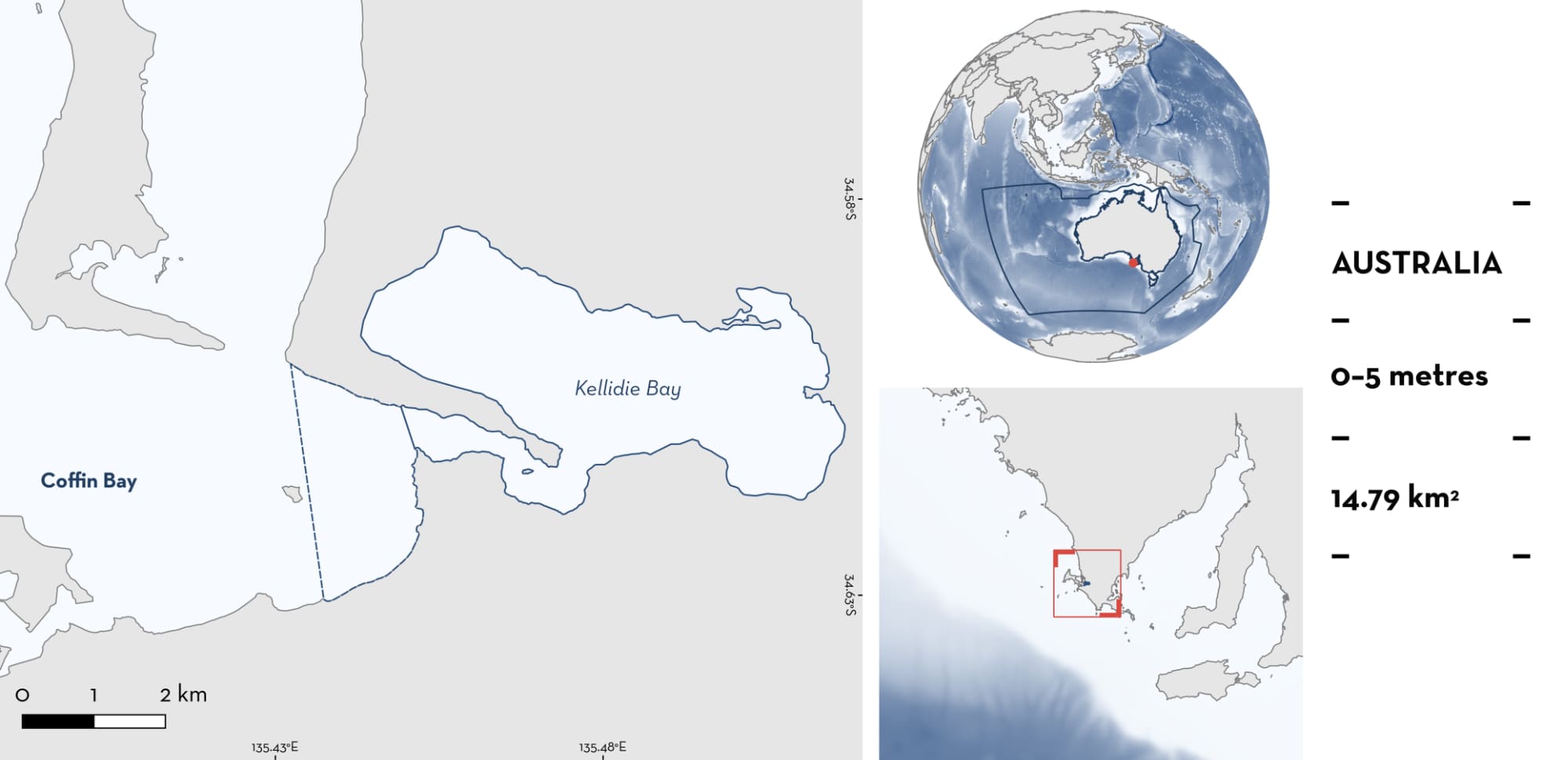
Kellidie Bay
Summary
Kellidie Bay is located in South Australia, Australia. This shallow intertidal environment is situated within Coffin Bay, an estuary on the lower Eyre Peninsula. As the eastern most bay in Coffin Bay, water movement is largely driven by large tides and evaporative and rainfall processes. The shallow, warm environment contains a range of macroalgal, seagrass, and sandy substrates. The area overlaps with the Thorny Passage Marine Park. Within this area there are: undefined aggregations (Southern Eagle Ray Myliobatis tenuicaudatus).
Download factsheet
Kellidie Bay
DESCRIPTION OF HABITAT
Kellidie Bay is located in on the lower Eyre Peninsula, South Australia, Australia. It is a shallow bay situated inside Coffin Bay, a large inverse estuarine environment, ~45 km northwest of Port Lincoln. Kellidie Bay is the shallowest and easternmost of multiple bays (e.g., Mount Dutton, Yangie, Little Douglas bays) located inside Coffin Bay (Whitmarsh et al. 2020). It is characterised by the presence of sandy substrates, seagrass patches, and algal coverage (Whitmarsh et al. 2020). Two small creeks flow into the area during rain events (Saunders 2012). Habitats within Coffin Bay include sponge gardens, reef structures, sandflats, seagrass meadows, saltmarsh plains, mangroves, and macroalgal reefs (Whitmarsh et al. 2020).
The area is prone to large tidal movements with many bays and channels becoming exposed at low tides. Due to the narrow mouth of Coffin Bay, water exchange and energy flow between the open ocean and the estuary is limited. Water mixing in the area is affected by tidal movements, evaporation, and rainfall processes. Sea surface temperature ranges between 20–22°C during the austral summer and ~12°C during winter (Kämpf & Ellis 2015)
The area overlaps with the Thorny Passage Marine Park (NPWS SA 2025).
This Important Shark and Ray Area is benthic and pelagic and is delineated from inshore and surface waters (0 m) to 5 m based on the bathymetry of the area.
CRITERION C
SUB-CRITERION C5 – UNDEFINED AGGREGATIONS
Kellidie Bay is an important area for undefined aggregations of one ray species.
Southern Eagle Ray aggregations regularly occur in Kellidie Bay, according to acoustic telemetry and observations made by citizens scientists (Davey et al. 2023; iNaturalist 2025). In September 2019 and January 2020, 30 Southern Eagle Rays were tagged in the Coffin Bay estuary with 26 (86.6%) tagged at Kellidie Bay (Davey et al. 2023). Individuals were monitored between September 2019–January 2021 on an array of 28 receivers (detection range <300–500 m) deployed across five bays located inside Coffin Bay, of which seven were deployed in Kellidie Bay. Almost all the individuals showed a high residency to Kellidie Bay spending ~74% of their time there (Davey et al. 2023). Southern Eagle Rays were only present in Kellidie Bay in summer with a seasonal winter exodus from May to August likely due to thermal tolerance limits. Aggregations were confirmed based on acoustic telemetry as multiple individuals (7–8 on average and up to 13) were detected almost daily on the same receiver in a one-hour period (Davey et al. 2023). When looking at a finer temporal scale (five-minute period), aggregations of 3–5 individuals were recorded in ~30% of time on some of the receivers (C Huveneers et al. unpubl. data 2025). The underlying assumption is that these tagged rays are representative for the species, so that an aggregation of 3–5 individuals is significant and likely comprises additional, untagged individuals. Aggregations of Southern Eagle Rays were reported by citizen scientist in 2016 and 2025, confirming their regular presence in the area (iNaturalist 2025). Tagged individuals ranged between 78.5–133.0 cm disc width (DW) for females and 69.5–96.0 cm DW for males. This indicates that aggregations are composed of mature individuals as size-at-maturity for the species is 80–100 cm DW for females and 65–69 cm DW for males (Last et al. 2016). Most Southern Eagle Rays were female (88%), indicating that Kellidie Bay could serve as an important reproductive site for the species, with females potentially using warm waters to aid embryonic development (Speed et al. 2012). However, males also occupied Kellidie Bay and displayed similar space use to females, indicating that the site is not solely used for reproduction (Davey et al. 2023). In addition, Kellidie Bay is characterised by high nutrient loads, slow flushing time, and diverse habitats, supporting an abundance of invertebrate prey (e.g., mud cockles Katelysia spp. and scallops of the family Pectinidae; Hartill 1989), which likely contributes to the presence of the aggregation within this area (Davey et al. 2023). Additional information is needed to understand the nature and function of these aggregations.
Download factsheet
SUBMIT A REQUEST
ISRA SPATIAL LAYER REQUEST
To make a request to download the ISRA Layer in either a GIS compatible Shapefile (.shp) or Google Earth compatible Keyhole Markup Language Zipped file (.kmz) please complete the following form. We will review your request and send the download details to you. We will endeavor to send you the requested files as soon as we can. However, please note that this is not an automated process, and before requests are responded to, they undergo internal review and authorization. As such, requests normally take 5–10 working days to process.
Should you have questions about the data or process, please do not hesitate to contact us.