
ISRA FACTSHEETS
ISRA FACTSHEETS
AUSTRALIA AND SOUTHEAST INDIAN OCEAN
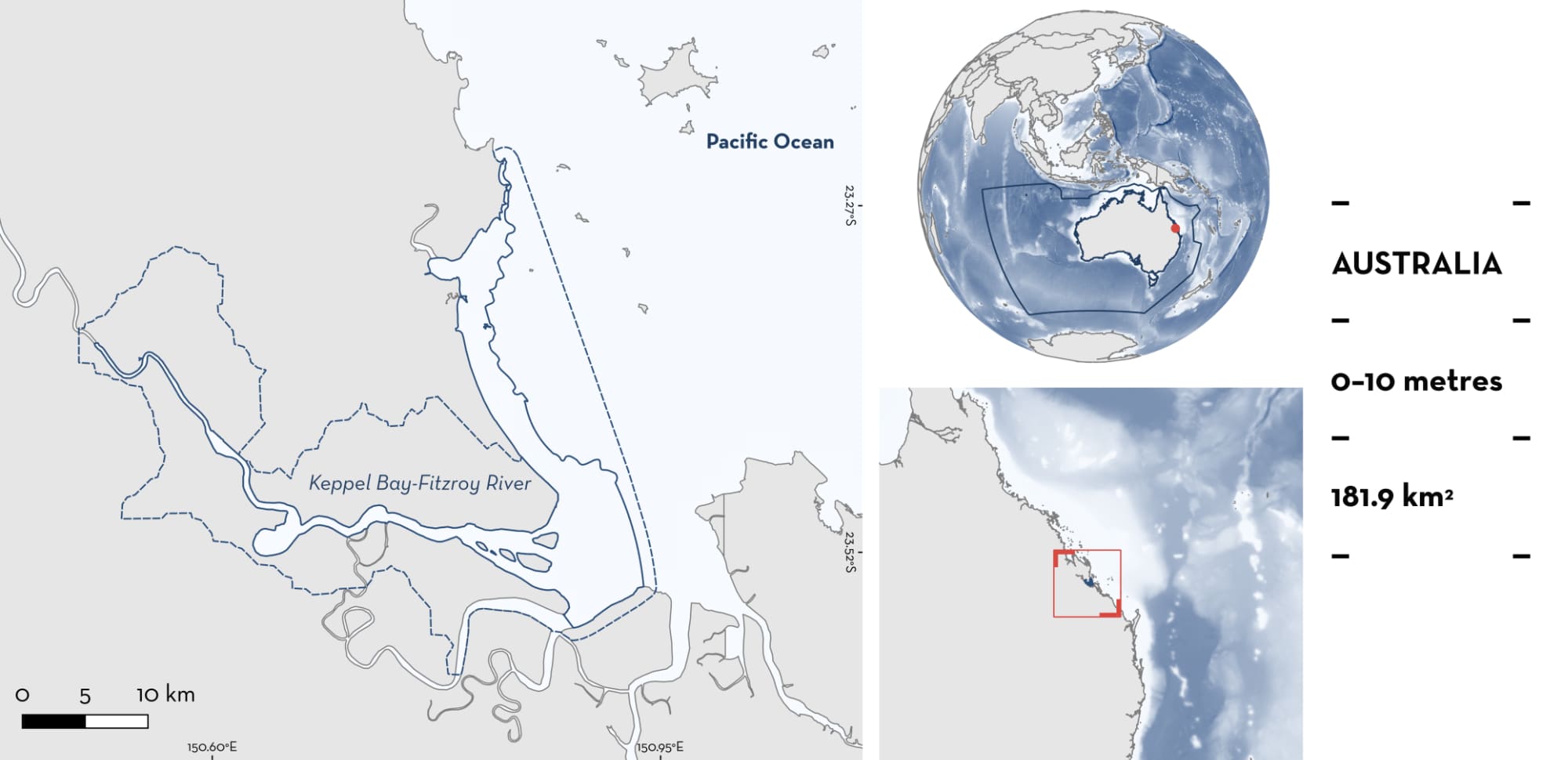
Keppel Bay-Fitzroy River
Summary
Keppel Bay-Fitzroy River is located on the central Queensland coast, Australia. It extends from the Fitzroy River mouth to Rockhampton barrage, ~60 km upstream, and includes the northern coast of Keppel Bay up to Tanby Point. The area is characterised by extensive mangroves, saltmarsh, seagrass meadows, and intertidal flats dominating the delta and inner bay margin, with inshore fringing coral reefs within the bay. It is influenced by a highly variable, macrotidal flow with an amplitude of up to ~5 m, leading to saltwater intrusion, highly turbid waters, and low-salinity plumes. The area overlaps with the Fitzroy Floodplain and Delta Key Biodiversity Area. Within this area there are: threatened species and reproductive areas (Bull Shark Carcharhinus leucas).
Download factsheet
Keppel Bay-Fitzroy River
DESCRIPTION OF HABITAT
Keppel Bay-Fitzroy River is located on the central Queensland coast, Australia. The area extends from the Fitzroy River mouth to Rockhampton barrage, ~60 km upstream, and includes the northern coast of Keppel Bay up to Tanby Point. The Fitzroy River drains a catchment of approximately 143,000 km2, making it the largest catchment discharging into the Great Barrier Reef and forming its largest estuarine system, which extends about 60 km in length (Lewis et al. 2015). The area is characterised by extensive mangroves, saltmarsh, seagrass meadows, and intertidal flats dominating the delta and inner bay margin, with inshore fringing coral reefs within the bay (Lewis et al. 2015).
The area is influenced by a highly variable, macrotidal flow with an amplitude of up to ~5 m, leading to saltwater intrusion, but also presenting freshwater conditions (Lewis et al. 2015). Flood and wet-season events during the austral summer from December–March drive turbid, low-salinity plumes and deliver fine sediments and nutrients into Keppel Bay.
Keppel Bay-Fitzroy River overlaps with the Fitzroy Floodplain and Delta Key Biodiversity Area (KBA 2025).
This Important Shark and Ray Area is benthic and pelagic and is delineated from inshore and surface waters (0 m) to 10 m based on the bathymetry of the area.
CRITERION A
VULNERABILITY
One Qualifying Species considered threatened with extinction according to the IUCN Red List of Threatened Species regularly occurs in the area. This is the Vulnerable Bull Shark (Rigby et al. 2021).
CRITERION C
SUB-CRITERION C1 – REPRODUCTIVE AREAS
Keppel Bay-Fitzroy River is an important reproductive area for one shark species.
Neonate, young-of-the-year (YOY), and juvenile Bull Sharks are regularly observed in this area (Harry et al. 2011; Lubitz 2023; Queensland Shark Control Program [QSCP] 2025; N Lubitz unpubl. data 2025).
Between 1996–2025, the QSCP used year-round deployments of a combination of gillnets and drumlines along 85 beaches in Queensland. Drumlines and gillnets were positioned ~500–1,000 m from the shoreline, with gillnets running 186 m parallel to the shoreline, with a gauge of 50 cm and a 6 m drop (Banaghan et al. 2025; QSCP 2025). Species, sex, and size were recorded for all sharks caught. Between 1996–2022, the area and surrounding bays in the Capricorn Coast region accounted for 49.3% (n = 515) of all Bull Shark juveniles (<175 cm total length; TL) caught along the Queensland Coast (Banaghan et al. 2025). The size-at-birth for the species is 56–81 cm TL and YOY can be up to 99 cm TL (Pillans et al. 2020; Ebert et al. 2021). However, juveniles up to ~150 cm TL or five years old are often still site attached to riverine ecosystems where they were born (Werry et al. 2011). Between 2001–2025, a total of 110 neonates and YOY (<100 cm TL) were captured at Emu Park and Fisherman’s Beach, within the area, representing 31.5% of 349 Bull Sharks captured in the area (QSCP 2025). These two beaches recorded the highest number of neonates and YOY along the Capricorn Coast region. A peak in captures occurred between 2017 and 2021. Bull Sharks were recorded throughout the year (except August), with 89.1% of them occurring between November–June (QSCP 2025).
In 2009, observer data were collected from vessels operating in the commercial gillnet sector of the Queensland East Coast Inshore Finfish Fishery (Harry et al. 2011). All captured sharks were identified, measured and sexed (Harry et al. 2011). Derived from this effort on two surveyed days in February 2009, a total of 79 Bull Sharks were captured upstream in the Fitzroy River (within the area) ranging in size between 67.5–98 cm TL (Harry et al. 2011). Neonates (n = 77, 97.4%) ranging in size between 67.5–87.5 cm TL were identified based on size (n = 3), presence of an open umbilical scar (n = 58), or a partial open umbilical scar (n = 16). YOY (n = 2, 2.5%), ranged in size between 91–98 cm TL. Most of the individuals (n = 76) were captured on a single day (February 2009), demonstrating their high abundance despite low survey effort (Harry et al. 2011).
Additionally, a research study in October and December 2021 and February and December 2024, captured, measured, and released 26 Bull Sharks in the Fitzroy River using rod-and-line during five survey days (N Lubitz unpubl. data 2025). Up to 14 individuals were captured within three hours on a single survey day. Bull Sharks were caught in Rockhampton, ~55 km upstream from the river mouth. Individuals ranged in size from 70–85 cm TL and all had a visible umbilical scar. Twenty individuals were neonates (77% of the total) ranging from 70–81 cm TL, and six sharks were YOY (23%) ranging from 82–85 cm TL. Captured Bull Sharks comprised 15 females, 10 males, and one shark for which the sex was not determined (N Lubitz unpubl. data 2025).
Combined, this information shows that Keppel Bay-Fitzroy River is an important area for the early life-stage Bull Sharks. Although the area is located only ~70 km north of Tannum Sands, which also hosts important habitat for young Bull Sharks, these river systems are individually important. Bull Sharks in Australia display natal philopatry, with females returning to particular river systems to pup (Tillett et al. 2012; Lubitz 2023). For example, half-sibling pairs were found within a river on Australia’s east coast up to seven cohorts apart, highlighting the long-term natal philopatry of females (Lubitz 2023). Therefore, individual rivers and coastal habitats in this region represent discrete portions of habitat that are important to Bull Sharks.
Download factsheet
SUBMIT A REQUEST
ISRA SPATIAL LAYER REQUEST
To make a request to download the ISRA Layer in either a GIS compatible Shapefile (.shp) or Google Earth compatible Keyhole Markup Language Zipped file (.kmz) please complete the following form. We will review your request and send the download details to you. We will endeavor to send you the requested files as soon as we can. However, please note that this is not an automated process, and before requests are responded to, they undergo internal review and authorization. As such, requests normally take 5–10 working days to process.
Should you have questions about the data or process, please do not hesitate to contact us.

