
ISRA FACTSHEETS
ISRA FACTSHEETS
AUSTRALIA AND SOUTHEAST INDIAN OCEAN
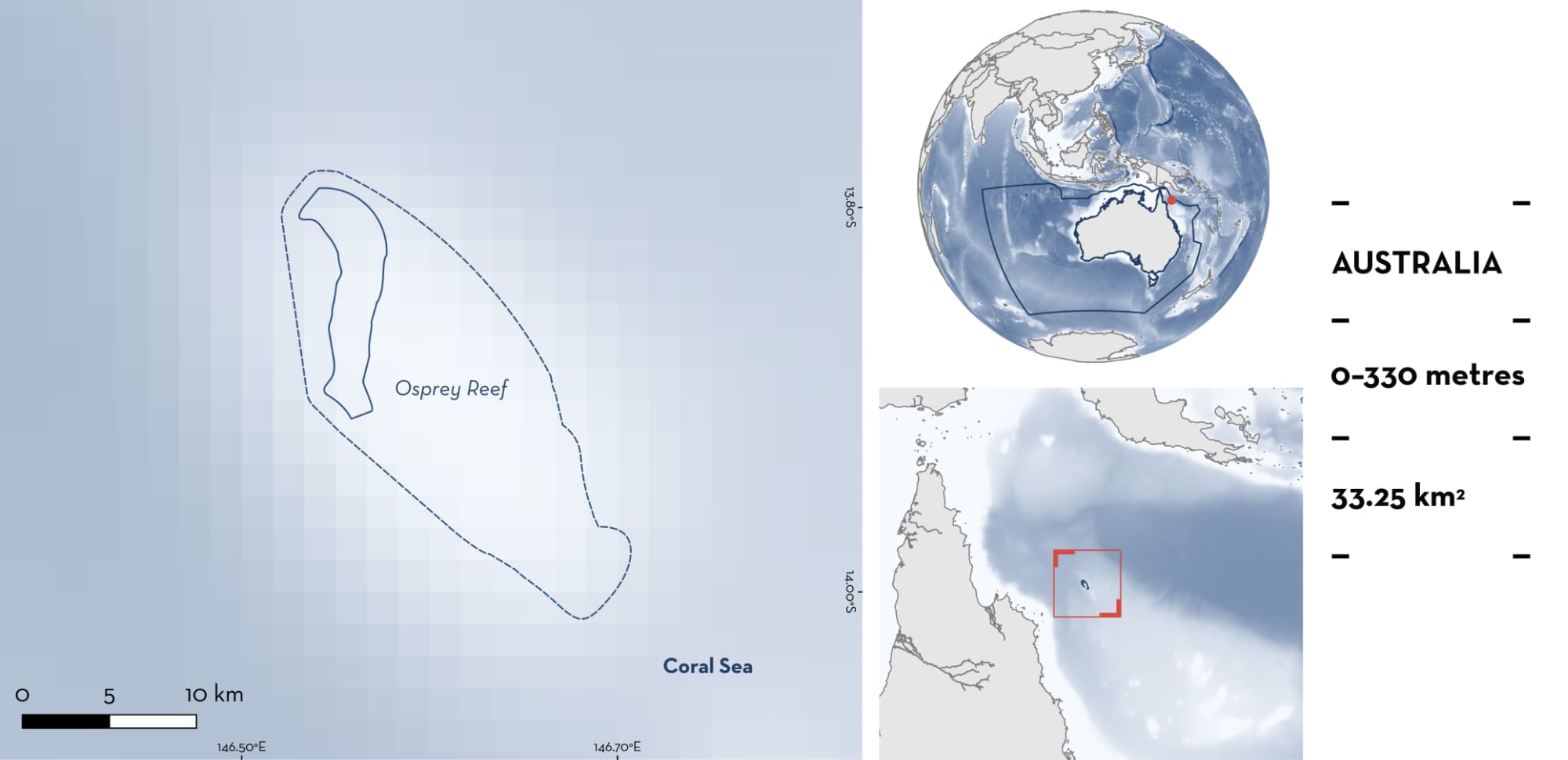
Osprey Reef
Summary
Osprey Reef is located in the Coral Sea, off Queensland, Australia. It is situated ~220 km east of Cape Melville and comprises the northwestern part of the larger Osprey Reef. The habitat is characterised by pelagic waters, steep reef walls, a reef channel, and insular shelf slopes. It is influenced by tides, by the South Equatorial Current, and by southeasterly trade winds. This area is located on the leeward (wind-protected) side of the larger reef. It overlaps with the Coral Sea Marine Park. Within this area there are: threatened species (e.g., Grey Reef Shark Carcharhinus amblyrhynchos); resting areas (Whitetip Reef Shark Triaenodon obesus); and undefined aggregations (Grey Reef Shark).
Download factsheet
Osprey Reef
DESCRIPTION OF HABITAT
Osprey Reef is located ~220 km east of Cape Melville in the Coral Sea, off Queensland, Australia. The area comprises the northwestern part of the larger Osprey Reef, which is an isolated volcanic seamount ~125 km off the edge of the Great Barrier Reef (O’Shea et al. 2010; Barnett et al. 2012). It rises from the Queensland Plateau from depths of >2,000 m and the reef extends to just below the surface. The reef spans ~25 by 12 km and has a large central lagoon with a maximum depth of 40 m (Barnett et al. 2012). The area is delineated from the northern corner of the reef (‘North Horn’ dive site) along the western reef wall to just past the single entrance into the lagoon (‘Admiralty’ and ‘False Entrance’ dive sites). The habitat is characterised by pelagic waters, steep outer reef slopes, a reef channel, and insular shelf slopes.
The area is influenced by tides and wind (Leis 1994). Strong southeasterly trade winds dominate during the austral winter from June to September, driving westward surface flow associated with the South Equatorial Current and its northward branch, the North Queensland Current (Choukroun et al. 2010). In summer, winds are relatively weak and more variable. The area lies on the leeward (wind-protected) side of Osprey Reef, which modifies local circulation and reduces wave exposure (Barnett et al. 2012). The broader region is influenced by the westward-flowing South Equatorial Current and the southward extension of the East Australian Current (Choukroun et al. 2010). Tides further influence local flow patterns within the reef.
This area overlaps with the Coral Sea Marine Park – Marine National Park zone (Parks Australia 2025).
This Important Shark and Ray Area is benthic and pelagic and is delineated from surface waters (0 m) to 330 m based on the global depth range of the Qualifying Species.
CRITERION A
VULNERABILITY
Two Qualifying Species considered threatened with extinction according to the IUCN Red List of Threatened Species regularly occur in the area. This is the Endangered Grey Reef Shark (Simpfendorfer et al. 2020a) and the Vulnerable Whitetip Reef Shark (Simpfendorfer et al. 2020b).
CRITERION C
SUB-CRITERION C3 – RESTING AREAS
Osprey Reef is an important resting area for one shark species.
Whitetip Reef Sharks are regularly seen resting in this area (Barnett et al. 2016). Eight adult females were tagged with bi-axial acoustic accelerometers and tracked within a small-scale array of eight receivers at North Horn, within this area, in November–December 2009 (Barnett et al. 2016). The distribution of activity data was bimodal with a peak at 0.1 m s-2 (resting) and at 1.3 m s-2 (actively swimming). Tracked individuals were active at night but rested during the day (Barnett et al. 2016). Historic passive acoustic telemetry data from 2008–2009 show that most (11 of 18) of the tagged Whitetip Reef Sharks were recorded by receivers on >90% of monitoring days, highlighting their regular use of this area (Barnett et al. 2012). They were detected mostly in the north and west of the reef, within this area (Barnett et al. 2012). Contemporary information from divers shows that Whitetip Reef Sharks are still abundant and are regularly seen resting on the substrate during the day in this area (iNaturalist 2025). Between 2017–2019, researchers were able to take genetic samples within this area from six individuals in one day, and from an additional seven individuals on another day, also highlighting the continued abundance of this species (M Hirschfeld pers. comm. 2025). The isolated nature of Osprey Reef and the steep reef walls descending into deep waters mean that reef ledges and sand patches are important resting sites for this species.
CRITERION C
SUB-CRITERION C5 – UNDEFINED AGGREGATIONS
Osprey Reef is important for undefined aggregations of one shark species.
Passive acoustic telemetry data show that Grey Reef Sharks regularly aggregate in this area (Barnett et al. 2012; N Lubitz et al. unpubl. data 2025). A total of 36 Grey Reef Sharks tagged with acoustic transmitters were detected in Osprey Reef between February 2021 and November 2024 (N Lubitz et al. unpubl. data 2025). Aggregations were defined as three or more tagged individuals detected on a receiver within five minutes. The approximate range in which receivers detect tagged sharks 100% of the time on Coral Sea reefs is ~400 m (Barnett et al. 2012). Aggregations in consecutive 5-min bins were grouped into an event and its duration was calculated.
There were ~1,230,000 detections recorded at this reef, but one station had few detections (n = 186; 0% of total) and was excluded. The remaining five receiver locations were used to define the boundary of the area. There were 79,454 five-minute bins with aggregations recorded within the area, grouped into 31,761 aggregation events that lasted between 0.2–537 min (mean = 10.8 min). Aggregations comprised 3–11 individuals at a time (mean = 3.5 individuals). As aggregations lasted up to several hours, these events comprised up to 22 unique tagged sharks (61% of total), but a maximum of 11 individuals (31% of total) were recorded at the same time. There was no evidence of clear seasonality in aggregation number, size, or duration. There were fewer aggregations during the night (28%) than during the day (72%), but there was no defined peak within the daytime. Aggregations were recorded on 72% of monitoring days, highlighting their regular occurrence. Although one station is located at a dive site (‘North Horn’) where tour operators sometimes attract and feed reef sharks, most days with aggregations were recorded at two stations further south at the entrance to the lagoon (833 and 551 days, respectively), highlighting that aggregations persist naturally. Only six of 81 Grey Reef Sharks tagged in the broader Coral Sea region (Osprey Reef, Holmes Reefs, Flinders Reefs, Bougainville Reef) were detected at multiple reefs, highlighting their high residency and site fidelity, and the individual importance of each reef (N Lubitz et al. unpubl. data 2025).
Additionally, historic passive acoustic telemetry data from 2008–2009 support aggregations and the space use of Grey Reef Sharks in this area, with 11 of the 18 tagged individuals recorded on >90% of monitoring days (Barnett et al. 2012). They were detected mostly in the north and west of the reef, within this area (Barnett et al. 2012). Aggregations of Grey Reef Sharks have also regularly been reported by divers and recorded on iNaturalist between 2000–2025 (iNaturalist 2025). Historic data from a cleaning station recorded 38 Grey Reef Shark cleaning events in 288 h of remote video footage captured in 2007 (O’Shea et al. 2010). This indicates that the area may also be important for cleaning. Juvenile Grey Reef Sharks are seen inside the lagoon, but not on the outside of the reef, and it is possible that this part of the area is important for the early life-stages of the species (Barnett et al. 2012). Additional information is required to determine the nature and function of these aggregations.
Download factsheet
SUBMIT A REQUEST
ISRA SPATIAL LAYER REQUEST
To make a request to download the ISRA Layer in either a GIS compatible Shapefile (.shp) or Google Earth compatible Keyhole Markup Language Zipped file (.kmz) please complete the following form. We will review your request and send the download details to you. We will endeavor to send you the requested files as soon as we can. However, please note that this is not an automated process, and before requests are responded to, they undergo internal review and authorization. As such, requests normally take 5–10 working days to process.
Should you have questions about the data or process, please do not hesitate to contact us.

