ISRA FACTSHEETS
ISRA FACTSHEETS
AUSTRALIA AND SOUTHEAST INDIAN OCEAN
Richmond River
Summary
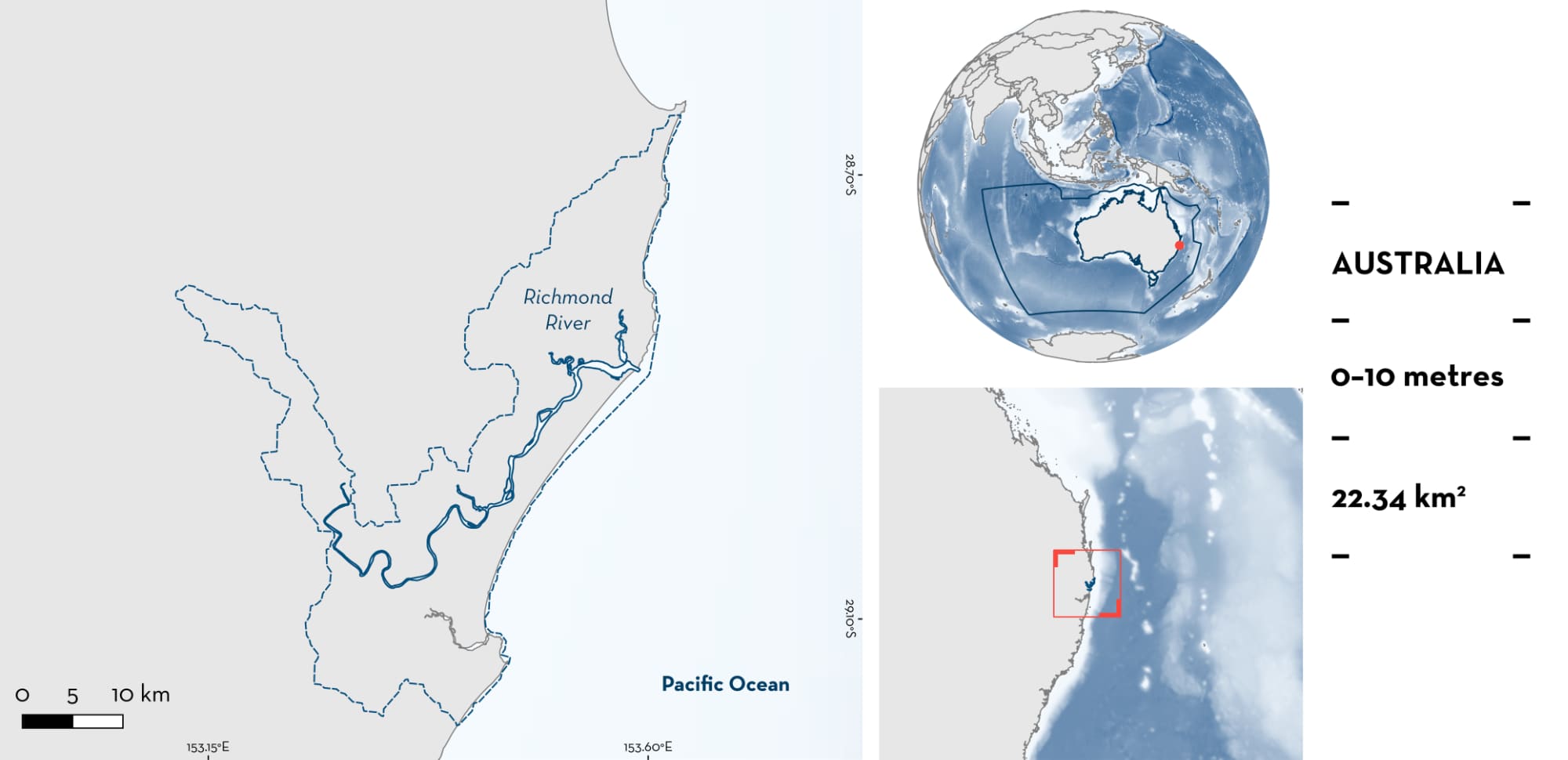
Richmond River is located near Ballina on the north coast of New South Wales, Australia. This area comprises the lower reaches of the Richmond River from the town of Coraki to the river mouth in the regional urban centre of Ballina. The habitat is characterised by mangroves and urban and agricultural land adjoining the riverbanks. It is influenced by freshwater input from the river and by tidally-driven saltwater intrusion that reaches 90 km upstream. River flow varies seasonally and is higher during February–April. This area overlaps with the Richmond River Nature Reserve. Within this area there are: threatened species and reproductive areas (Bull Shark Carcharhinus leucas).
Download factsheet
Richmond River
DESCRIPTION OF HABITAT
Richmond River is located on the north coast of New South Wales, Australia. The area comprises the lower reaches of the Richmond River from the town of Coraki to the river mouth in the regional urban centre of Ballina. The Richmond River has a 7,000 km2 catchment with extensive floodplains (Beardmore et al. 2019). The Wilson River is the major tributary of the Richmond River, and the confluence is located in Coraki, at the upstream boundary of this area (Beardmore et al. 2019). The habitat is characterised by mangroves and urban and agricultural land adjoining the riverbanks (Beardmore et al. 2019).
This area is influenced by freshwater input from the river, and by saltwater intrusion driven by the tides. The Richmond River has an exceptionally long tidal influence, reaching 90 km inland, and hence all this area is within the estuary characterised by a gradient of salinity levels (New South Wales [NSW] Government 2023). Average annual rainfall varies across the catchment from 1,000–3,000 mm per year (Beardmore et al. 2019). About half of the annual flow occurs in the wet season from February–April, and periodic flood events dramatically increase river flow on occasion (NSW Government 2023).
This area overlaps with the Richmond River Nature Reserve (UNEP WCMC & IUCN 2025).
This Important Shark and Ray Area is benthic and pelagic and is delineated from inshore and surface waters (0 m) to 10 m based on the bathymetry of the area.
CRITERION A
VULNERABILITY
One Qualifying Species considered threatened with extinction according to the IUCN Red List of Threatened Species regularly occurs in the area. This is the Vulnerable Bull Shark (Rigby et al. 2021).
CRITERION C
SUB-CRITERION C1 – REPRODUCTIVE AREAS
Richmond River is an important reproductive area for one shark species.
Neonate and young-of-the-year (YOY) Bull Sharks are regularly encountered in this area (N Lubitz unpubl. data 2025). A research study captured and released 20 individuals on nine survey days in November–January 2021, 2024, and 2025 (N Lubitz unpubl. data 2025). Up to eight individuals were caught within 4 h of fishing with rod-and-line. The total length (TL) was measured and the umbilical scar recorded. Captured sharks included 13 females and seven males. Most of the individuals were neonates (n = 11; 55%) ranging from 75–80 cm TL. Another five individuals were YOY (25%) ranging from 82–100 cm TL. All sharks <100 cm TL and one shark of 100 cm TL had an umbilical scar present (open or healed). The size-at-birth for the species is 56–81 cm TL (Ebert et al. 2021). The remaining four individuals were small juveniles ranging 100–120 cm TL. Bull Sharks in eastern Australia remain in river and estuary habitats for up to five years (Werry et al. 2011; Niella et al. 2022), highlighting that these small juveniles, in addition to neonates and YOY, are still restricted to the area (Smoothey et al. 2023).
A passive acoustic telemetry study tagged 233 Bull Sharks in New South Wales and monitored their coastal detections from 2015–2023 (Smoothey et al. 2023). Eleven individuals were tagged in Richmond River, ranging from 151–303 cm TL and including nine juveniles and two mature females. The juveniles had more detections in the coastal array 1–2 years after tagging, at which point they were large juveniles that leave the river habitat (Smoothey et al. 2023). Traditional ecological knowledge also indicates that Bull Sharks have long been a food source for Indigenous people in this area, with sharks following mullet swimming upriver from May–September (ABC News 2017). Additionally, neonate, YOY, and small juvenile Bull Shark captures by recreational fishers have been reported on social media between 2015–2025. Although there are other rivers on the New South Wales coast that also regularly host small Bull Sharks, these river systems are individually important. Bull Sharks in Australia display natal philopatry, with females returning to particular river systems to pup (Tillett et al. 2012; Lubitz 2023). For example, half-sibling pairs were found within a river up to seven cohorts apart, highlighting the long-term natal philopatry of females (Lubitz 2023). Therefore, individual rivers in this region represent discrete portions of habitat that are important to Bull Sharks.
Download factsheet
SUBMIT A REQUEST
ISRA SPATIAL LAYER REQUEST
To make a request to download the ISRA Layer in either a GIS compatible Shapefile (.shp) or Google Earth compatible Keyhole Markup Language Zipped file (.kmz) please complete the following form. We will review your request and send the download details to you. We will endeavor to send you the requested files as soon as we can. However, please note that this is not an automated process, and before requests are responded to, they undergo internal review and authorization. As such, requests normally take 5–10 working days to process.
Should you have questions about the data or process, please do not hesitate to contact us.