ISRA FACTSHEETS
ISRA FACTSHEETS
AUSTRALIA AND SOUTHEAST INDIAN OCEAN
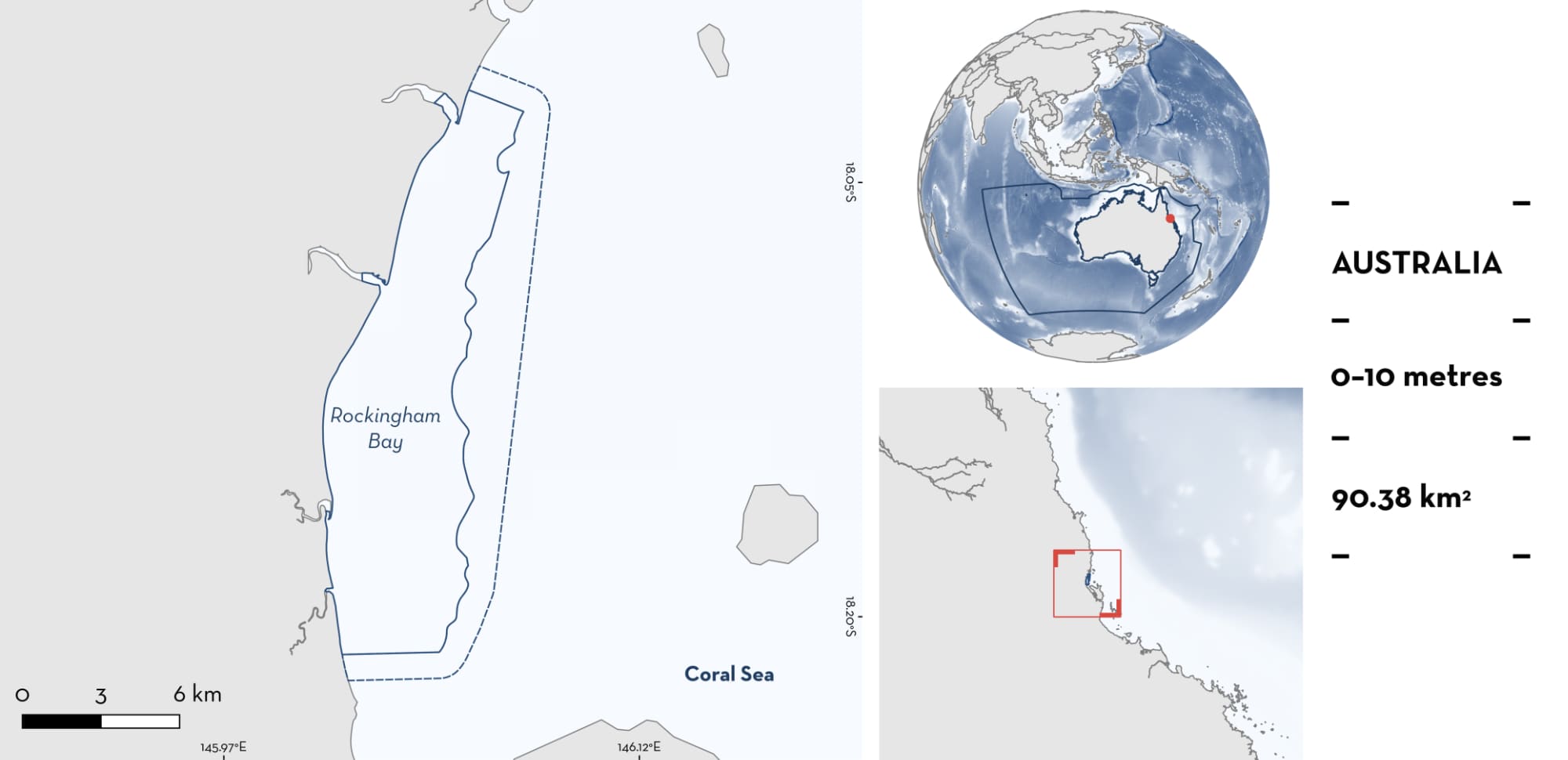
Rockingham Bay
Summary
Rockingham Bay is located on the central Great Barrier Reef coast, Queensland, Australia. It encompasses the coastal area of Rockingham Bay. The area is characterised by mangrove-lined foreshores, seagrass, silty substrates, and mudflats. It is influenced by freshwater flood plumes in the wet season along with southeast dry season winds which result in high turbidity. The area overlaps with the Great Barrier Reef Marine Park. Within this area there are: threatened species and reproductive areas (Scalloped Hammerhead Sphyrna lewini).
Download factsheet
Rockingham Bay
DESCRIPTION OF HABITAT
Rockingham Bay is located on the central Great Barrier Reef coast, Queensland, Australia. It encompasses the coastal area of Rockingham Bay. The area is characterised by mangrove-lined foreshores, seagrass, silty substrates, and mudflats (Yates et al. 2015a).
The area is influenced by freshwater flood plumes in the wet season (November–April), along with southeast dry season (May–October) winds which results in high turbidity. The bay is a shallow (<10 m) and sheltered from ocean swells by the Great Barrier Reef (Yates 2014). The area experiences seasonal rainfall with 60–80% typically occurring during the wet season which in turn influences significant seasonal fluctuations in water turbidity (Yates 2014).
The area overlaps with the Great Barrier Reef Marine Park – Marine National Park Zone (UNEP-WCMC & IUCN 2025).
This Important Shark and Ray Area is benthic and pelagic and is delineated from inshore and surface waters (0 m) to 10 m based on the bathymetry of the area.
CRITERION A
VULNERABILITY
One Qualifying Species considered threatened with extinction according to the IUCN Red List of Threatened Species regularly occurs in the area. This is the Critically Endangered Scalloped Hammerhead (Rigby et al. 2019).
CRITERION C
SUB-CRITERION C1 – REPRODUCTIVE AREAS
Rockingham Bay is an important reproductive area for one shark species.
Between 2007–2014, observer data were gathered from vessels operating in the commercial gillnet sector of the Queensland East Coast Inshore Finfish Fishery from foreshore nets placed in the area (Harry et al. 2011a). Additionally, between January 2012 and March 2014, fishery-independent surveys were conducted to characterise the shark assemblage in coastal bays spanning ~400 km of Queensland’s north coast. Data collection occurred over eight sampling efforts, each lasting at least five weeks. During each round, each bay (this area included) received at least 8 gillnet and 10 longline deployments over four days. Benthic-set gillnets (114 mm mesh, 200–400 m long) were deployed for ~1 hour each with a total of 54 gillnet soak hours in the area (Yates et al. 2015a, 2015b). Longlines were 800 m long with hooks spaced ~10 m apart, averaging 53 hooks per line (range 29–81), and were set for ~40 minutes, with up to two deployed at once, with a total of 74.3 longline soak hours (Yates et al. 2015a, 2015b). All captured sharks were identified, measured, sexed, tagged, with life-stage assessed using length-at-age and anatomical indicators (Harry et al. 2011a; Yates et al. 2015a, 2015b).
Between 2007–2014, a total of 74 Scalloped Hammerheads ranging in size between 44.5–85.0 cm total length (TL) were captured within the area during monitoring by observers (n = 24) and fishery-independent surveys (n = 51; Harry et al. 2011a; Yates et al. 2015a, 2015b). Neonates (n = 53, 71.6%) ranging in size between 44.5–57.0 cm TL were identified based on size (n = 22), or partially open umbilical scars (n = 8). Young-of-the-year (YOY; n = 20, 27%), ranged in size between 59.0–74.5 cm TL. Size-at-birth for the species is 31–57 cm TL (Ebert et al. 2021) and YOY reach ~78 cm TL (Harry et al. 2011b). Neonates and YOY were captured across years in 2007 (n = 24), 2012 (n = 34), 2013 (n = 14), and 2014 (n = 1; Harry et al. 2011a; Yates et al. 2015a, 2015b). Although captures of these life-stages occurred in January, February, May, June, and September–November, 50.7% of captures occurred between October–February (Yates et al. 2015a, 2015b). Among the coastal bays of the Townsville region spanning ~400 km of coastline, this area contained the highest abundance of early life-stage Scalloped Hammerheads (Harry et al. 2011a; Yates et al. 2015a, 2015b).
Download factsheet
SUBMIT A REQUEST
ISRA SPATIAL LAYER REQUEST
To make a request to download the ISRA Layer in either a GIS compatible Shapefile (.shp) or Google Earth compatible Keyhole Markup Language Zipped file (.kmz) please complete the following form. We will review your request and send the download details to you. We will endeavor to send you the requested files as soon as we can. However, please note that this is not an automated process, and before requests are responded to, they undergo internal review and authorization. As such, requests normally take 5–10 working days to process.
Should you have questions about the data or process, please do not hesitate to contact us.