ISRA FACTSHEETS
ISRA FACTSHEETS
AUSTRALIA AND SOUTHEAST INDIAN OCEAN
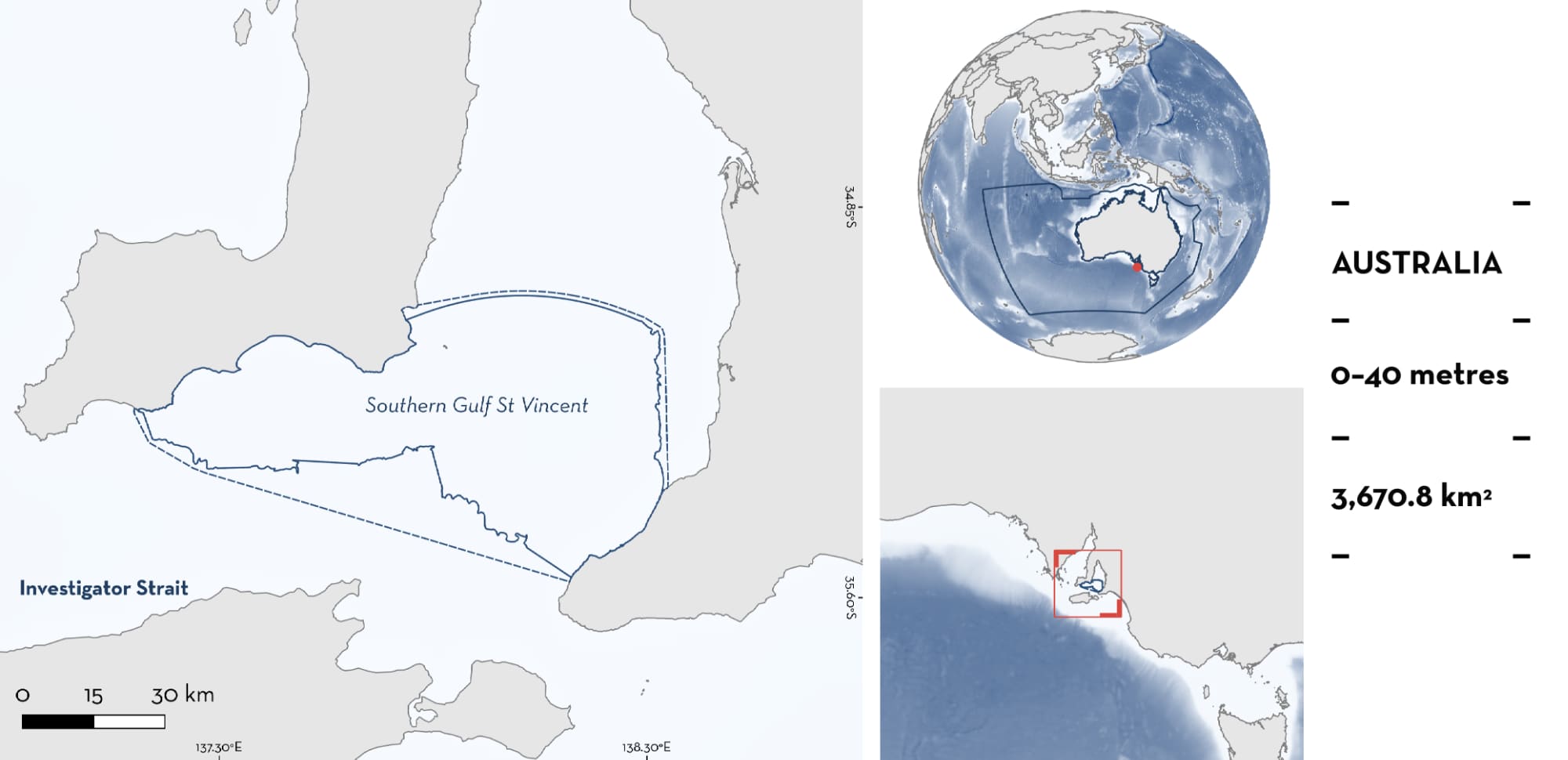
Southern Gulf St Vincent
Summary
Southern Gulf St Vincent is located in South Australia, Australia. The area is characterised by sand substrates, seagrass, rocky reefs, and high macroalgae coverage. This area overlaps with two protected areas. Within this area there are: threatened species (Coastal Stingaree Urolophus orarius); and range-restricted species (e.g., Pygmy Thornback Skate Dentiraja flindersi).
Download factsheet
Southern Gulf St Vincent
DESCRIPTION OF HABITAT
Southern Gulf St Vincent is located in South Australia, Australia. The area is characterised by sand substrates, seagrass (e.g., Posidonia, Zosteraceae, Amphibolis spp.), rocky reefs, and high macroalgae coverage (Edyvane 1999).
The area is influenced by the dynamics of the Gulf St Vincent, which is a shallow gulf environment (maximum depth ~40 m) that supports an abundance of tidal wetlands, seagrass meadows, mangroves, rocky reefs, and saltmarshes (Edyvane 1999). This is an estuary system with water transported into the gulf via Investigator Strait and Backstairs Passage, but Kangaroo Island blocks most of the gulf mouth from the open ocean, limiting water exchange and sheltering the gulf from high wave energy (Tanner 2002).
The area overlaps with Lower Yorke Peninsula Marine Park and Encounter Marine Park (NPWS SA 2025).
This Important Shark and Ray Area is benthic and is delineated from inshore and surface waters (0 m) to 40 m based on the bathymetry of the area.
CRITERION A
VULNERABILITY
One Qualifying Species considered threatened with extinction according to the IUCN Red List of Threatened Species regularly occurs in the area. This is the Endangered Coastal Stingaree (Kyne et al. 2019).
CRITERION B
RANGE RESTRICTED
This area holds the regular presence of Pygmy Thornback Skate, Western Shovelnose Stingaree, and Coastal Stingaree as resident range-restricted species. Based on fishing surveys and citizen science records, these species regularly occur in the area (ALA 2025a, 2025b; iNaturalist 2025a, 2025b, 2025c).
Historical records found in the Atlas of Living Australia show that 63 Pygmy Thornback Skate were observed between 1981–2025 across Australia (ALA 2025a). Of these records, the majority (n = 39, 67.2%) were from this area and were observed during trawl fishing surveys conducted between May and December 2006–2009 (ALA 2025a). Contemporary citizen science records show that this species still occurs in the area (iNaturalist 2025a). Four observations for the species have been reported in iNaturalist for Australia, all from 2025. Of these, three were recorded in South Gulf St Vincent highlighting the importance of the area for this data poor species (iNaturalist 2025a). Pygmy Thornback Skates occur only in South Australia, and the distribution of this species is mainly restricted to the Gulf St Vincent, Spencer Gulf, and surrounding areas (Finucci & Armstrong 2025). This species is restricted to the South West Australian Shelf Large Marine Ecosystem (LME).
Citizen science records show that Western Shovelnose Stingaree regularly occurs in the area (iNaturalist 2025b). Of 65 observations recorded in iNaturalist for South Australia, 26 (46.4%) were from this area. Individuals in this area were observed between 2009–2025, with the majority (n = 24; 92%) recorded after 2020. This area has the largest number of individuals recorded across South Australia (iNaturalist 2025b). This species occurs in the South West Australian Shelf and the West Central Australian Shelf LMEs.
Historical records examined in the Atlas of Living Australia show that 20 Coastal Stingarees were observed between 1978–2009 across Australia (ALA 2025b). Of these records, the majority (n = 11, 55%) were from this area and were recorded from photographic observations and from catches in benthic trawlers that were deposited in fish collections. Contemporary citizen science records show that this area holds the largest number of individuals for this species recorded across all of Australia (iNaturalist 2025c). Of 19 observations recorded between 2011–2025 for Australia, nine (47%) were from this area (iNaturalist 2025c). This area has been highlighted as one of the most important habitats for the species (Daley & Hyde 2023). The Coastal Stingaree occurs primarily in the South West Australian Shelf LME and marginally in the Southeast Australian Shelf LME.
Download factsheet
SUBMIT A REQUEST
ISRA SPATIAL LAYER REQUEST
To make a request to download the ISRA Layer in either a GIS compatible Shapefile (.shp) or Google Earth compatible Keyhole Markup Language Zipped file (.kmz) please complete the following form. We will review your request and send the download details to you. We will endeavor to send you the requested files as soon as we can. However, please note that this is not an automated process, and before requests are responded to, they undergo internal review and authorization. As such, requests normally take 5–10 working days to process.
Should you have questions about the data or process, please do not hesitate to contact us.