ISRA FACTSHEETS
ISRA FACTSHEETS
AUSTRALIA AND SOUTHEAST INDIAN OCEAN
Timor Sea Banks
Summary
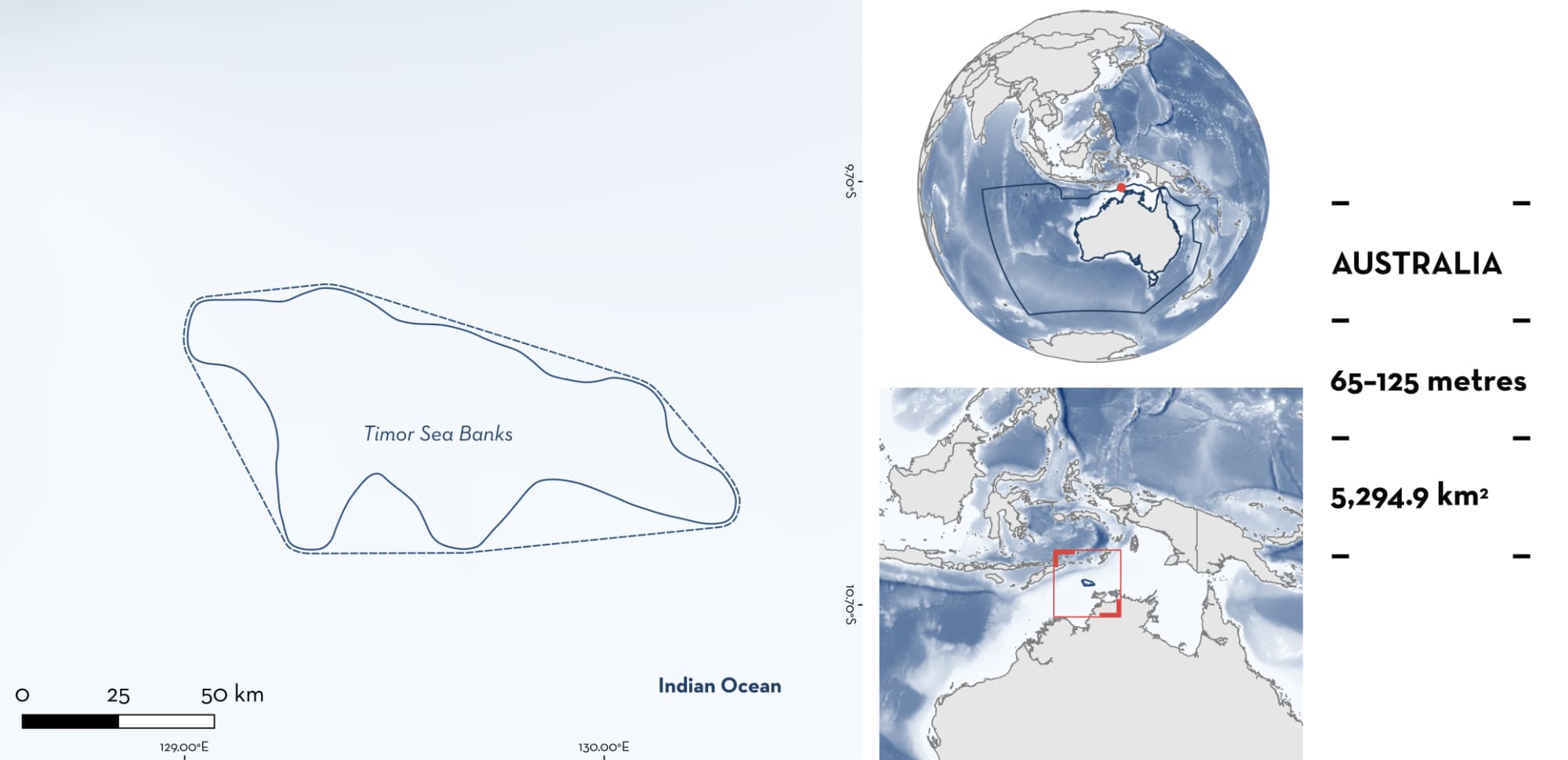
Timor Sea Banks is located northwest of the Tiwi Islands, Northern Territory, Australia. The area sits close to the edge of the Australian Exclusive Economic Zone. The seafloor is characterised by intersecting soft sediment channels and hard sediment ridges. The resulting fine-scale topographic variation influences local hydrodynamics, sediment deposition, and productivity. Within the area there are: threatened species and range-restricted species (Spotted Shovelnose Ray Aptychotrema timorensis).
Download factsheet
Timor Sea Banks
DESCRIPTION OF HABITAT
Timor Sea Banks is located northwest of the Tiwi Islands, Northern Territory, Australia. The area sits on the Flinders-Evans Shoals close to the edge of the Australian Exclusive Economic Zone. The seafloor is characterised by an intersecting network of soft sediment valleys and hard sediment terraces of between 50–150 m depth (van Andel & Veevers 1967; Harris et al. 2005; Baker et al. 2008; Lucieer et al. 2025).
These channels and ridges create fine-scale topographic variation, influencing local hydrodynamics, sediment deposition, and productivity, driven primarily by tidal currents (Harris et al. 2005; Baker et al. 2008). The area is influenced by the eastern branch of the Indonesian Throughflow current flowing through the Timor Passage which persists for most of the year, and wind-driven coastal counter currents primarily during the austral spring and summer (D’Adamo & Onton 2003; Sprintall et al. 2014).
This Important Shark and Ray Area is benthic and subsurface and is delineated from 65–125 m based on the depth range of Qualifying Species in the area.
CRITERION A
VULNERABILITY
One Qualifying Species considered threatened with extinction according to the IUCN Red List of Threatened Species regularly occurs in the area. This is the Vulnerable Spotted Shovelnose Ray (Last et al. 2015).
CRITERION B
RANGE RESTRICTED
Timor Sea Banks holds the regular presence of Spotted Shovelnose Ray as a resident range-restricted species.
Sharks and rays were recorded by fishery observers monitoring the incidental catch of a demersal trawl fishery trial operating off the Northern Territory, Australia (GJ Johnson et al. unpubl. data 2015–2018). A total of 21 Spotted Shovelnose Rays were recorded across four years: 2015, 2016, 2017, and 2018. Captures occurred in the months of May, August, September, October, and November (GJ Johnson et al. unpubl. data 2015–2018). Of these records, 20 fall within Timor Sea Banks (the other record is ~80 km west of the area; GJ Johnson et al. unpubl. data 2015–2018). The spread of records across multiple months and years shows the regular occurrence of the species in the area. Additional temporal data are required to determine seasonality since records reflect the seasonality and years of the fishery trials. A subset of specimens (n = 12) were dissected to examine aspects of life-history, including reproductive status. Of five mature females, three were pregnant (GJ Johnson et al. unpubl. data 2015–2018). Pregnant females were recorded in September of both 2016 and 2017, with variable embryo sizes, the largest of which were close to being near-term (GJ Johnson et al. unpubl. data 2015–2018). This is the only known area where pregnant females of this range-restricted species have been documented, suggesting that Timor Sea Banks is important for reproduction.
Historic records comprise only six survey specimens, one of which (the holotype; Last 2004) falls within Timor Sea Banks in proximity to the contemporary records while the others are scattered across the Australian Northwest Shelf. In total, over three-quarters (78%) of all known records of the species are from Timor Sea Banks, highlighting the importance of the area. The species has not been recorded during fishery monitoring elsewhere in the Northern Territory. Spotted Shovelnose Rays are restricted to the North Australian Shelf Large Marine Ecosystem (LME) and the Northwest Australian Shelf LME.
Download factsheet
SUBMIT A REQUEST
ISRA SPATIAL LAYER REQUEST
To make a request to download the ISRA Layer in either a GIS compatible Shapefile (.shp) or Google Earth compatible Keyhole Markup Language Zipped file (.kmz) please complete the following form. We will review your request and send the download details to you. We will endeavor to send you the requested files as soon as we can. However, please note that this is not an automated process, and before requests are responded to, they undergo internal review and authorization. As such, requests normally take 5–10 working days to process.
Should you have questions about the data or process, please do not hesitate to contact us.