ISRA FACTSHEETS
ISRA FACTSHEETS
AUSTRALIA AND SOUTHEAST INDIAN OCEAN
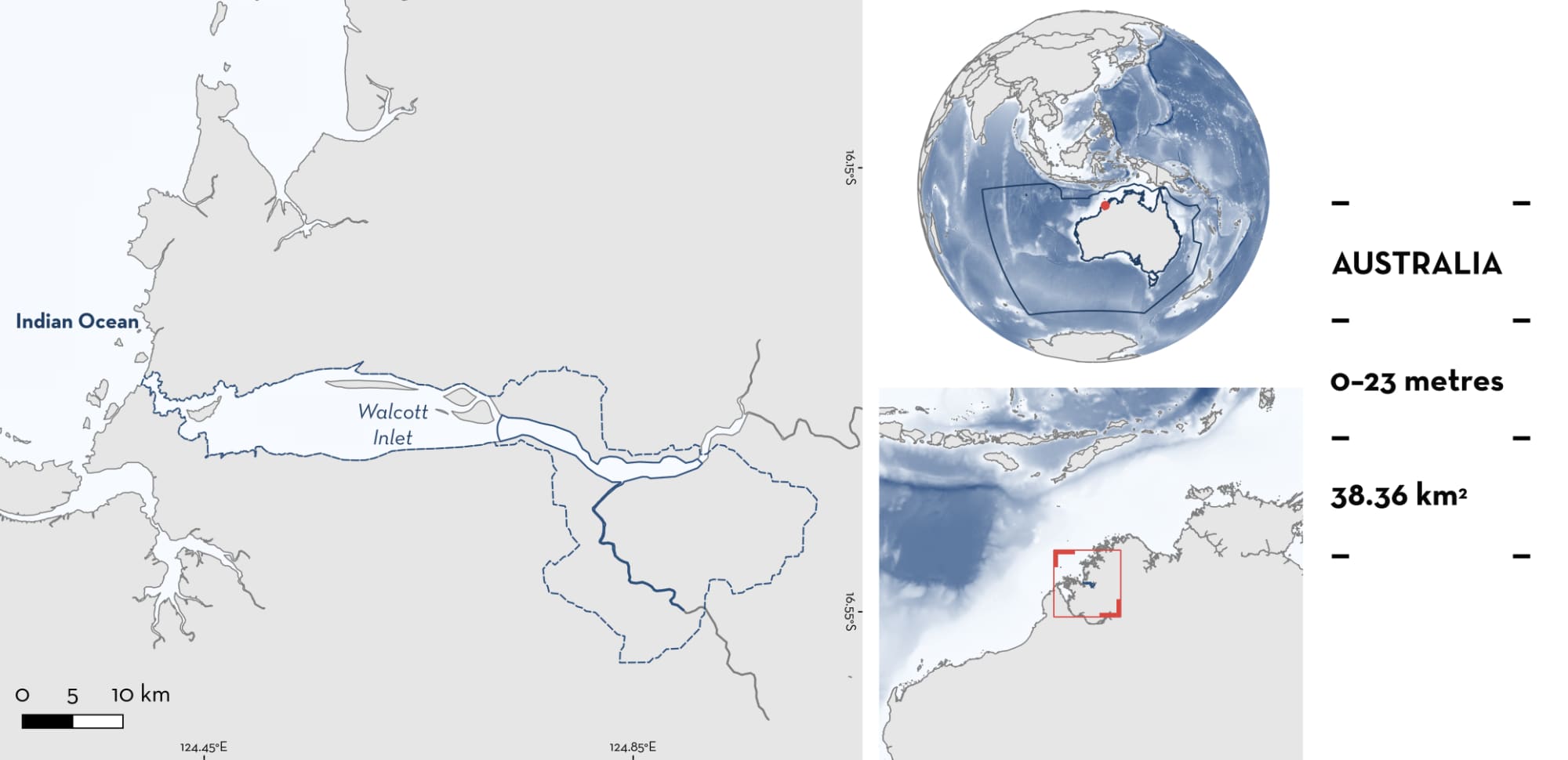
Walcott Inlet
Summary
Walcott Inlet is located in the Kimberley region of Western Australia, Australia. The area encompasses the Isdell River whose main tributaries are the Greytal and Springy rivers, and Plain and Bell creeks which flow into Walcott Inlet. The habitat is characterised by rocky substrate and sandy plains with narrow alluvial valleys. Near Walcott Inlet, the Isdell River forms a long, deep gorge. Within this area there are: threatened species and reproductive areas (Northern River Shark Glyphis garricki).
Download factsheet
Walcott Inlet
DESCRIPTION OF HABITAT
Walcott Inlet is located in the Kimberley region of Western Australia, Australia. The area spans the traditional lands of the Ngarinyin and Worrorra peoples who hold Native Title over the area. It is a bedrock-fringed estuarine embayment on the Kimberley coast. Walcott Inlet receives freshwater input from the Isdell, Charnley, and Calder rivers. Near Walcott Inlet, the Isdell River forms a long, deep gorge. The Walcott Inlet system is characterised by extensive tidal mudflats, up to 5 km wide, that are regularly inundated by tides with an average tidal range of 11 m (Burbidge et al. 1991).
The Kimberley has two dominant seasons: the wet season from November until April and the dry season from May until October. Annual rainfall in this area averages around 850 millimetres. Like rainfall, river flow in the Kimberley is extremely seasonal, with approximately 80% occurring in the five months between December and April (DWER 2008).
This Important Shark and Ray Area is benthic and pelagic and is delineated from inshore and surface waters (0 m) to 23 m based on the bathymetry of the area.
CRITERION A
VULNERABILITY
One Qualifying Species considered threatened with extinction according to the IUCN Red List of Threatened Species regularly occurs in the area. This is the Vulnerable Northern River Shark (Kyne et al. 2021).
CRITERION C
SUB-CRITERION C1 – REPRODUCTIVE AREAS
Walcott Inlet is an important reproductive area for one shark species.
Based on fishery-independent surveys across seven major sites (bays or estuaries) from Prince Fredrick Harbor to King Sound between 2018–2021 and additional observations between 2015–2021, neonates and young-of-the-year (YOY) Northern River Sharks occur regularly in this area (A Harry unpubl. data 2018–2021). This area (which sits within one of the seven sites, i.e., the broader Walcott Inlet) was sampled based on reports of regular observations of very small Northern River Sharks at least since 2015 (A Harry pers. obs. 2025). In addition to this, records were obtained from photos or samples provided by commercial and recreational fishers.
Fishery-independent sampling was carried out with 30 m long net with stretched mesh sizes ranging from 5.0–20.3 cm (A Harry unpubl. data 2018–2021). Survey hours per site ranged 122–441 h (average = 307.3). Northern River Sharks were the second most commonly caught species at these seven sites (n = 37) after Dwarf Sawfish (n = 53). While Dwarf Sawfish were recorded in all sampled areas, Northern River Sharks were captured mostly in the broader Walcott Inlet (81%; n = 30 in 317 hours of survey), along with Secure Bay (n = 4 in 164 hours of survey) and King Sound (n = 3 in 333 hours of survey), both outside the area (A Harry unpubl. data 2018–2021). Of 30 Northern River Sharks from the broader Walcott Inlet, 21 were caught and measured during the fishery-independent sampling and nine came from photos provided by commercial, recreational, or customary fishers (only four with size estimates). Within this area, 26 Northern River Sharks were captured during surveys (n = 19) or by fishers (n = 7). Of 23 Northern River Sharks with size measurements in this area, 12 were neonates and YOY, with sizes ranging between 57.4–75.9 cm total length (TL) and were captured in 2019 (n = 11) and 2021 (n = 1) (A Harry unpubl. data 2018–2021). Reported size-at-birth for the species is 50–65 cm TL (Pillans et al. 2009). Additionally, four were small juveniles ranging 78.9–82.6 cm TL, captured in 2019 (n = 2) and 2021 (n = 2), supporting the importance of this area for early life-stages. Surveys across the broader Kimberley region and local ecological knowledge supports the regular occurrence and importance of this area for early life-stage Northern River Sharks (A Harry pers. obs. 2025).
Download factsheet
SUBMIT A REQUEST
ISRA SPATIAL LAYER REQUEST
To make a request to download the ISRA Layer in either a GIS compatible Shapefile (.shp) or Google Earth compatible Keyhole Markup Language Zipped file (.kmz) please complete the following form. We will review your request and send the download details to you. We will endeavor to send you the requested files as soon as we can. However, please note that this is not an automated process, and before requests are responded to, they undergo internal review and authorization. As such, requests normally take 5–10 working days to process.
Should you have questions about the data or process, please do not hesitate to contact us.