ISRA FACTSHEETS
ISRA FACTSHEETS
AUSTRALIA AND SOUTHEAST INDIAN OCEAN
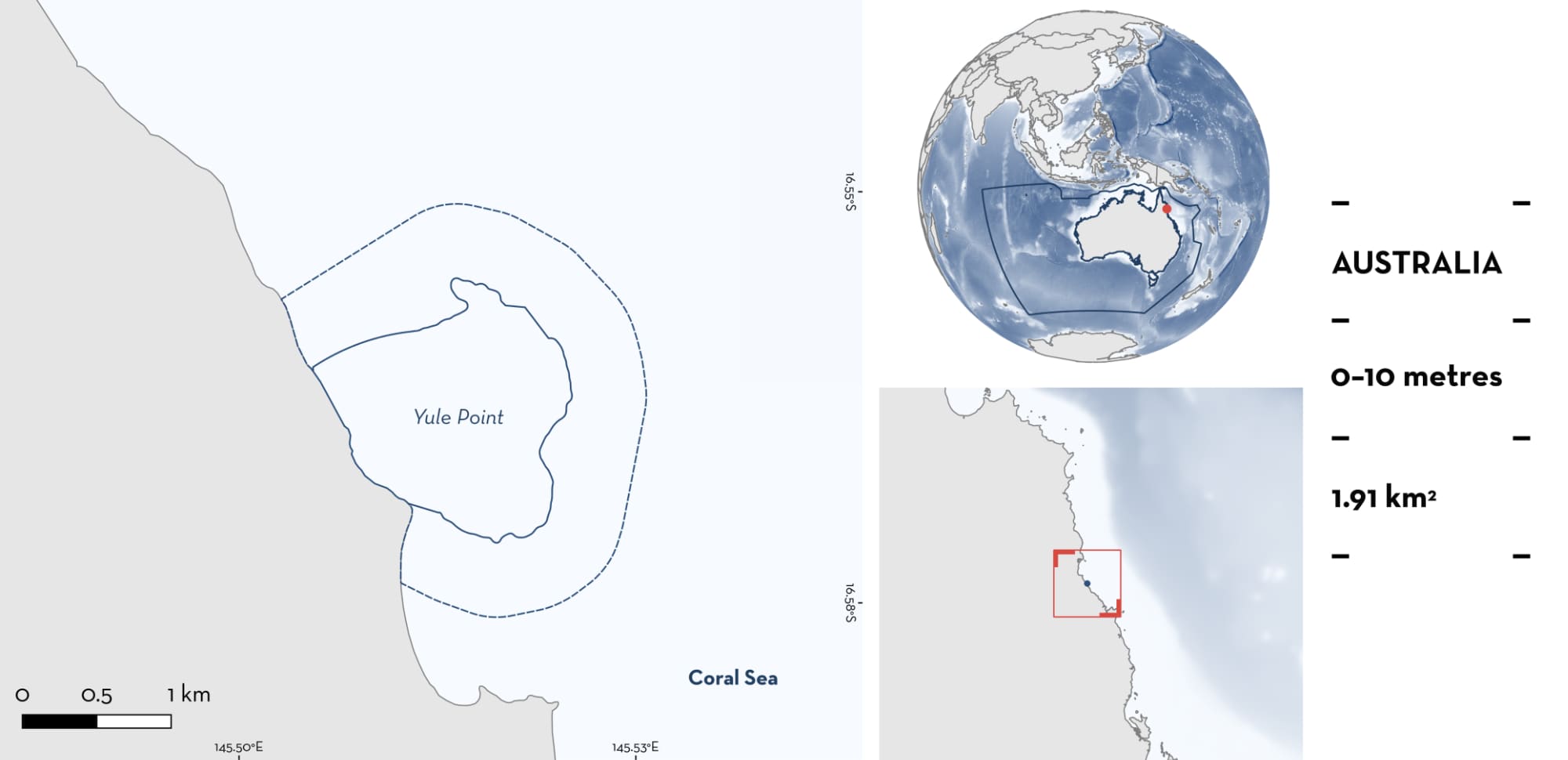
Yule Point
Summary
Yule Point is located in northeast Queensland, Australia. It encompasses a rocky promontory and a fringing reef, attached to the mainland. The area is characterised by a fringing reef, sandy beach ridges overlapping the inner margin of the reef, and mangrove swamps, with gravel, silty clay, mud, and sand substrates. The area is influenced by tides, storm waves, and prevailing southeasterly trade winds. It overlaps with the Great Barrier Reef Marine Park. Within this area there are: range-restricted species (Epaulette Shark Hemiscyllium ocellatum).
Download factsheet
Yule Point
DESCRIPTION OF HABITAT
Yule Point is located in northeast Queensland, Australia. It encompasses a rocky promontory and a fringing reef, attached to the mainland by a strait filled by the deposition of gravel, sand, and finer sediment derived mainly from the Mowbray River (Bird 1971). The area is characterised by a fringing reef, sandy beach ridges overlapping the inner margin of the reef, and mangrove swamps, with gravel, silty clay, mud, and sand substrates (Bird 1971). The inner section of the fringing reef is largely covered by sediment, with live corals concentrated along the seaward margin. The outer portion of the reef, which becomes exposed during low spring tides, has branching corals (Acropora spp.) and other Scleractinia spp. scattered across a reef flat dominated by coralline algae (Bird 1971).
The area is influenced by tides, storm waves, and prevailing southeasterly trade winds, which drive a north-westward longshore current (Wolanski & Lambrechts 2020). At Yule Point, the tidal range reaches ~2.8 m (Bird 1971). During the wet season, heavy downpours are frequent, and large volumes of freshwater are discharged into the coastal zone, temporarily reducing salinity in nearshore waters. In addition, storm waves generated by occasional cyclones move boulders and cobble along the shore, causing abrasion damage to corals that have colonised rock crevices and spaces between boulders (Bird 1971).
The area overlaps with the Great Barrier Reef Marine Park – Marine National Park Zone (UNEP-WCMC & IUCN 2025).
This Important Shark and Ray Area is benthic and is delineated from inshore and surface waters (0 m) to 10 m based on the bathymetry of the area.
CRITERION B
RANGE RESTRICTED
Yule Point holds the regular presence of Epaulette Shark as a resident range-restricted species. Records were collated from the citizen science database iNaturalist (iNaturalist 2025). These records come from direct observations with photographic evidence. Epaulette Sharks ranges from the tip of Cape York to the southern extent of the Great Barrier Reef, with genetically distinct populations occurring along this ~1,200 km distribution (Dudgeon et al. 2020; AM Hasenei unpubl. data 2025). This area hosts the largest cluster of observations (n = 30) in Far North Queensland and the third highest concentration of iNaturalist records across the species’ entire range (i.e., Queensland; iNaturalist 2025). Records were submitted in 2012 (n = 1), 2022 (n = 4), 2023 (n = 19), 2024 (n = 3), and 2025 (n = 3) (iNaturalist 2025). Observations were recorded across eight months of the year, with peaks during the austral spring and summer (70%, n = 21), primarily between October–January suggesting that the species is resident in the area (iNaturalist 2025). Size was inferred from available photos with individuals being adults of more than ~55 cm total length (TL; iNaturalist 2025). Size-at-maturity for the species is ~54–64 cm TL (Ebert et al. 2021).
Additionally, a dedicated research project on genetics and physiology of the species undertaken in September 2025 captured 20 adult Epaulette Sharks using hand nets during two sampling days in the area (AM Hasenei unpubl. data 2025). Animals ranged in size between 60–70 cm TL, with a sex ratio of 1:2.33 (male: female; AM Hasenei unpubl. data 2025). Adult Epaulette Sharks are observed in the area during low tide, resting within intertidal coral flats and rubble crevices to avoid predation and conserve energy (AM Hasenei unpubl. data 2025). Due to their low dispersal potential and their strong habitat specific dependency, it is likely that this area is important for reproduction, feeding, and resting, as the species is resident with limited movements (Heupel & Bennett 2007; Nay et al. 2020) and likely undergo their full life cycle within the area. The area’s shallow topography and isolated coral bommies provide consistent low tide refugia where sharks exhibit prolonged stationary behaviour. This site is ecologically significant for Epaulette Sharks and is unique among other parts of its range. As a mainland fringing reef bordering extensive seagrass meadows, it supports high biodiversity and experiences environmental conditions that differ markedly from those of habitat for the species on the outer reefs of the Great Barrier Reef (AM Hasenei unpubl. data 2025). Epaulette Sharks are restricted to the Northeast Australian Shelf Large Marine Ecosystem (LME) and the East Central Australian Shelf LME.
Download factsheet
SUBMIT A REQUEST
ISRA SPATIAL LAYER REQUEST
To make a request to download the ISRA Layer in either a GIS compatible Shapefile (.shp) or Google Earth compatible Keyhole Markup Language Zipped file (.kmz) please complete the following form. We will review your request and send the download details to you. We will endeavor to send you the requested files as soon as we can. However, please note that this is not an automated process, and before requests are responded to, they undergo internal review and authorization. As such, requests normally take 5–10 working days to process.
Should you have questions about the data or process, please do not hesitate to contact us.