
ISRA FACTSHEETS
ISRA FACTSHEETS
AUSTRALIA AND SOUTHEAST INDIAN OCEAN
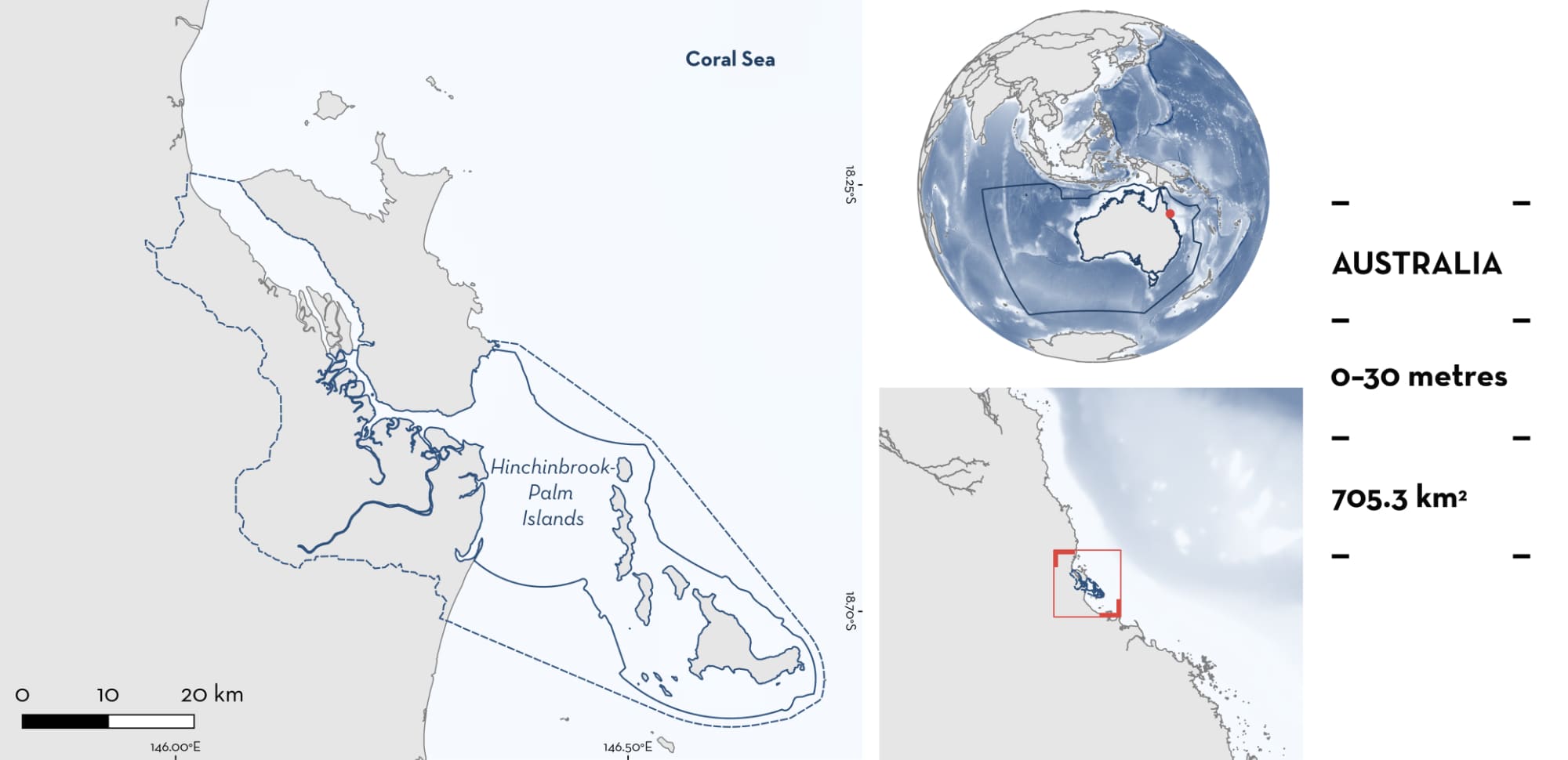
Hinchinbrook-Palm Islands
Summary
Hinchinbrook-Palm Islands is located in Queensland, Australia. The area is situated ~75 km northwest of Townsville. It comprises coastal waters off Lucinda, several islands (e.g., Orpheus), the lower reaches of the Herbert and Seymour rivers, and parts of the shallow passage between Hinchinbrook Island and the mainland. The habitat is characterised by extensive mangroves, seagrass beds, intertidal sandflats, fringing coral reefs, reef flats, rubble, and sandy and muddy substrates. It is influenced by a tropical climate with a wet season from November–April, by southeasterly trade winds, and by semi-diurnal tides. This area overlaps with the Great Barrier Reef Marine Park. Within this area there are: threatened species (e.g., Great Hammerhead Sphyrna mokarran); reproductive areas (e.g., Giant Guitarfish Glaucostegus typus); feeding areas (e.g., Australia Whipray Himantura australis); and undefined aggregations (Reef Manta Ray Mobula alfredi).
Download factsheet
Hinchinbrook-Palm Islands
DESCRIPTION OF HABITAT
Hinchinbrook-Palm Islands is located in Queensland, Australia. It is situated ~75 km northwest of Townsville and encompasses several islands, including Hinchinbrook, Orpheus, Fantome, Curacoa, and Great Palm. On Orpheus Island, two semi-enclosed bays (Pioneer Bay and Hazard Bay) are bordered by a fringing reef and have extensive intertidal sand and rubble flats and mangroves (Kanno 2023). It also comprises coastal and intertidal waters near the town of Lucinda (Lucinda sandflats), the narrow passage between Hinchinbrook Island and the mainland, as well as estuarine waters of the Herbert and Seymour rivers. The habitat is characterised by extensive mangroves, seagrass beds, intertidal sandflats, fringing coral reefs, reef flats, rubble, and sandy and muddy substrates (Martins et al. 2020a, 2022; Kanno 2023; Myers et al. 2025a).
The area is influenced by semi-diurnal tides, with a daily amplitude of ~4 m (Kanno 2023). The coastal waters therefore experience a regular cycle that influences water depth, turbidity, and temperature. It is also influenced by a tropical climate, with a wet season from November–April that can also include cyclones. While the annual rainfall is ~1,150 mm, most river discharge is concentrated in the wet season. During May–September, southeasterly trade winds influence the area.
This area overlaps with the Great Barrier Reef Marine Park – Scientific Research Zone and Marine National Park Zone (UNEP-WCMC & IUCN 2025).
This Important Shark and Ray Area is benthic and pelagic and is delineated from surface waters (0 m) to a depth of 30 m based on the bathymetry of the area.
CRITERION A
VULNERABILITY
Nine Qualifying Species considered threatened with extinction according to the IUCN Red List of Threatened Species regularly occur in the area. Threatened sharks comprise two Critically Endangered species and two Vulnerable species; threatened rays comprise one Critically Endangered species, two Endangered species, and two Vulnerable species (IUCN 2025).
CRITERION C
SUB-CRITERION C1 – REPRODUCTIVE AREAS
Hinchinbrook-Palm Islands is an important reproductive area for three shark and five ray species.
The Herbert and Seymour rivers are important for early life-stage Bull Sharks (N Lubitz et al. unpubl. data 2025). Seven research fishing surveys using rod-and-line captured 28 neonates and young-of-the-year (YOY) (open and healed umbilical scars, 67–98 cm total length; TL) in these rivers between June 2021 to February 2025 (N Lubitz et al. unpubl data 2025). Most captures were during the austral summer which is the pupping season for Bull Sharks in this region (Lubitz 2023). Captures occurred between 8–16 km upstream from the river mouths and included freshwater sections of the rivers with notable absence of mangroves. The natal philopatry observed in females in eastern Australia means that multiple river systems along a coast can potentially be important for the reproduction of Bull Sharks (Tillet et al. 2012; Lubitz 2023). Genetic sequencing has shown relatedness between neonates/YOY in the Herbert and Seymour rivers, as well as between YOY from the rivers and acoustically tagged adults that exhibited year-round small home ranges within the marine parts of this area, further supporting natal philopatry (Lubitz 2023). No neonate or YOY were caught in nearby coastal waters outside the Herbert and Seymour rivers; only larger juveniles (>130 cm TL) and adults occur offshore around Hinchinbrook Island.
Blacktip Reef Sharks use the shallow reef flat of Pioneer Bay on Orpheus Island as a key reproductive area (George et al. 2019; Kanno 2023). Neonates and YOY occur year-round, with a peak in summer. Mating and parturition have been reported to occur between November–March (Chin et al. 2013; Schlaff et al. 2020). Long-term beach walk surveys confirm consistent use of the bay, with surveys often recording seven or more individuals between the mangroves and shallow beaches (Orpheus Island Research Station Staff pers. comm. 2025). Scientific fishing and acoustic tracking studies further demonstrate repeated use of this area by young Blacktip Reef Sharks. Between 2010–2013, 2017, and 2020–2021, sharks were captured using rod-and-line, multi-hook longlines, and seine netting, and were then monitored with passive and active acoustic telemetry (George et al. 2019; Schlaff et al. 2020; Kanno 2023). Each shark was measured, sexed, and assessed for maturity based on umbilical scar condition, body size, and clasper calcification (where possible). Between 2010–2013, 59 individuals were captured, of which 60% (n = 35) were immature (neonates, YOY, or small juveniles; 51.0–81.2 cm TL), found exclusively inside the bay. In contrast, any adults captured (99.8–145.2 cm TL) were recorded outside the bay (Schlaff et al. 2020). The regional size-at-birth estimate is ~50 cm TL, with maturity reached at 95–110 cm TL (Last & Stevens 2009), confirming these captures represented neonates, YOY, and small juveniles. Acoustic tracking also recorded six YOY (61.8–77.0 cm TL) tracked for >62 h in shallow (<1 m) water (George et al. 2019). Their movements were driven by the tide, swimming between mangrove roots at high tide and on the shallow reef flats at low tide (George et al. 2019). The adjacent mangrove root systems provide juveniles refuge from predators and access to foraging grounds, critical given the presence of large predators such as Great Hammerheads foraging in deeper reef flat areas (George et al. 2019; Kanno 2023; N Lubitz unpubl. data 2025). Adults are also regularly present in the area, likely migrating seasonally to inshore reefs for mating, although their home range extends further (Schlaff et al. 2020). Pioneer Bay is likely to be important for early life-stages of the species because of the proximity of refuge (mangroves) and foraging habitats (reef flat).
Multi-year recreational fisher knowledge with records from 2007–2025 indicates that neonate and YOY Scalloped Hammerheads occur regularly within the area (N Lubitz et al. pers. obs. 2025). Their size was visually estimated from photographs supplied by recreational fishers. Neonate and YOY were defined either by the state of the umbilical scar or by size, with individuals <80 cm TL classified as neonate or YOY. The size-at-birth for the species is 31–57 cm TL (Ebert et al. 2021). In March 2025, a local fisher caught 12 neonate/YOY at Haycock Island, inside the narrow passage between Hinchinbrook Island and the mainland. At the same location, three YOY (56–80cm TL; healed umbilical scars) were tagged with acoustic tags in July 2025. Nearby, recreational fishers also reported neonates and YOY off beaches at the southern end of Hinchinbrook Island in March 2018, and near the Sugar Jetty in Lucinda, where they are observed, often in groups, annually between November–January. Anecdotal evidence suggests schooling behaviour as fishers always report catching multiple neonates/YOY. The entrance to, and the southern end of, the passage appears to be the key location for neonate/YOY Scalloped Hammerheads, as they were not captured elsewhere in this area despite widespread scientific fishing effort in 2023–2025. This location is characterised by turbid waters close to mangroves and rocky reefs, with availability of shallow and deep habitat close to each other. High turbidity was similarly an important driver of Scalloped Hammerhead juveniles in nearby Rockingham Bay (Simpfendorfer et al. 2014).
Spotted Eagle Ray YOY and juveniles are regularly observed on the Lucinda sandflats (B Nolan unpubl. data 2025). A total of 16 drone survey days between June 2024 and June 2025 recorded the species every day, with 97 individuals tracked that remained within 1.6 km of the high tide mark (B Nolan unpubl. data 2025). Size estimates were derived from still frames based on a calibrated relationship between drone altitude and pixel size. Size estimates of 20 individuals showed that most (n = 17; 85%) were YOY with a size of 60–85 cm disc width (DW). The size-at-birth for the species is 50 cm DW and YOY can be up to ~85 cm DW (Schluessel et al. 2010; Boggio-Pasqua et al. 2022). The other three individuals were juveniles <100 cm DW, further highlighting that this area is important for early life-stages of the species. YOY Spotted Eagle Rays were recorded across all survey months demonstrating their year-round presence in this area. Photo-identification confirmed that at least one individual remained in the area for six consecutive months from July–December 2024 and was resighted again in June 2025 (B Nolan unpubl. data 2025). These sightings indicate that the Lucinda sandflats constitute an important area for YOY and juvenile Spotted Eagle Rays, that may remain in the area for several months at a time. Additionally, two individuals (61 and 75 cm DW) were captured with seine nets at Lucinda between 2017–2018 (Crook 2020). Larger rays (>100 cm DW) also sometimes occur on the Lucinda sandflats, and three separate individuals with possible mating scars were observed in September 2024, including one individual with new mating scars on two days of observation (B Nolan unpubl. data 2025). Combined, this area is important for early life-stages and potentially for mating of Spotted Eagle Rays.
Giant Guitarfish neonates and YOY are regularly observed on the Lucinda sandflats in this area (Crook 2020; Myers et al. 2025a). Standardised seine net surveys from 2017–2019 captured 42 individuals ranging from 33–187 cm TL (mean 62 cm TL; Crook 2020), while 65 captures from 2022–2025 ranged from 30–115 cm TL (mean = 46 cm TL; Myers et al. 2025a). Out of the combined 92 captures (excluding re-captures of the same individual), 33 (30%) were neonates based on a size of 30–40 cm TL. Almost all others were YOY (n = 55; 60%) with a size of 41–65 cm TL. The size-at-birth for the species is 38–40 cm TL and YOY can be up to ~65 cm TL (White et al. 2014; Last et al. 2016). No adults were captured in either study, highlighting that this area is particularly important for early life-stages and juveniles of the species. Recaptures of neonates and YOY in different surveys support them remaining on the intertidal flat for at least 30 days post-capture (Myers et al. 2025a). Two Giant Guitarfish were captured in Pioneer Bay in 2016–2018 (Martins 2019), but they are uncommon outside the Lucinda sandflats. Acoustic tracking of three adult Giant Guitarfish (220–280 cm TL) shows that some individuals remain resident for multiple years in the larger area around the Lucinda sandflats (N Lubitz unpubl. data 2025), indicating that mating and/or pupping may also occur here.
Australian Whipray neonates and YOY are regularly observed in this area year-round. The species is one of the most common ray species across drone transect surveys, with 27 surveys each at Lucinda and Orpheus Island (Hazard Bay and Pioneer Bay) yielding a total of 230 observations during May–October 2021 (Myers 2024). Captures of at least 57 individuals using seine netting from 2022–2024 showed that around one third (18 individuals) were neonates or YOY with a size of <40 cm DW (Crook 2020; Myers et al. 2025b). Size-at-birth for the species is 35 cm DW (Last et al. 2016). Five active acoustic tracks of neonate and YOY individuals <40 cm DW show this species makes predictable tidal movements to and from the intertidal zone and spends 100% of their time in the shallows at Lucinda (Crook 2020). Additionally, 32 active drone tracks from 2018–2019 showed that 35 individuals <54 cm DW spent 100% of their time in the shallows at Lucinda. These data highlight the importance of the Lucinda sandflats for early life-stages of the species.
Broad Cowtail Ray YOY and small juveniles are regularly observed on the Lucinda sandflats within this area (Crook 2020; Myers et al. 2025a). Between 2016–2018, seine net surveys captured seven Broad Cowtail Rays at Lucinda, ranging 29–50 cm DW (mean = 39.5 cm DW). The size-at-birth for the species is 18 cm DW and fast initial growth suggests a size-at-one-year of ~35 cm DW (O’Shea et al. 2013; Last et al. 2016). From 2017–2025, additional seine net surveys recorded at least 160 individuals between 29–68 cm DW (mean ± standard error = 39.5 ± 0.6 cm DW) (Crook 2020; Myers et al. 2025a). Considering the small mean size near the size-at-one-year for the species, many of these individuals were YOY and small juveniles. From 2017–2019, drone tracking of 65 rays confirmed all spent 100% of their time in shallow habitats on the Lucinda sandflats. Additionally, the species is regularly seen in Pioneer Bay, with underwater video surveys recording Broad Cowtail Rays in 31.2% of samples and drone surveys showing that the species comprised 28.8% of all rays recorded (Kanno et al. 2019; Martins et al. 2020a, 2022; Myers 2024). Active acoustic tracking of seven YOY and juveniles (29–50 cm DW) also demonstrated complete residency in the shallow waters of Pioneer Bay (Martins et al. 2020a, 2022). Young-of-the-year and small juvenile Broad Cowtail Rays demonstrate strong site fidelity, predictable tidal movements, and seasonal peaks in abundance in this area (Martins et al. 2020a; 2022). Refuge behaviour is a likely driver, as Great Hammerheads forage extensively on rays on these shallow flats (N Lubitz et al. unpubl. data 2025). Collectively, these studies show that Pioneer Bay (Orpheus Island) and Lucinda’s intertidal flats serve as predictable reproductive habitats for Broad Cowtail Rays.
Mangrove Whipray YOY are regularly observed in Pioneer Bay within this area. A total of 35 individuals (27–61 cm DW) were caught between April 2016–March 2018 using seine and dip nets (Martins et al. 2022). Given a size-at-birth of ~14 cm DW and a size-at-maturity of ~55–65 cm DW (Last et al. 2016), as well as growth rates from similar species suggesting a size-at-one-year of ~30 cm DW (O’Shea et al. 2013), these captures were almost all YOY and juveniles. Twelve individuals (29–54 cm DW) were captured and tracked with towed-float GPS telemetry, spending 100% of their time in shallow reef flat and mangrove-edge habitats (Martins et al. 2020b). Another 12 Mangrove Whiprays (31–35 cm DW) were also captured with rod-and-line or seine nets and monitored with passive acoustic telemetry between 2020–2021 (Kanno 2023). Fine-scale tracking of four of these small juveniles showed regular use of the intertidal flats and mangroves as refuge from predators (Martins et al. 2020b, 2022; Kanno 2023). Additionally, a scientific study captured 24 Mangrove Whiprays in Pioneer Bay in 2022, with 71% (n = 17) YOY or very small juveniles with a size range of 30–35 cm DW (Myers 2024).
CRITERION C
SUB-CRITERION C2 – FEEDING AREAS
Hinchinbrook-Palm Islands is an important feeding area for two shark and five ray species.
Adult Bull Sharks actively forage in this area. Passive acoustic tracking of 16 individuals on an acoustic array of 27 receivers from April 2021 to July 2025, combined with a stable isotope analysis, show that, although other conspecifics can be highly mobile along the entire Queensland coast, 11 adults (69%) exhibited small home ranges within the area. These regularly moved between Lucinda, Palm Islands, and Hinchinbrook while feeding in pelagic food webs, as evidenced through stable isotope analysis (Lubitz et al. 2023). Their stable isotope values suggested a diet of pelagic fishes, and the values were different to those of Great Hammerheads that feed on rays (Lubitz et al. 2023). This area is one of the most important spawning grounds for a variety of pelagic teleost fishes, including mackerel, with spawning in winter (Lubitz et al. 2023; N Lubitz unpubl. data 2025). Twelve tracked Bull Sharks tagged elsewhere were also detected in this area in winter, overlapping with the spawning season and suggesting that they come to this area to feed (Lubitz et al. 2023; N Lubitz unpubl. data 2025). Bull Sharks were previously suggested to frequent mid-shelf reefs ~50–100 km from this area during winter to exploit fish spawning aggregations (Espinoza et al. 2016). Additionally, observations of one Bull Shark actively hunting and foraging on intertidal flats at the mouth of the Herbert River in 2019, and two animals in shallow areas on the Lucinda sandflats in September 2022, further support this as a feeding area (N Lubitz unpubl. data 2025).
Adult Great Hammerheads within this area are ray specialists (Lubitz et al. 2023; N Lubitz unpubl. data 2025). Stable isotope data and drone/video observations indicate extensive feeding on stingrays. Muscle δ13C (-11.8) and δ15N (11.4) values of adults were similar to those of Broad Cowtail Rays from sandflats (-12.4 and 9.9, respectively), but different from fish-eating Bull Sharks resident to this area (-15.2 and 12.9), supporting a diet dominated by stingrays (Lubitz et al. 2023). There are seven drone/video records and at least nine personal observations of adults actively hunting and consuming Broad Cowtail Rays, Spotted Eagle Rays, and possibly Mangrove Whiprays in this area between September 2022 and November 2025 (N Lubitz et al. pers. obs. 2025). A 270 cm TL Great Hammerhead was captured in July 2025 with what appeared to be the tail of a Mangrove Whipray protruding from the throat (N Lubitz et al. pers. obs. 2025). Hunting and feeding events occurred throughout this area, with observations on the Lucinda sandflats, the flats near the mouth of the Herbert River, intertidal flats at Taylors Beach, as well as off Orpheus Island (Pioneer Bay and Hazard Bay). Given surveys were not designed to specifically look for predation events, but these are regularly observed opportunistically, this indicates a relatively high frequency of occurrence. Additionally, nine acoustically tracked individuals repeatedly used shallow, inshore areas, likely for foraging, between June 2021 and July 2025. For example, one large adult male tagged in May 2025 visited the Lucinda sandflats weekly and remained present for 2–3 days each week during two months. Upon leaving the sandflat, detections occurred near the intertidal mudflats outside the mouth of the Herbert River and in the Hinchinbrook Channel, where it was also likely feeding (N Lubitz unpubl. data 2025).
Spotted Eagle Rays are regularly observed feeding on the Lucinda sandflats. Drone tracking (n = 195) was conducted between June 2024 and June 2025 (S Sullivan & B Nolan unpubl. data 2025). The drone was flown in a haphazard search pattern until a ray was located, then lowered to 3–10 m and manually piloted to remain centred above the individual. Each track consisted of a continuous recording for up to 10 minutes, or until the ray was lost from view or battery levels required return. GPS coordinates, altitude, and speed were recorded to determine track duration, movement, and location. Size estimates were derived from still frames based on a calibrated relationship between drone altitude and pixel size. Feeding behaviours were identified from the video based on observed movements and substrate disturbance, with each instance recorded as a feeding event. Of the 113 Spotted Eagle Rays tracked with drones, 43 individuals (38%) were recorded feeding on the Lucinda sandflats within 1.5 km of the high tide mark. Size estimates based of 20 individuals from drone images suggest these were mainly YOY and small juveniles <100 cm DW. Bivalve prey, which are preferred by Spotted Eagle Rays, were abundant in sediment core samples taken from coarse sand intertidal areas at Lucinda Beach in 2023–2024 (Myers et al. 2025b), which further supports the frequent observations of feeding and highlights the sandflat as an important feeding area.
Giant Guitarfish regularly feed on penaeid prawns in this area (Myers et al. 2025b). Their feeding ecology has been studied at Lucinda using stomach content and stable isotope analyses. Gastric lavage studies on over 70 neonates and YOY (mean size 46 cm TL) between 2023–2024 resulted in high percentages of stomachs with prey content (65.7%), indicating recent consumption of prey from within the sandflat (Myers et al. 2025a). Penaeid prawns were their main prey, with a percent frequency in stomachs of 89.2%. High densities of penaeid prawns were also found in the same intertidal zone, highlighting that prey is readily available for Giant Guitarfish (Myers et al. 2025b). Tracking of 21 individuals during high tide drone surveys (~30 min flights) has shown this species commonly feeds in unvegetated sandflat areas, with up to 212 feeding events recorded per hour (K Crook unpubl. data 2025). A further 26 individuals were tracked with drones (~30 min flights) between June 2024 to January 2025 and all were feeding, although feeding events were not counted in those surveys (S Sullivan & B Nolan unpubl. data 2025).
Australian Whiprays regularly feed on decapods on the Lucinda sandflats (Crook et al. 2022; Myers et al. 2025b). Their feeding ecology was assessed using stomach content analysis of 26 individuals captured in 2021–2024 (Myers et al. 2025b). Stomach content analysis showed that 78% of individuals had freshly consumed prey in their stomachs, mainly including decapod crustaceans with a frequency of 100%. This prey is abundant in the unvegetated, mud/sandflat habitats in this area (Myers et al. 2025b). Drone tracking of 62 rays has shown high feeding activity, with a mean of 35.1 feeding events per hour, which often result in substantial feeding pit formation (Crook et al. 2022). Active acoustic tracking of five individuals has shown regular return movements to the same feeding areas over multiple days (Crook 2020).
Broad Cowtail Rays are regularly observed feeding on the Lucinda sandflats and in Pioneer Bay. They forage across the open reef flat of Pioneer Bay, similar to Mangrove Whiprays, targeting benthic prey on bare sand and coral rubble substrates. Stationary underwater video surveys in 2013 documented feeding on sandflats, often in aggregations with conspecifics or assemblages with Mangrove Whiprays (Kanno et al. 2019). Feeding activity differed significantly between habitats in summer, with sandflats used most frequently, while there was no difference in winter. Seasonal variation was also evident in mangrove habitats, where juveniles were feeding more in summer than in winter, while edge and sandflat use remained consistent across seasons (Kanno et al. 2019). Between 2017–2019, active acoustic tracking of seven rays (2.5–11.2 h per track) demonstrated repeated use of the same feeding grounds across tidal cycles (Crook 2020). Drone-based observations further confirmed high feeding activity, with 63 tracks recording a mean of 17.7 ± 15.4 feeding events per hour (Crook et al. 2022). In a second study, drone tracking of 40 individuals recorded 312 feeding events in Pioneer Bay (Myers 2024). Stable isotope analysis also indicated reliance on prey types found within the reef flat (Martins et al. 2022). Stomach content analysis (2022–2024) of 64 Broad Cowtail Rays captured on the Lucinda sandflats via seine nets showed >70% of stomachs contained prey. Polychaetes, bivalves, and gastropods were the preferred prey items (% frequency >30 each), all abundant within the habitat (Myers et al. 2025b). Most recently, 41 rays (40–80 cm DW, estimated from drone images) were observed during 191 drone surveys between June 2024–June 2025 on the Lucinda sandflats. Of these, 17 individuals were recorded feeding in unvegetated sandflat areas (B Nolan unpubl. data 2025). Collectively, these findings demonstrate the regular and predictable occurrence of feeding and confirm that Pioneer Bay and the Lucinda sandflats are critical foraging habitats, particularly for young Broad Cowtail Rays.
Pioneer Bay provides consistent and predictable feeding opportunities for Mangrove Whiprays, linked to tidal cycles, benthic prey availability, and habitat features (Kanno et al. 2019; Martins et al. 2020b). Mangrove Whiprays forage across the open reef flat, targeting benthic prey on bare sand and coral rubble (Myers 2024). Juveniles feed within mangrove roots at high tide before shifting to adjacent sandflats as the tide ebbs (Martins et al. 2020b, 2022). Multiple observational methods, telemetry, and stable isotope analyses confirm these ontogenetic and habitat patterns. Although the species often feeds within and near mangroves, their prey’s carbon value indicated that mangrove primary productivity contributes little to their diet. Stable isotope data suggested that baitfish, crabs, and annelid worms were their likely prey. These prey may be found among the mangroves but not relay on a mangrove-derived food chain (Martins et al. 2022). In 2013, stationary video cameras monitored stingray presence and behaviour during summer (6–13 February) and winter (17–24 August). Feeding was frequently recorded within and adjacent to mangroves (Kanno et al. 2019). Seasonal differences were evident, with feeding occurring more often in mangroves during summer, but shifted to edge and sandflat habitats in winter, demonstrating habitat-specific foraging strategies by juveniles (Kanno et al. 2019). From 40 drone tracks collected in 2021 and 2023, 212 feeding events were documented (Myers 2024). These showed Mangrove Whiprays commonly foraged on coral rubble and smooth sand patches within the reef flat, highlighting the importance of structurally diverse habitats for juvenile feeding. Stable isotope analyses further confirm resource partitioning between species, reflecting differential use of foraging habitats and prey resources within Pioneer Bay (Martins et al. 2022).
CRITERION C
SUB-CRITERION C5 – UNDEFINED AGGREGATIONS
Hinchinbrook-Palm Islands is an important area for undefined aggregations of one ray species.
Adult male and female Reef Manta Rays with an estimated size of 250–450 cm DW aggregate around the Palm Island group in winter (N Lubitz pers. obs. 2025; Orpheus Island Research Station Staff pers. comm. 2025). Drone footage has captured trains of Reef Manta Rays in Pioneer Bay and at Fantome Island. Estimations from Orpheus Island Research Station staff and visiting researchers report nearly daily observations of the species, when people are out on the boat, during some periods in winter. In some instances, single individuals are observed, but up to five individuals have been reported together. Aggregations of three or more individuals are opportunistically seen at least once every two weeks during June–September (Orpheus Island Research Station Staff pers. comm. 2025). Observations of aggregations date back to 2015 and have repeatedly been reported until July 2025. Observations peak in June–September each year, with confirmed sightings of multiple individuals together in 2015, 2018, 2019, 2021, 2022, 2023, 2024, and 2025. Some observations show that individuals swim with their mouths wide open, likely for feeding. Further information is required to understand the nature and function of these aggregations.
Download factsheet
SUBMIT A REQUEST
ISRA SPATIAL LAYER REQUEST
To make a request to download the ISRA Layer in either a GIS compatible Shapefile (.shp) or Google Earth compatible Keyhole Markup Language Zipped file (.kmz) please complete the following form. We will review your request and send the download details to you. We will endeavor to send you the requested files as soon as we can. However, please note that this is not an automated process, and before requests are responded to, they undergo internal review and authorization. As such, requests normally take 5–10 working days to process.
Should you have questions about the data or process, please do not hesitate to contact us.

