ISRA FACTSHEETS
ISRA FACTSHEETS
AUSTRALIA AND SOUTHEAST INDIAN OCEAN
North Hook Island
Summary
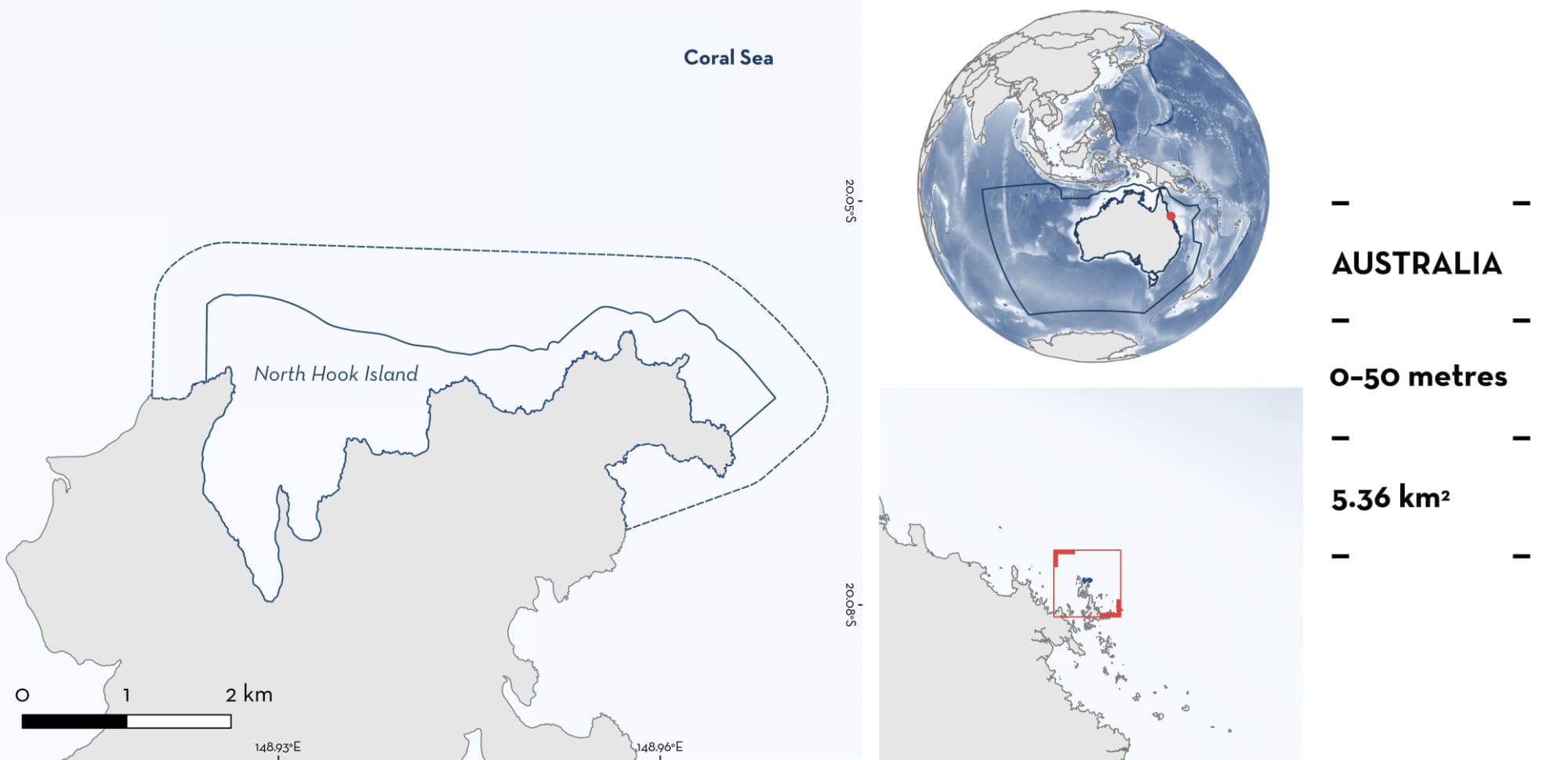
North Hook Island is located in the Whitsunday Islands, Queensland, Australia. The habitat includes steep rocky drop-offs, sheltered shallow bays, sandy substrates, and large fringing coral reefs. The area is influenced by strong tidal currents which support productivity and concentrate plankton. This area overlaps with the Great Barrier Reef Marine Park. Within this area there are: threatened species and feeding areas (Reef Manta Ray Mobula alfredi).
Download factsheet
North Hook Island
DESCRIPTION OF HABITAT
North Hook Island is located in the Whitsunday Islands, Queensland, Australia. The habitat includes steep rocky slopes, sheltered shallow bays, sandy substrates, and large fringing coral reefs. These reefs are made up of both soft and hard coral structures. The reef flats in shallow areas gradually give way to steep drop-offs, where the seabed descends quickly into deeper water.
Strong tidal currents pass through narrow channels in the area, resulting in large volumes of water movement. These currents mix nutrients in the water, supporting productivity. During tidal changes, visible tide lines often form at the surface, concentrating plankton in certain zones within the area. The area is influenced by the East Australian Current, the poleward flowing western boundary current of the South Pacific Gyre (Suthers et al. 2011). The East Australian Current flow is strongest in the austral summer, and the formation of eddies along this coastline also fluctuates seasonally (Ridgway & Hill 2009).
This area overlaps with the Great Barrier Reef Marine Park – Marine National Park Zone (UNEP-WCMC & IUCN 2025).
This Important Shark and Ray Area is benthic and pelagic and is delineated from inshore and surface waters (0 m) to a depth of 50 m based on the bathymetry of the area.
CRITERION A
VULNERABILITY
One Qualifying Species considered threatened with extinction according to the IUCN Red List of Threatened Species regularly occurs in the area. This is the Vulnerable Reef Manta Ray (Marshall et al. 2022).
CRITERION C
SUB-CRITERION C2 – FEEDING AREAS
North Hook Island is an important feeding area for one ray species.
Between 2021–2025, Reef Manta Ray sightings were collected from the broader Whitsundays Islands region via underwater visual census (UVC) surveys, boat-based observations, and aerial reports from wildlife spotter planes (Project Manta Whitsundays unpubl. data 2025). Surveys were opportunistic but year-round. In total, 395 surveys recorded Reef Manta Rays from the broader Whitsundays region, recording 938 individuals from these surveys (average per survey 2.37, range 1–30+ individuals). Of these, over one third of the surveys were from the comparatively small area of North Hook Island (n = 150, 38.0%), with 348 of the individuals recorded in this area (37.1%; Project Manta Whitsundays unpubl. data 2025). Sightings from this area highlight this relatively small area as the key hotspot for Reef Manta Ray habitat use comparative to the broader Whitsundays Islands region. Of the records that included observed behaviour in the area (n = 104), Reef Manta Rays were most commonly observed feeding (63.5%, n = 66), whereby animals swam along the surface with their mouth open and their cephalic lobes forming a funnel-like shape to maximise prey consumption (AO Armstrong pers. obs. 2025). Both boat-based and aerial surveys recorded Reef Manta Rays feeding near the surface, particularly along tide lines where zooplankton is aggregated (J Funnell pers. obs. 2025). There was strong seasonality to the sightings of Reef Manta Rays in this area, with most records occurring between May and September (n = 141, 94.0%).
Between 2018–2024, there have been 34 sightings of 27 individual Reef Manta Rays identified using photo-identification submitted by citizen scientists from the area (Project Manta unpubl. data 2025). This constitutes 69.4% (n = 49) of all sightings from across the broader Whitsundays region. Only three sightings had the associated behaviour of the Reef Manta Rays recorded from the area, with 66.7% of these sightings (n = 2) reporting feeding behaviour and the other reporting cleaning behaviour (Project Manta unpubl. data 2025).
It is assumed that the narrow passages of water in the area concentrate zooplankton, with observations typically involving small groups or solitary individuals feeding at the surface, and somersaulting behaviour documented on numerous occasions (J Funnell pers. obs. 2025). Notably, there have been sightings of up to 50 individual Reef Manta Rays spread out between Manta Ray Bay and Butterfly Bay within the area. Combined, these datasets support the importance of the area as foraging habitat for this species.
Download factsheet
SUBMIT A REQUEST
ISRA SPATIAL LAYER REQUEST
To make a request to download the ISRA Layer in either a GIS compatible Shapefile (.shp) or Google Earth compatible Keyhole Markup Language Zipped file (.kmz) please complete the following form. We will review your request and send the download details to you. We will endeavor to send you the requested files as soon as we can. However, please note that this is not an automated process, and before requests are responded to, they undergo internal review and authorization. As such, requests normally take 5–10 working days to process.
Should you have questions about the data or process, please do not hesitate to contact us.