ISRA FACTSHEETS
ISRA FACTSHEETS
AUSTRALIA AND SOUTHEAST INDIAN OCEAN
Capricorn Cays–Cape Byron Corridor
Summary
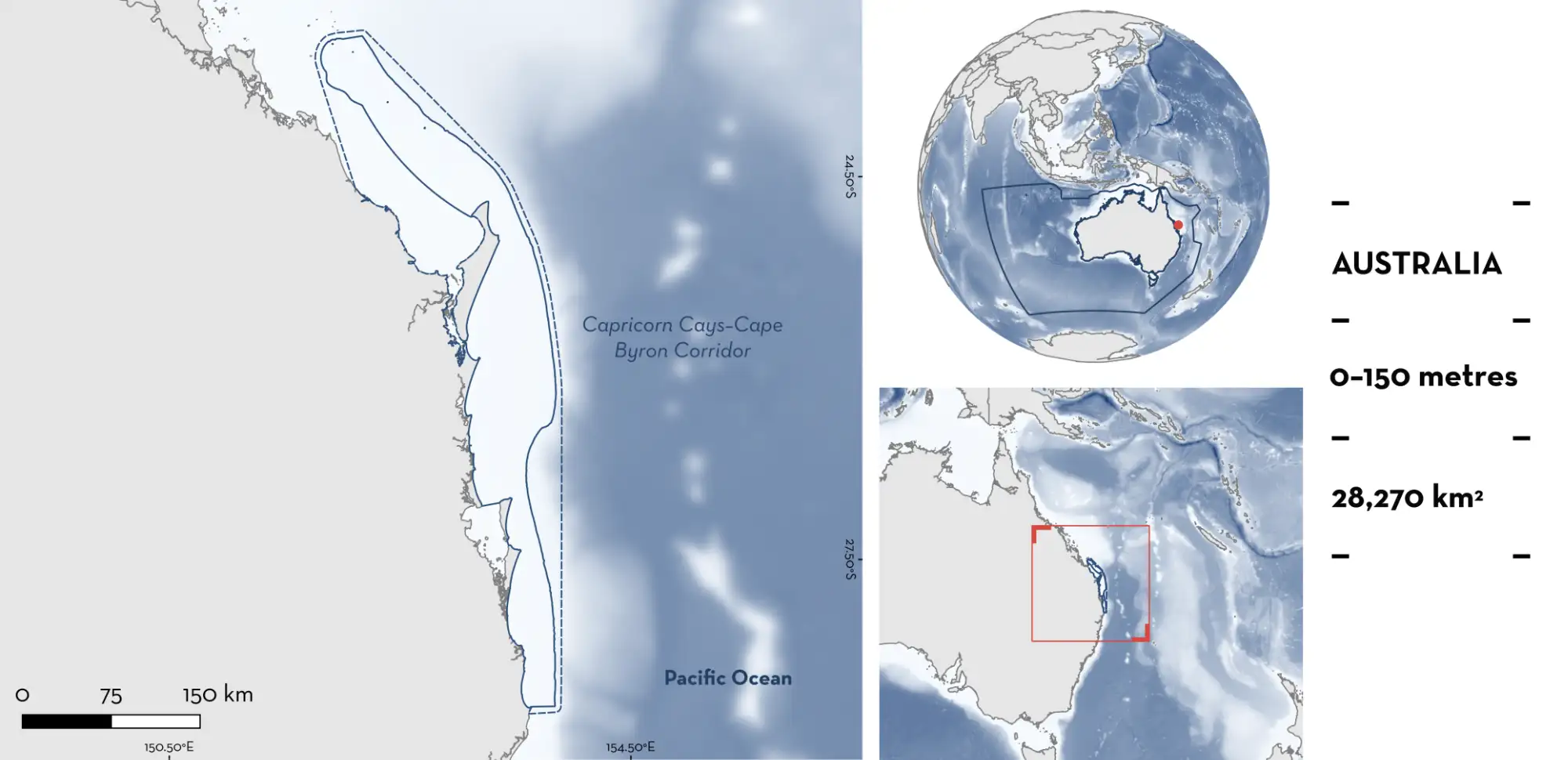
Capricorn Cays–Cape Byron Corridor is located off eastern Australia, spanning the waters from the Capricorn Bunker Group (Queensland) in the north to Byron Bay (New South Wales) in the south. The northern extent of the area is located in the southern Great Barrier Reef, and includes the coral cay islands of Heron, Lady Musgrave, and Lady Elliot. Walgun Cape Byron marks the southern extent of the area and includes the small volcanic islet complex of Nguthungulli Julian Rocks. The habitat is comprised of coral and rocky reefs, sandy and mixed sediments, and submerged pinnacles. The area is influenced by the East Australian Current and seasonal upwellings. Within this area there are: threatened species and areas important for movement (Reef Manta Ray Mobula alfredi).
Download factsheet
Capricorn Cays–Cape Byron Corridor
DESCRIPTION OF HABITAT
Capricorn Cays–Cape Byron Corridor is located off eastern Australia, spanning the waters from the Capricorn Bunker Group (Queensland) in the north to Byron Bay (New South Wales) in the south. The shelf of this coastal area narrows in a southward direction, with the habitat characterised by coral and rocky reefs, and sandy substrates (Harris et al. 2003). The northern extent of the area is located in the southern Great Barrier Reef, and includes the coral cay islands of Heron, Lady Musgrave, and Lady Elliot. These islands form part of the Capricorn Bunker Group, a series of coral cays and patch reefs characterised by extensive coral reefs and connected by sandy substrates (Armstrong et al. 2021). Walgun Cape Byron marks the southern extent of the area and includes the small volcanic islet complex of Nguthungulli Julian Rocks, comprised of diverse habitats including rocky reefs, sandy and mixed sediments, patchy coral communities, and submerged pinnacles (NSW DECC 2007; NSW MPA 2010).
The area is influenced by the East Australian Current, the poleward flowing western boundary current of the South Pacific Gyre (Suthers et al. 2011). The current’s flow is strongest in the austral summer, and the formation of eddies along this coastline also fluctuate seasonally (Ridgway & Hill 2009). The continental shelf is wider at the northern extent of the area and is influenced by the mesoscale oceanographic feature of the Capricorn Eddy (Weeks et al. 2015). The Capricorn Eddy can trigger upwelling of cooler, nutrient-enriched waters onto the shelf and transport these waters to the reef zone. At the southern extent of the area, the shelf constricts and the East Australian Current accelerates, generating an upwelling bottom boundary layer and sustaining a recurrent nearshore thermal front, most pronounced during spring and summer (Oke & Middleton 2001; Roughan & Middleton 2002).
This Important Shark and Ray Area is pelagic and is delineated from inshore and surface waters (0 m) to 150 m based on the depth use of Qualifying Species in the area.
CRITERION A
VULNERABILITY
One Qualifying Species considered threatened with extinction according to the IUCN Red List of Threatened Species regularly occurs in the area. This is the Vulnerable Reef Manta Ray (Marshall et al. 2022).
CRITERION C
SUB-CRITERION C4 – MOVEMENT
Capricorn Cays–Cape Byron Corridor is an important movement area for one ray species.
Reef Manta Rays make regular and predictable seasonal migrations throughout this area. Between 2009–2012, 33 Reef Manta Rays were tagged and tracked with external acoustic transmitters at Lady Elliot Island and North Stradbroke Island within the area (Couturier et al. 2018). Fifteen of the tagged rays (45.5%) were detected at other sites in the area during the deployment period, including Heron Island, North Stradbroke Island, and Noosa (no detections from receivers at Byron Bay were available during the study period). Eight of the tagged rays (24.2%) travelled to Heron Island and seven (21.2%) travelled south to North Stradbroke Island, with at least eight of these 15 rays making return movements to Lady Elliot Island within the tracking period (Couturier et al. 2018), demonstrating their return migrations within the area. In addition, 12 Reef Manta Rays were tagged with acoustic transmitters at Lady Elliot Island and North Stradbroke Island in 2017, with 10 of the rays (83.3%) being detected at other locations during the first few months of tracking, including three (30%) at Heron Island in the north of the area and two (20%) at Byron Bay in the south of the area (Project Manta unpubl. data 2025).
Between 1980–2025, 1,706 Reef Manta Rays were identified on the east coast of Australia using photo-identification from sightings from citizen science and researcher surveys. A total of 1,410 of these individuals (82.6%) were sighted at various locations within this area (Project Manta unpubl. data 2025). This was based on 9,568 encounters (95.3% of the sightings along the whole east coast of Australia; n = 10,037). Almost all sightings have been since 2007 when dedicated research surveys began (99.2%; n = 9,954; Project Manta unpubl. data 2025). Between 2008–2025, a total of 163 sightings were submitted from Heron Island at the northern extent of the area, comprising 148 individuals. Of these, 43.9% (n = 65) were also recorded from other locations within the area (Project Manta unpubl. data 2025). Dive staff at Heron Island regularly observe the species, with 52 observations of 90 Reef Manta Rays recorded in a sighting logbook between July–October 2025 (E Peters pers. comm. 2025). This suggests that photo-identification records underrepresent the sightings at the site and its connectivity with the broader movement corridor of Reef Manta Rays along the east coast of Australia. Due to dedicated research efforts, most Reef Manta Ray sightings from the area come from Lady Elliot Island (~108 km south of Heron Island). There were 7,007 encounters (73.2% of the sightings from the area) of 1,147 individuals sighted at Lady Elliot Island (81.3% of individuals from the area; Project Manta unpubl. data 2025). Off Byron Bay, at the southern extent of the area, there were 346 sightings of 184 individual Reef Manta Rays identified (Project Manta unpubl. data 2025). Of these 184 individuals, 89.1% (n = 164) have been sighted at other sites in the area, demonstrating the connectivity between these sites and extensive movement of Reef Manta Rays throughout this area.
Reef Manta Rays movements in this area are seasonal, with the peak of their aggregation at the northern sites of (e.g., Heron Island and Lady Elliot Island) between May–September (n = 5,900; 61.7% of sightings in the area), whereas sightings at the southern aggregation sites (e.g., North Stradbroke Island and Byron Bay) are more frequent between October–April (n = 2,072; 21.7% of sightings in the area; Project Manta unpubl. data 2025). These findings are in line with earlier studies that used the same photo-identification catalogue to determine the seasonal distribution, site preferences, and regional movements of Reef Manta Rays in eastern Australia prior to 2012 (Couturier et al. 2011, 2014).
In addition to the previous sites mentioned within the area, Reef Manta Rays have also been photo-identified at other coastal locations, providing evidence of connectivity throughout the movement corridor. From north to south these sites include: Heron Island (n = 165), Lady Musgrave Island (n = 88), Lady Elliot Island (n = 7,007), other Capricorn Bunker Group locations (n = 9), Wolf Rock (n = 70), Sunshine Coast (n = 7), Moreton Island (n = 4), North Stradbroke Island (n = 1,816), Gold Coast reefs (n = 8), Cook Island (n = 53), and Byron Bay (n = 346; Project Manta unpubl. data 2025). A total of 31.8% (n = 449) of the Reef Manta Rays identified from these sightings (n = 1,410), were sighted at one of the other locations along this coastal corridor confirming that a high number of individuals in this population have been documented making regional movements within this area. Although satellite tracking has been conducted in the northern part of the area at Lady Elliot Island (n = 8; Jaine et al. 2014), tags were deployed during winter and, with a maximum 120-day deployment, failed to capture the seasonal migrations of Reef Manta Rays in this area. However, the study did report the maximum depth use of the tagged rays (mean = 153.7 m; Jaine et al. 2014), confirming that their movements in this area were concentrated in continental shelf waters as documented in the photo-identification records.
Download factsheet
SUBMIT A REQUEST
ISRA SPATIAL LAYER REQUEST
To make a request to download the ISRA Layer in either a GIS compatible Shapefile (.shp) or Google Earth compatible Keyhole Markup Language Zipped file (.kmz) please complete the following form. We will review your request and send the download details to you. We will endeavor to send you the requested files as soon as we can. However, please note that this is not an automated process, and before requests are responded to, they undergo internal review and authorization. As such, requests normally take 5–10 working days to process.
Should you have questions about the data or process, please do not hesitate to contact us.