ISRA FACTSHEETS
ISRA FACTSHEETS
AUSTRALIA AND SOUTHEAST INDIAN OCEAN
The Group Minjerribah
Summary
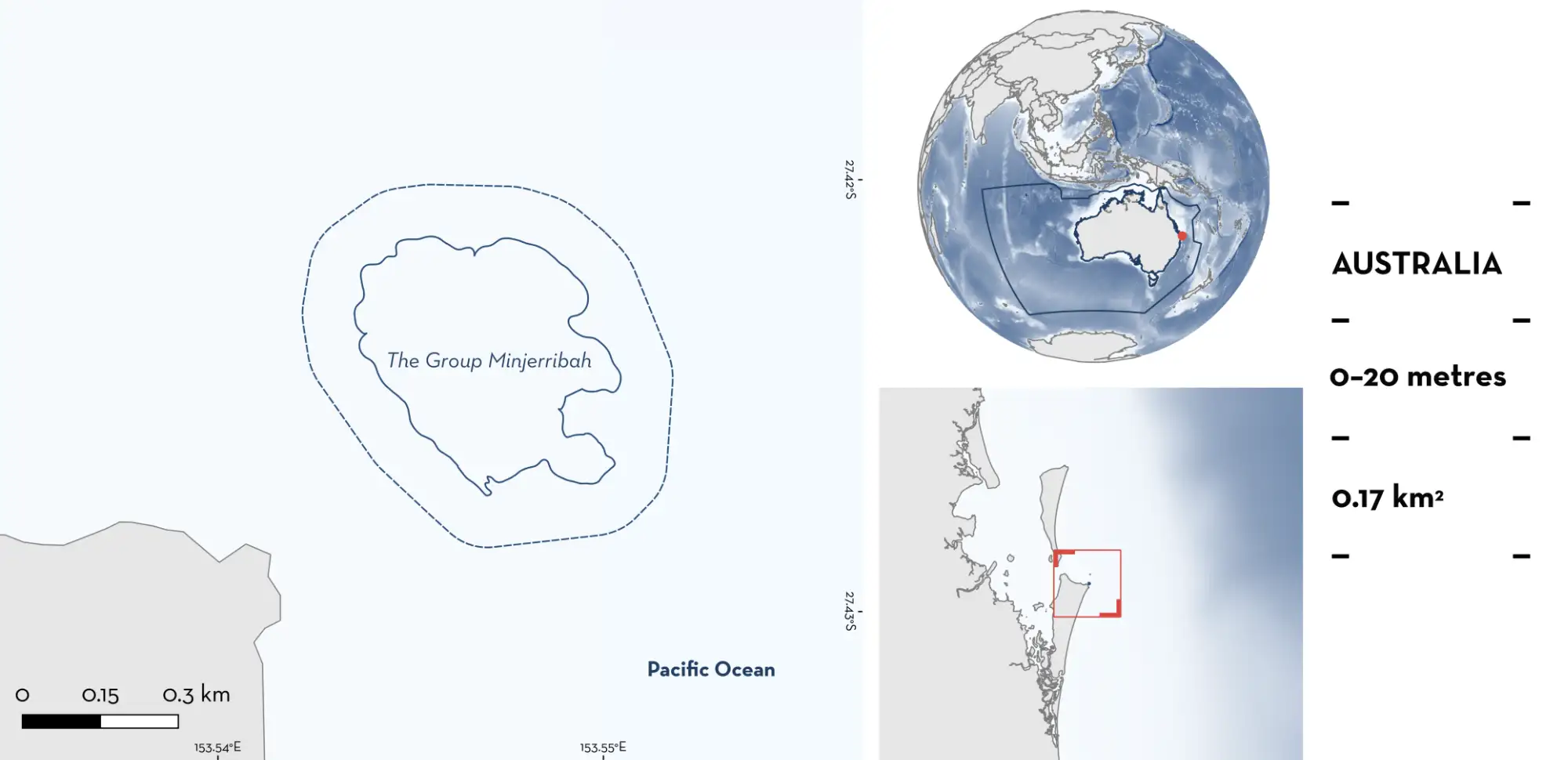
The Group Minjerribah is located in southeast Queensland, Australia. The area is situated ~500 m offshore from North Stradbroke Island and comprises a series of large submerged rocks separated by sand patches and lined by a sand gutter. The area experiences strong tidally driven currents and is influenced by fluctuations in the East Australian Current. The area overlaps with Moreton Bay Marine Park. Within this area there are: threatened species (e.g., Brown Stingray Bathytoshia lata); resting areas (e.g., Indo-Pacific Leopard Shark Stegostoma tigrinum); and undefined aggregations (Reef Manta Ray Mobula alfredi).
Download factsheet
The Group Minjerribah
DESCRIPTION OF HABITAT
The Group Minjerribah is located in southeast Queensland, Australia. The area is situated ~500 m offshore from North Stradbroke Island and comprises a series of large submerged rocks (‘bommies’) separated by sand patches and lined by a sand gutter in water depths of 5–18 m (Dudgeon et al. 2013). The area includes a popular dive site known locally as ‘Manta Bommie’.
The area experiences strong currents driven by tidal and lunar cycles (AO Armstrong pers. obs. 2025). It is influenced by its proximity to the East Australian Current, the poleward flowing western boundary current of the South Pacific Gyre (Suthers et al. 2011). The East Australian Current flow is strongest in the austral summer, and the formation of eddies along this coastline also fluctuate seasonally (Ridgway & Hill 2009).
The area overlaps with Moreton Bay Marine Park (Queensland Government 2019).
This Important Shark and Ray Area is benthic and pelagic and is delineated from surface waters (0 m) to 20 m based on the bathymetry of the area.
CRITERION A
VULNERABILITY
Six Qualifying Species considered threatened with extinction according to the IUCN Red List of Threatened Species regularly occur in the area. Threatened sharks comprise one Endangered species; threatened rays comprise one Critically Endangered species and four Vulnerable species (IUCN 2025).
CRITERION C
SUB-CRITERION C3 – RESTING AREAS
The Group Minjerribah is an important resting area for one shark and one ray species.
Between 2003–2025, dedicated research dives were conducted in the area across multiple, consecutive and non-consecutive field trips (CL Dudgeon & AO Armstrong unpubl. data 2025). Indo-Pacific Leopard Sharks were observed on 100% of dives between November–April, with occasional sharks seen outside this period. The majority of sightings (~90%) were of resting sharks, with occasional sightings of sharks seen swimming through the area. Sightings from recreational divers in the area confirms that on average, 3–4 Indo-Pacific Leopard Sharks are observed per 60-minute dive in the area, with sharks observed resting close together on the sandy benthos (G Willis pers. obs. 2025).
Between 2004–2025, a photo-identification database for Indo-Pacific Leopard Sharks gathered information on sightings from citizen scientists and researchers in the area (Spot the Leopard Shark unpubl. data 2025). A total of 427 individuals were identified during this period. Of these individuals, there has been 783 encounters, with 96.2% of sightings (n = 753) falling between November–February (Spot the Leopard Shark unpubl. data 2025). Sightings per day range from 1–29 individuals (mean ± standard deviation = 7.5 ± 8.8), with photographs and observations confirming resting behaviour in this species.
In 2004, 10 Indo-Pacific Leopard Sharks were tagged with acoustic transmitters in the area and tracked for a 21-month period (Dudgeon et al. 2013). The sharks were detected for a median 18 days in the area (range, 5–116 days), demonstrating their residency and site fidelity to this area for resting aggregations. Seasonality in the presence of tagged Indo-Pacific Leopard Sharks at The Group Minjerribah also supported the photo-identification records, with the greatest presence of sharks occurring in the months of November–February. For additional analyses, data were sourced from Australia’s Integrated Marine Observing System (IMOS) – IMOS is enabled by the National Collaborative Research Infrastructure Strategy (NCRIS). Between 2014–2024, 31 Indo-Pacific Leopard Sharks were tracked using acoustic transmitters, with 88,033 detections from the area, supporting the ongoing and contemporary importance of the habitat in this area to this species (IMOS unpubl. data 2025).
Between 2003–2025, dedicated research dives were conducted in the area across multiple, consecutive and non-consecutive field seasons (CL Dudgeon & AO Armstrong unpubl. data 2025). Dives are mostly conducted between November–April, and Bottlenose Wedgefish were observed on almost every dive. On an average 60-minute dive, three rays are observed (range 1–10 rays, depending on weather conditions and visibility). The majority of sightings (~90%) are of Bottlenose Wedgefish resting in the sandy drop-off part of the area, with rare sightings of rays seen swimming through the area (CL Dudgeon & AO Armstrong pers. obs. 2025). Sightings from recreational divers in the area confirm that on average, 5–10 resting Bottlenose Wedgefish are observed per 60-minute dive (G Willis pers. obs. 2025). From sightings submitted from the broader Moreton Bay region to the citizen science online database iNaturalist, there were 37 records of Bottlenose Wedgefish, with 63% (n = 17) of these records from within the area (iNaturalist 2025), highlighting its relative importance for this species.
CRITERION C
SUB-CRITERION C5 – UNDEFINED AGGREGATIONS
The Group Minjerribah is an important area for undefined aggregations of five ray species.
Between 2003–2025, dedicated research dives were conducted in the area across multiple, consecutive and non-consecutive field seasons (CL Dudgeon & AO Armstrong unpubl. data 2025). Dives are mostly conducted between November–April, and assemblages of rays were observed on almost every dive. Assemblages consist of Brown Stingrays, Australian Whiprays, Broad Cowtail Rays, and Blotched Fantail Rays. On an average 60-minute dive, five rays are observed, with Broad Cowtail Rays dominating the assemblage (range 3–12 rays, depending on weather conditions and visibility). The majority of sightings (~90%) were of resting rays, with occasional sightings of rays seen swimming through the area (CL Dudgeon & AO Armstrong pers. obs. 2025). Observations usually comprised the rays piled on top of one another on the sandy substrates, forming assemblages likely for resting not observed outside of the area. Sightings from recreational divers in the area confirms that on average, 5–10 resting stingrays were observed per 60-minute dive (G Willis pers. obs. 2025). From sightings submitted from the broader Moreton Bay region to the citizen science online database iNaturalist, there were: two sightings of Brown Stingrays (100% from within this area); five sightings of Australian Whiprays (n = 3; 60% from within this area); 20 sightings of Broad Cowtail Rays (n = 13; 65% from within this area); and 21 sightings of Blotched Fantail Rays (n = 19; 90.5% from within the area; iNaturalist 2025), highlighting its relative importance for these species.
Between 1991–2025, 1,815 sightings of Reef Manta Rays were collated in a photo-identification database from underwater visual census (UVC) surveys and citizen science contributions in the area (Project Manta unpubl. data 2025). Most of the sighting records were since 2010 (96.6%, n = 1,753). Of the 558 survey dates, 220 (39.4%) recorded aggregations of >3 Reef Manta Rays, with an average of 6.2 individuals recorded per survey (range 3–30; Project Manta unpubl. data 2025). Observed behaviour was recorded for 336 of the sightings (18.5% of the total), with almost all observations recording Reef Manta Rays engaged in cleaning behaviour (n = 328, 97.6% of recorded behaviours; Project Manta unpubl. data 2025). Photo-identification has identified 399 individuals, with >50 individuals returning to the area >10 times. Reef Manta Rays are known to show site fidelity and return to preferred cleaning stations (Armstrong et al. 2021). Aggregations in this area are seasonal in nature, with the majority of sightings occurring between October–April (97.1% of sightings; Project Manta unpubl. data 2025), linked to the species’ seasonal movements on the east coast of Australia. Sightings from recreational divers in the area confirm that at least 2–3 Reef Manta Rays are observed at the cleaning stations in the area per 60-minute dive (G Willis pers. obs. 2025), supporting the importance of this area for this species.
Further information is required to understand the nature and function of these aggregations.
Download factsheet
SUBMIT A REQUEST
ISRA SPATIAL LAYER REQUEST
To make a request to download the ISRA Layer in either a GIS compatible Shapefile (.shp) or Google Earth compatible Keyhole Markup Language Zipped file (.kmz) please complete the following form. We will review your request and send the download details to you. We will endeavor to send you the requested files as soon as we can. However, please note that this is not an automated process, and before requests are responded to, they undergo internal review and authorization. As such, requests normally take 5–10 working days to process.
Should you have questions about the data or process, please do not hesitate to contact us.