ISRA FACTSHEETS
ISRA FACTSHEETS
AUSTRALIA AND SOUTHEAST INDIAN OCEAN
Corbett and 13-124 Reefs
Summary
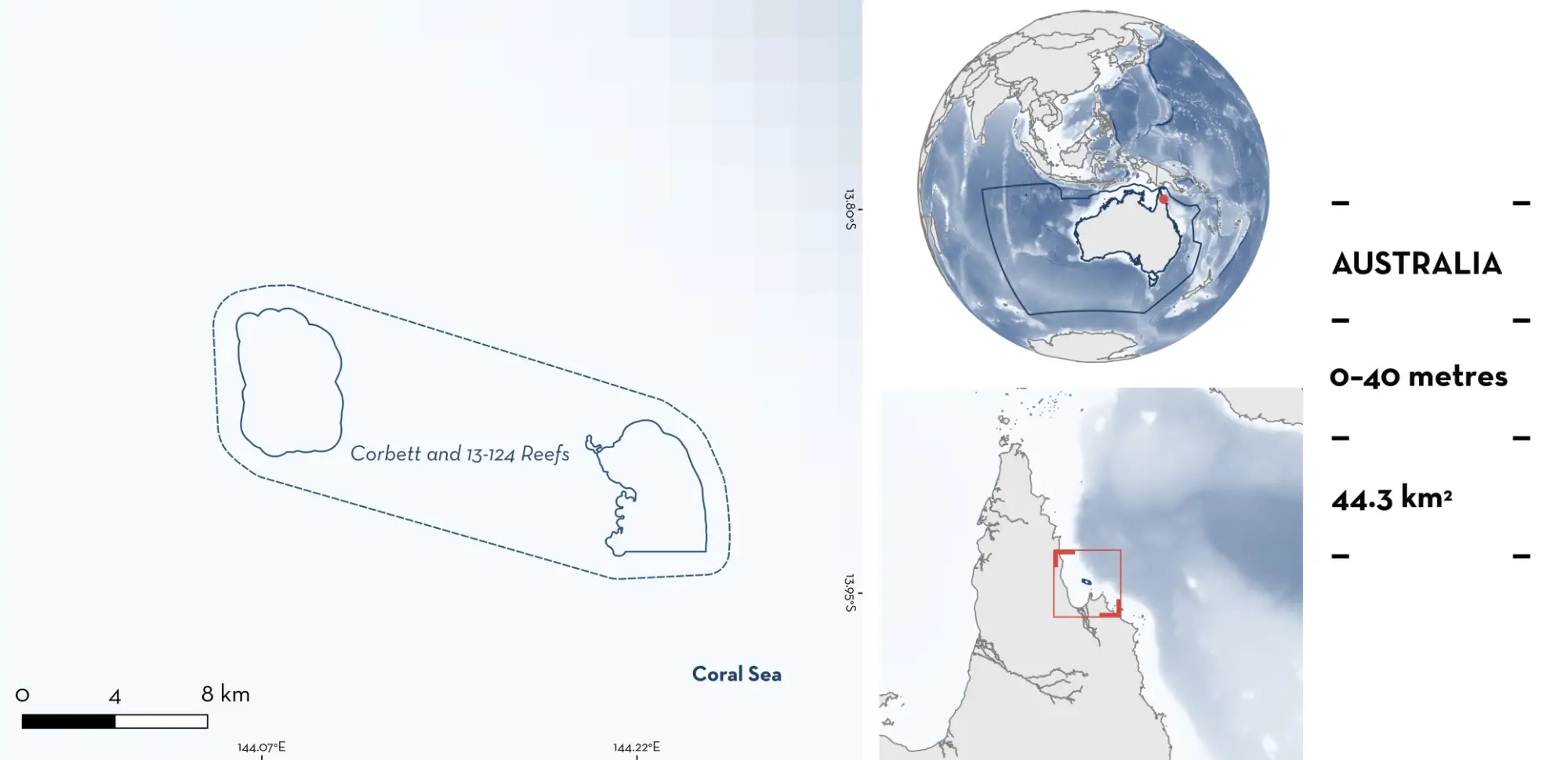
Corbett and 13-124 Reefs is located within the northern Great Barrier Reef, Queensland, Australia. This split area includes two mid-shelf reefs, adjacent to Princess Charlotte Bay. The area is characterised by shallow coral reefs dominated by stony corals, extensive seagrass beds on top of the reef flat, and a mix of sand, mud, and coral rubble substrates. It is influenced by strong tidal and wind-driven currents, seasonal wind regimes, and restricted water circulation. The area overlaps with the Great Barrier Reef Marine Park. Within this area there are: threatened species and undefined aggregations (Grey Reef Shark Carcharhinus amblyrhynchos).
Download factsheet
Corbett and 13-124 Reefs
DESCRIPTION OF HABITAT
Corbett and 13–124 Reefs is located within the northern Great Barrier Reef, Queensland, Australia. This split area includes two mid-shelf reefs, adjacent to Princess Charlotte Bay, the 13–124 Reef and the northern part of Corbett Reef. Corbett Reef is a large (207.5 km2) planar sand-reef formation which do not occur elsewhere on the Great Barrier Reef (Dobbs 2011). The area is characterised by shallow coral reefs dominated by stony coral (Scleractinia), extensive seagrass beds on top of the reef flat, and a mix of terrigenous sand, mud, and coral rubble substrates.
The area is influenced by strong tidal and wind-driven currents, seasonal wind regimes, and restricted water circulation with the Coral Sea due to the presence of a barrier reef, functioning as a semi-enclosed shelf (Wolanski & Lambrechts 2020). During the trade winds season (austral winter), consistent southeasterly winds intensify northward-flowing currents and slow southward-flowing currents. In the monsoon season (summer), there is little effect on currents from surface winds (Steinberg 2023).
The area overlaps with the Great Barrier Reef Marine Park – Marine National Park Zone (UNEP-WCMC & IUCN 2025).
This Important Shark and Ray Area is benthic and pelagic and is delineated from surface waters (0 m) to 40 m based on the bathymetry of the area.
CRITERION A
VULNERABILITY
One Qualifying Species considered threatened with extinction according to the IUCN Red List of Threatened Species regularly occurs in the area. This is the Endangered Grey Reef Shark (Simpfendorfer et al. 2020).
CRITERION C
SUB-CRITERION C5 – UNDEFINED AGGREGATIONS
Corbett and 13-124 Reefs is important for undefined aggregations of one shark species.
Baited Remote Underwater Video Station (BRUVS surveys were conducted between December–January in 2015 (n = 91 deployments), 2016 (n = 101), 2019 (n = 42), and 2024 (n = 84) in the area at depths between 2–40 m (Global FinPrint 2016; Simpfendorfer et al. 2023; AIMS 2025). The maximum number of individuals observed in a single frame (MaxN) were recorded (Global FinPrint 2016; Simpfendorfer et al. 2023; AIMS 2025). Aggregations were defined as instances where the total number of individuals captured in one frame (MaxN) was =>3 animals of the same species.
Grey Reef Sharks were recorded in 87 deployments (27.4%) in the area. Aggregations ranged between 3 and 8 (mean ± standard deviation = 4 ± 1.59) individuals across 11 deployments (AIMS 2025). These were recorded in 2015 (n = 4), 2016 (n = 3), 2019 (n = 2), and 2024 (n = 2) (AIMS 2025). To demonstrate the occurrence of Grey Reef Shark aggregations independent of bait in this area, the time to cumulative MaxN was calculated for the 2015 deployments. Aggregations appeared on the BRUVS surveys within the first 0–12.5 minutes of deployment; faster than the other locations across the Great Barrier Reef (AIMS 2025). Along the Far Northern Great Barrier Reef, this area had the highest number of deployments in which Grey Reef Shark aggregations were observed (AIMS 2025). Additionally, synthesised data from the Global Archive and The Fish Collective for BRUVS surveys were extracted after quality control was undertaken using CheckEM (GlobalArchive 2025; The Fish Collective 2025; Gibbons et al. in press). Based on this dataset, the area is the only location on the east coast of Australia where aggregations of more than three individuals (as indicated by MaxN) were repeatedly recorded across multiple years of the FinPrint project between 2010–2018 (AIMS 2025; GlobalArchive 2025; The Fish Collective 2025). Further information is required to understand the nature and function of these aggregations.
Download factsheet
SUBMIT A REQUEST
ISRA SPATIAL LAYER REQUEST
To make a request to download the ISRA Layer in either a GIS compatible Shapefile (.shp) or Google Earth compatible Keyhole Markup Language Zipped file (.kmz) please complete the following form. We will review your request and send the download details to you. We will endeavor to send you the requested files as soon as we can. However, please note that this is not an automated process, and before requests are responded to, they undergo internal review and authorization. As such, requests normally take 5–10 working days to process.
Should you have questions about the data or process, please do not hesitate to contact us.